
We read your photo as:
Explain diffusion and osmosis and describe an experiment to demonstrate osmosis.
ScanSolve AI Answer
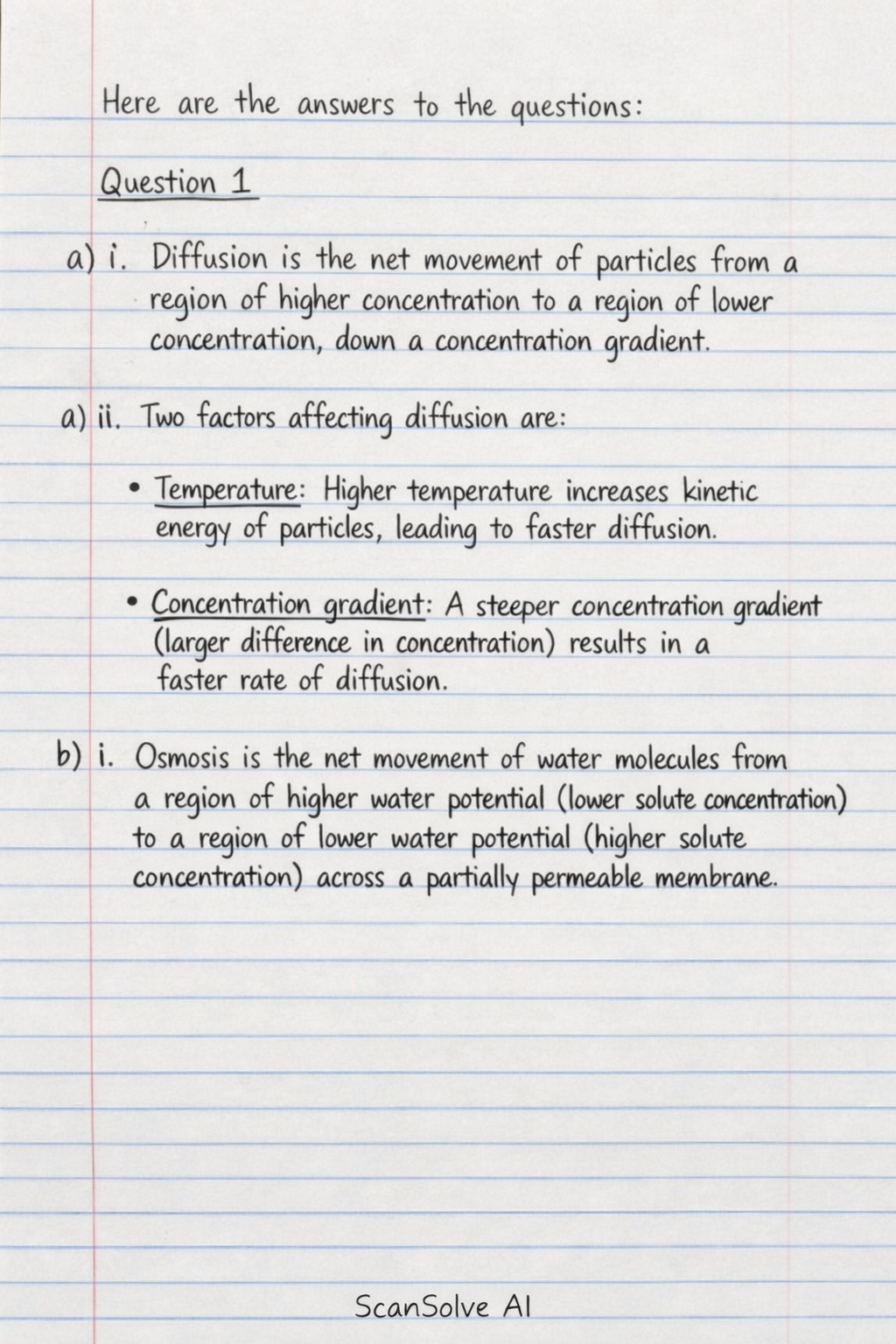
Here are the answers to the questions:
Question 1
a) i. Diffusion is the net movement of particles from a region of higher concentration to a region of lower concentration, down a concentration gradient.
a) ii. Two factors affecting diffusion are:
- Temperature: Higher temperature increases kinetic energy of particles, leading to faster diffusion.
- Concentration gradient: A steeper concentration gradient (larger difference in concentration) results in a faster rate of diffusion.
b) i. Osmosis is the net movement of water molecules from a region of higher water potential (lower solute concentration) to a region of lower water potential (higher solute concentration) across a partially permeable membrane.
b) ii. An experiment to demonstrate osmosis using a potato osmometer:
- Peel a large potato and cut a cavity in its center, leaving a thin base.
- Fill the cavity with a concentrated sugar solution and mark the initial level of the solution.
- Place the potato in a beaker containing pure water, ensuring the water level in the beaker is below the level of the sugar solution in the potato cavity.
- Leave the setup for a few hours.
- Observation: The level of the sugar solution in the potato cavity will rise.
- Explanation: Water molecules from the beaker (higher water potential) move through the partially permeable potato cells into the sugar solution (lower water potential) in the cavity, causing the volume to increase.
c) Four differences between plant and animal cells:
- Plant cells have a cell wall, while animal cells do not.
- Plant cells typically have a large, central vacuole, whereas animal cells have small, temporary vacuoles or none.
- Plant cells contain chloroplasts for photosynthesis, while animal cells do not.
- Plant cells are generally fixed and rectangular in shape, while animal cells are often irregular and more flexible.
d) Two importance of diffusion in living organisms:
- Gas exchange: Diffusion is crucial for the exchange of oxygen and carbon dioxide in the lungs (alveoli) and tissues of animals, and in leaves (stomata) of plants during photosynthesis and respiration.
- Absorption of nutrients: Digested food molecules (e.g., glucose, amino acids) are absorbed from the small intestine into the bloodstream by diffusion.
Question 2
a) i. An acid is a substance that produces hydrogen ions () when dissolved in water.
a) ii. An alkali is a soluble base that produces hydroxide ions () when dissolved in water.
b) i. Three properties of acids:
- They have a sour taste.
- They turn blue litmus paper red.
- They react with metals above hydrogen in the reactivity series to produce hydrogen gas.
b) ii. Two uses of bases:
- Antacids (e.g., magnesium hydroxide) are used to neutralize excess stomach acid.
- Sodium hydroxide is used in the manufacture of soap and paper.
c) i. A neutralization reaction is a chemical reaction between an acid and a base (or alkali) that produces a salt and water. The ions from the acid combine with the ions from the base to form water, effectively neutralizing each other.
Still stuck on this one?
Ask a follow-up, and the answer starts from this question.
More Biology Questions
Handwritten Step-by-Step Solution
Get this as a handwritten image on WhatsApp — like a tutor wrote it for you.
Try on WhatsApp