
We read your photo as:
Directions: Each question consists of four lettered headings A, B, C, D. Select the heading which is closely related to the description which follows.
ScanSolve AI Answer
Answer
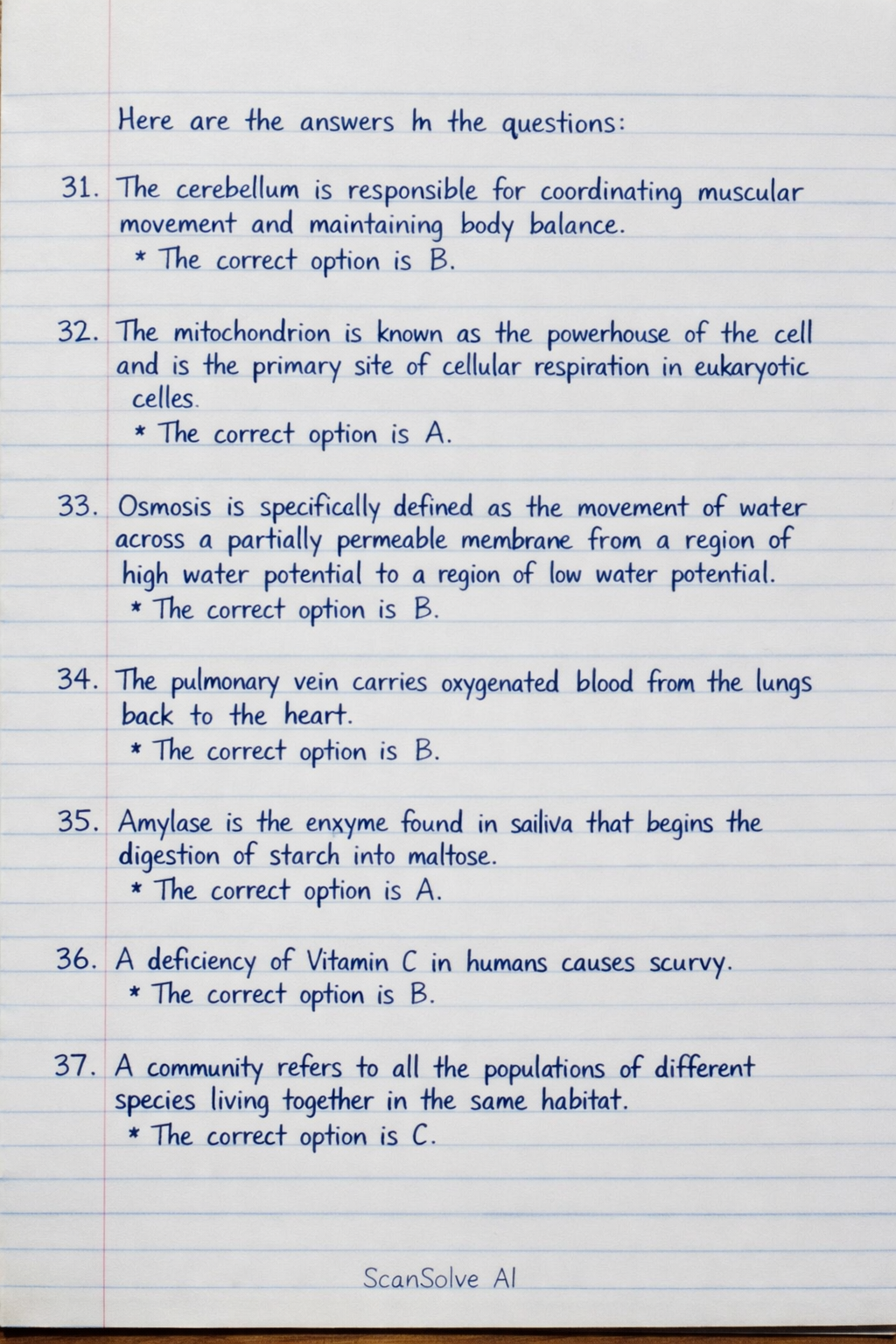
Here are the answers to the questions:
31. The cerebellum is responsible for coordinating muscular movement and maintaining body balance.
- The correct option is B.
32. The mitochondrion is known as the powerhouse of the cell and is the primary site of cellular respiration in eukaryotic cells.
- The correct option is A.
33. Osmosis is specifically defined as the movement of water across a partially permeable membrane from a region of high water potential to a region of low water potential.
- The correct option is B.
34. The pulmonary vein carries oxygenated blood from the lungs back to the heart.
- The correct option is B.
35. Amylase is the enzyme found in saliva that begins the digestion of starch into maltose.
- The correct option is A.
36. A deficiency of Vitamin C in humans causes scurvy.
- The correct option is B.
37. A community refers to all the populations of different species living together in the same habitat.
- The correct option is C.
38. Eutrophication is the process where excessive nutrient enrichment of a water body leads to algal blooms and subsequent oxygen depletion.
- The correct option is C.
39. A plant cell that has lost so much water that its cell membrane pulls away from the cell wall is described as plasmolysed.
- The correct option is C.
40. The pancreas is a gland that produces both digestive enzymes (like amylase, lipase, and trypsin) and hormones such as insulin and glucagon.
- The correct option is B.
Try one yourself
A new problem that tests the same skill.
Still stuck on this one?
Ask a follow-up, and the answer starts from this question.
More Biology Questions
Handwritten Step-by-Step Solution
Get this as a handwritten image on WhatsApp — like a tutor wrote it for you.
Try on WhatsApp