
We read your photo as:
PART A: MULTIPLE CHOICE QUESTIONS Circle the correct answer for each question from the given alternatives A, B, C or D.
ScanSolve AI Answer
Answers
5 partsHere are the answers to the multiple-choice questions:
QUESTION 1
Wage is defined as the price of labor. It represents the cost paid by employers for the use of an employee's time and skills.
The final answer is
QUESTION 2
Minimum wage is the lowest amount of money an employer can legally pay an employee. It is a price floor set by the government, typically above the equilibrium wage.
The final answer is
QUESTION 3
Wage indexation is the practice of adjusting wages to maintain real income during inflation. This means that as prices rise, wages are increased to ensure that workers' purchasing power remains the same.
The final answer is
QUESTION 4
Full wage indexation occurs when wages are adjusted by the exact same percentage as the inflation rate.
- In option A, the wage adjustment (5%) is less than the inflation rate (7%).
- In option B, the adjustment is in absolute amounts, not a percentage matching inflation.
- In option C, the minimum wage is adjusted by 20% when the inflation level is 20%, which is a perfect match.
- In option D, the adjustment is in absolute amounts and only for one specific good, not general inflation.
The final answer is
QUESTION 5
One of the primary reasons for government intervention in the incomes of employees is to redistribute income. Progressive taxation, where higher earners pay a larger percentage of their income in taxes, is a common tool used to achieve this redistribution and reduce income inequality.
The final answer is
Try one yourself
A new problem that tests the same skill.
Still stuck on this one?
Ask a follow-up, and the answer starts from this question.
More Economics Questions
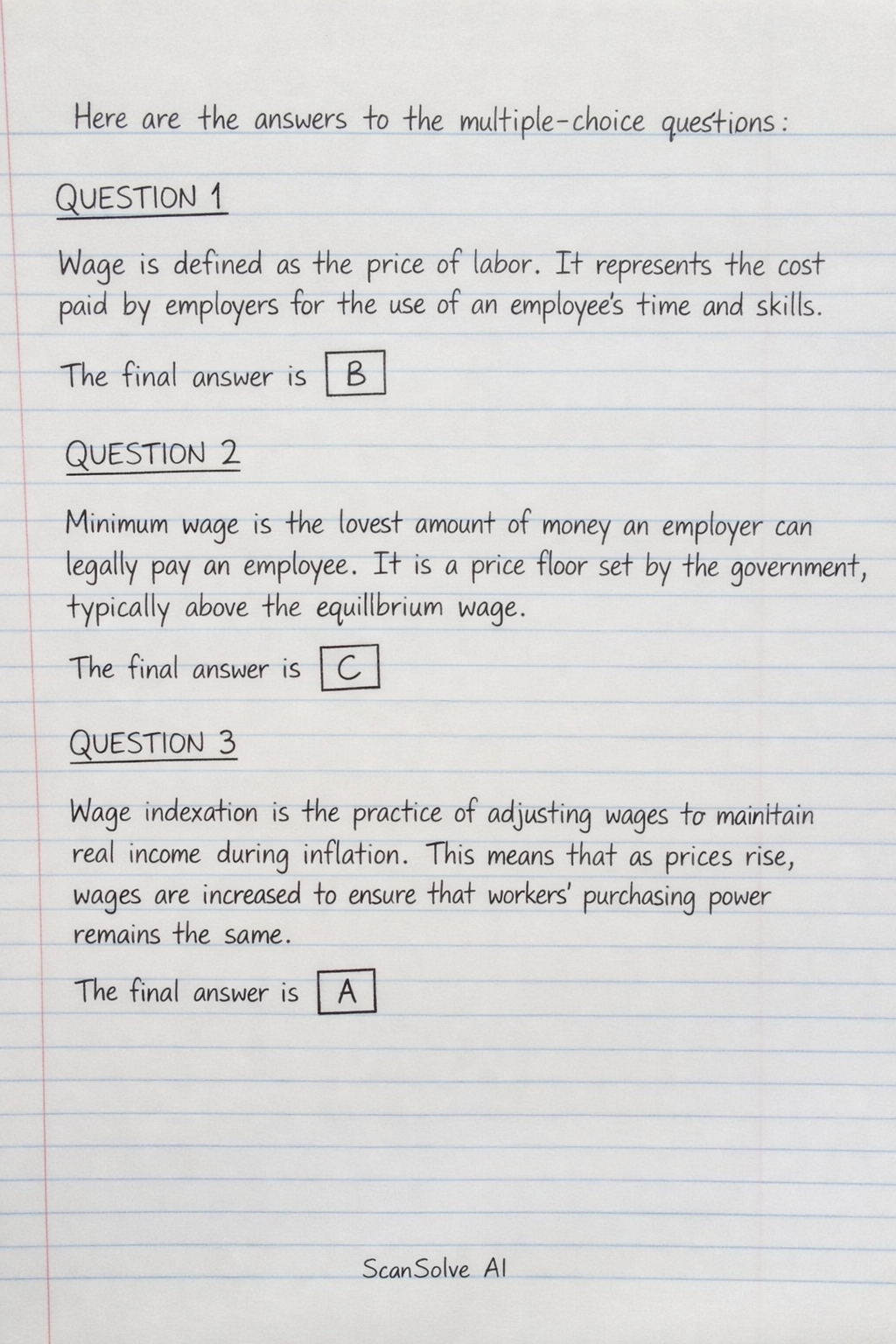
Handwritten Step-by-Step Solution
Get this as a handwritten image on WhatsApp — like a tutor wrote it for you.
Try on WhatsApp