
We read your photo as:
Discuss any four of the following quantitative parameters: stomatal number, stomatal index, palisade ratio, epidermal cell number, and vein-islet number.
Biology
ScanSolve AI Answer
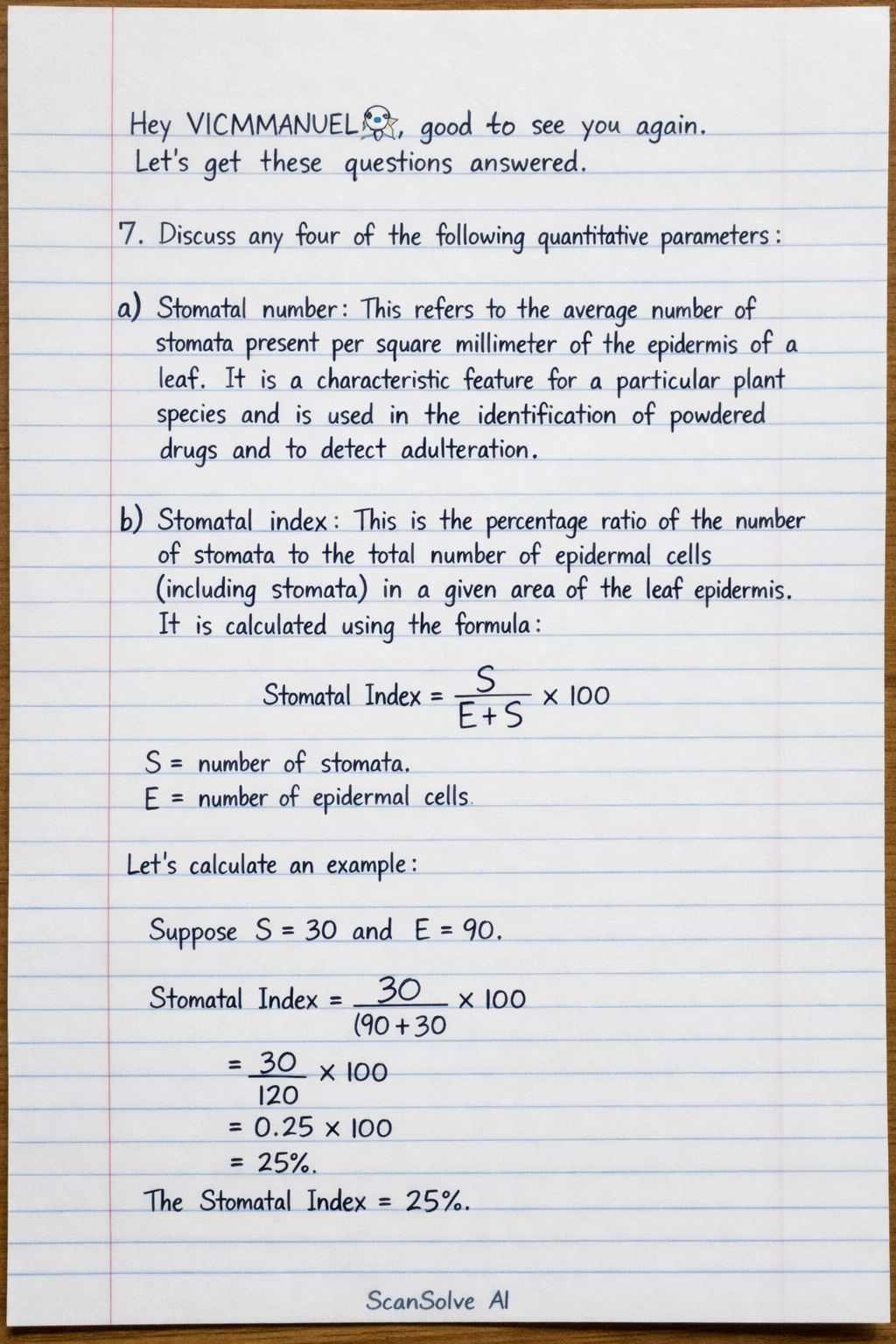
Let's get these questions answered.
7. Discuss any four of the following quantitative parameters:
- a. Stomatal number: This refers to the average number of stomata present per square millimeter of the epidermis of a leaf. It is a characteristic feature for a particular plant species and is used in the identification of powdered drugs and to detect adulteration.
- b. Stomatal index: This is the percentage ratio of the number of stomata to the total number of epidermal cells (including stomata) in a given area of the leaf epidermis. It is calculated using the formula: where is the number of stomata and is the number of epidermal cells in the same area. The stomatal index is considered more constant than the stomatal number as it is less affected by changes in cell size due to environmental factors.
- c. Palisade ratio: This is the average number of palisade cells beneath one epidermal cell, as observed in a surface view of the leaf. It is a relatively constant value for a given species and is particularly useful in the identification and authentication of powdered leaf drugs.
- e. Vein-islet number: This is the number of vein-islets (small areas of photosynthetic tissue enclosed by the ultimate veinlets) per square millimeter of leaf surface. Like other quantitative parameters, it is a fairly constant characteristic for a particular plant species and is used for identification and to detect adulteration in crude drugs.
8. Define the following:
- a. Pharmacognosy: This is the scientific study of medicinal drugs derived from natural sources, primarily plants, but also animals and microorganisms. It encompasses the history, distribution, cultivation, collection, preparation, identification, evaluation, and uses of these natural products.
- b. Crude drugs: These are natural products that have undergone only collection and drying, with minimal or no processing. They are unrefined natural substances used as medicines or as raw materials for the preparation of medicines. Examples include whole leaves, barks, roots, or seeds.
- c. Monograph: In the context of pharmacopoeias, a monograph is a detailed written account or description of a single drug or substance. It typically includes information such as its source, description, identification tests, purity standards, assay methods, storage conditions, and therapeutic uses.
9. Outline the morphological classification of crude drugs with three examples.
Crude drugs can be classified based on the morphological part of the plant or animal from which they are derived.
- Leaves: Senna, Digitalis, Peppermint
- Flowers: Clove, Saffron, Chamomile
- Fruits: Fennel, Coriander, Anise
- Seeds: Nux Vomica, Castor, Isabgol
- Barks: Cinchona, Cinnamon, Cascara
- Roots: Rauwolfia, Ipecac, Liquorice
- Rhizomes: Ginger, Turmeric, Podophyllum
- Woods: Quassia, Sandalwood, Red Saunders
- Hairs/Fibers: Cotton, Silk, Hemp
- Glands/Secretions: Gums (Acacia), Resins (Asafoetida), Balsams (Tolu Balsam)
- Whole Organisms: Ergot, Yeast, Cantharides
10. Describe organized and unorganized crude drugs? Provide three examples for each.
- Organized Crude Drugs: These are crude drugs that are direct parts of plants or animals and retain their original cellular structure. They can be identified by their morphological features and histological examination.
- Examples: Senna leaves, Cinchona bark, Ginger rhizome.
- Unorganized Crude Drugs: These are crude drugs that are products of plants or animals, such as extracts, exudates, gums, resins, or oils. They do not possess a definite cellular structure and are usually prepared by processes like incision, extraction, or evaporation.
- Examples: Acacia gum, Opium latex, Castor oil.
Was this helpful?
Still stuck on this one?
Ask a follow-up, and the answer starts from this question.
Got a different question?Ask your own question
More Biology Questions
Q1.Write short notes on Chemomicroscopy Micrometry 2.Using physical and chemical means, differentiate…QDescribe the various types of stomataQWhat are the differences between Ranunculaceous, Cruciferous, Rubiaceous, and Caryophyllaceous…QHere are the solutions to the questions: 1. Stomata are usually present on/at the: (i) lower layer…QState three environmental factors that affect the rate of stomatal transpiration
Browse by topic:Anatomy
Handwritten Step-by-Step Solution
Get this as a handwritten image on WhatsApp — like a tutor wrote it for you.
Try on WhatsApp