
We read your photo as:
Distinguish between conservation and preservation. State three reasons why biodiversity should be conserved and give two examples of in-situ conservation measures.
Biology
ScanSolve AI Answer
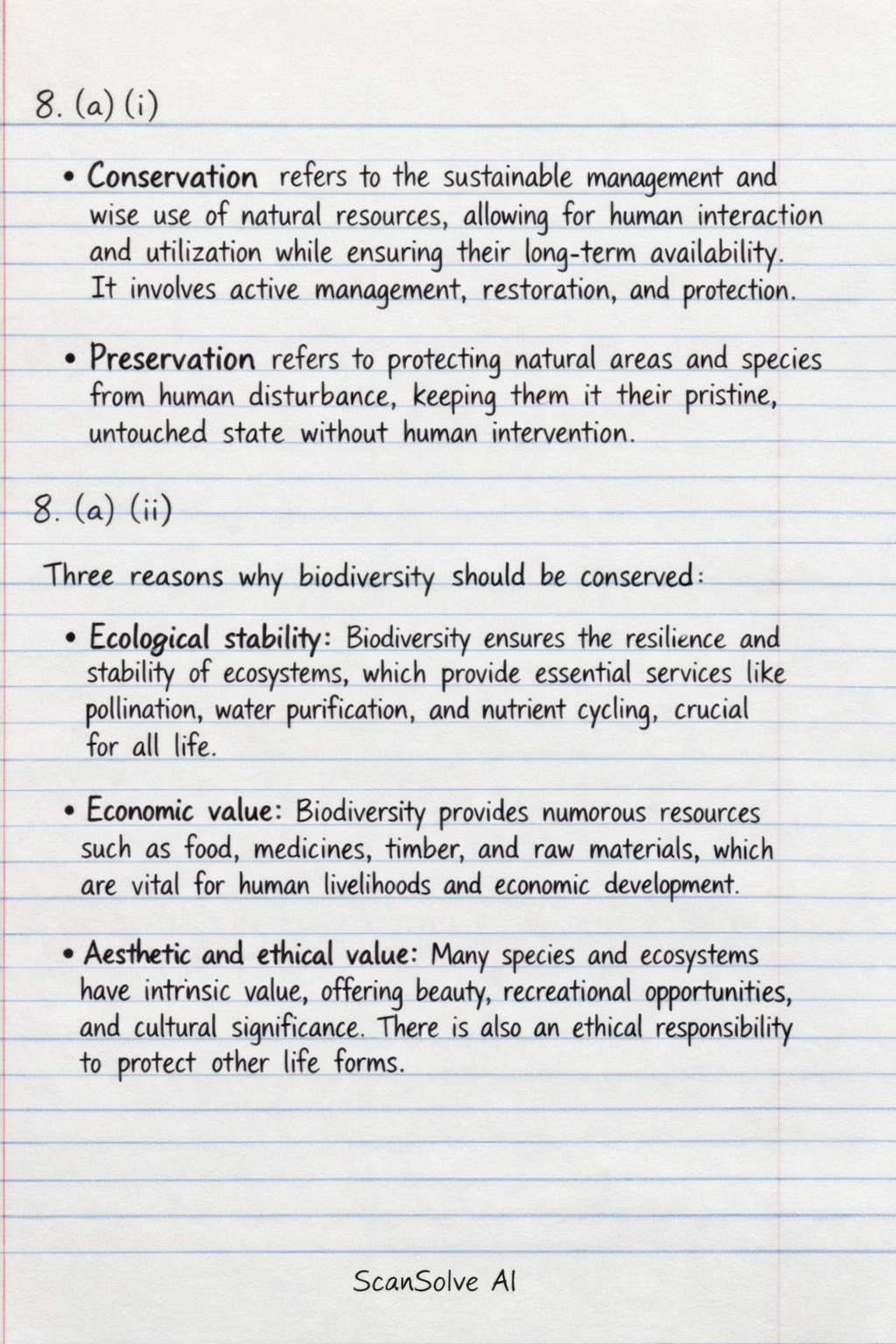
8. (a) (i)
- Conservation refers to the sustainable management and wise use of natural resources, allowing for human interaction and utilization while ensuring their long-term availability. It involves active management, restoration, and protection.
- Preservation refers to protecting natural areas and species from human disturbance, keeping them in their pristine, untouched state without human intervention.
8. (a) (ii)
Three reasons why biodiversity should be conserved:
- Ecological stability: Biodiversity ensures the resilience and stability of ecosystems, which provide essential services like pollination, water purification, and nutrient cycling, crucial for all life.
- Economic value: Biodiversity provides numerous resources such as food, medicines, timber, and raw materials, which are vital for human livelihoods and economic development.
- Aesthetic and ethical value: Many species and ecosystems have intrinsic value, offering beauty, recreational opportunities, and cultural significance. There is also an ethical responsibility to protect other life forms.
8. (b) (i)
Two in-situ conservation measures used in areas like Limbe Botanic Garden and Korup National Park:
- Establishment and management of protected areas: Designating and actively managing national parks (like Korup National Park) and reserves to protect entire ecosystems and the species within them in their natural habitats. This includes setting boundaries, regulating access, and implementing management plans.
- Anti-poaching and law enforcement: Implementing patrols and enforcing strict laws against illegal hunting, logging, and other destructive activities within the protected areas to safeguard wildlife populations and natural resources.
8. (b) (ii)
Ex-situ conservation is sometimes necessary as a complementary strategy because:
- It provides a safety net for critically endangered species whose natural habitats are severely threatened or destroyed, preventing their total extinction.
- It allows for controlled breeding programs to increase population numbers of rare species, especially those with specific reproductive needs or low success rates in the wild.
- It facilitates scientific research and public education about endangered species, raising awareness and understanding that can support in-situ efforts.
8. (c)
Likely ecological consequences of converting a mangrove forest to an oil palm plantation:
- Loss of biodiversity: Mangrove forests are highly biodiverse ecosystems, serving as critical habitats and nurseries for numerous fish, crustaceans, birds, and other wildlife. Conversion would lead to widespread habitat destruction and significant loss of species.
- Coastal erosion and increased vulnerability to natural disasters: Mangrove root systems stabilize coastlines, protecting against erosion, storm surges, and tsunamis. Their removal would leave coastal areas exposed and highly vulnerable.
- Disruption of ecosystem services: Mangroves filter pollutants, sequester large amounts of carbon, and support local fisheries. Their destruction would impair water quality, release stored carbon, and devastate fish stocks, impacting local livelihoods.
- Soil degradation: Mangrove soils are often anoxic and rich in organic matter. Clearing them can lead to soil acidification, release of greenhouse gases, and loss of soil fertility, making the land less productive in the long term.
Two realistic measures the government could take to balance economic development with conservation:
- Mandatory Environmental Impact Assessments (EIAs): Implement and strictly enforce comprehensive EIAs for all proposed large-scale development projects, especially those impacting sensitive ecosystems like mangroves. This ensures that potential ecological consequences are thoroughly evaluated, mitigation measures are planned, and alternative, less damaging sites are considered before project approval.
- Sustainable land-use planning and zoning: Develop and enforce robust land-use plans that clearly designate and protect critical ecological areas, such as mangrove forests, as conservation zones. This would direct agricultural expansion, like oil palm plantations, to already degraded lands or areas with lower ecological value, rather than allowing the destruction of pristine natural habitats.
Was this helpful?
Still stuck on this one?
Ask a follow-up, and the answer starts from this question.
Got a different question?Ask your own question
More Biology Questions
QDefine conservation and preservation. Explain three reasons why biodiversity should be conserved.Q1a) Conservation is the protection, preservation, management, or restoration of natural environments…QDefine the term conservation.QHabitat preservation and restoration are crucial to protect the natural environments where species…QDefine conservation, biodiversity, and endangered species. List the main biomes and four physical…
Browse by topic:Ecology
Handwritten Step-by-Step Solution
Get this as a handwritten image on WhatsApp — like a tutor wrote it for you.
Try on WhatsApp