
We read your photo as:
Does the pulse count increase when executing heavy tasks?
Biology
ScanSolve AI Answer
here are the answers for Experiment 3.2:
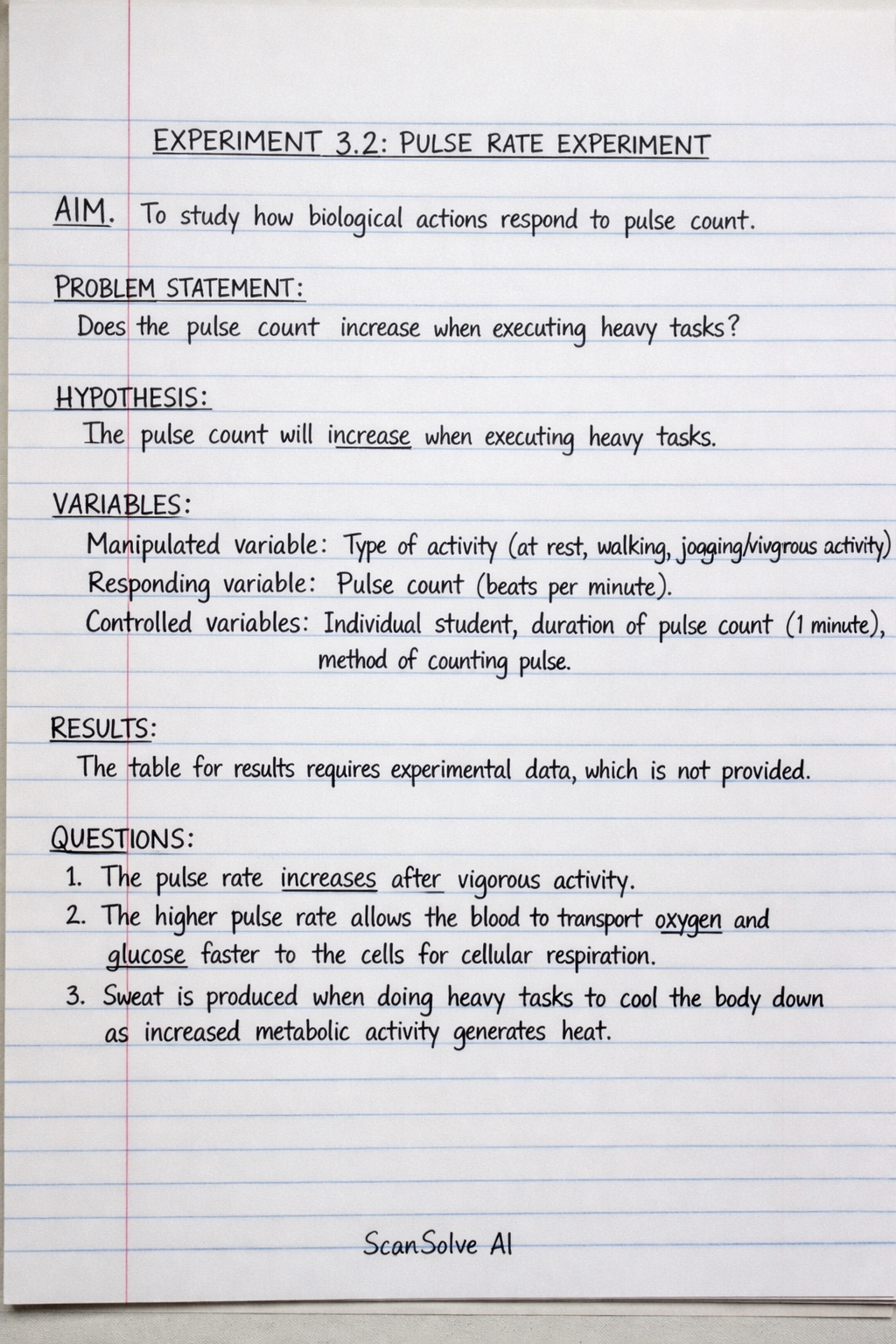
EXPERIMENT 3.2: PULSE RATE EXPERIMENT
AIM
To study how biological actions respond to pulse count.
PROBLEM STATEMENT
Does the pulse count increase when executing heavy tasks?
HYPOTHESIS
The pulse count will increase when executing heavy tasks.
VARIABLES
- Manipulated variable: Type of activity (e.g., at rest, walking, jogging/vigorous activity)
- Responding variable: Pulse count (beats per minute)
- Controlled variable: Individual student, duration of pulse count (1 minute), method of counting pulse
RESULTS
- The table for results requires experimental data, which is not provided.
QUESTIONS
- The pulse rate increases after vigorous activity.
- The higher pulse rate allows the blood to transport oxygen and glucose faster to the cells for cellular respiration.
- Sweat is produced when doing heavy tasks to cool the body down as increased metabolic activity generates heat.
CONCLUSIONS
- From the results, the hypothesis is accepted (or supported).
- Pulse rate increases after vigorous activity.
Was this helpful?
Still stuck on this one?
Ask a follow-up, and the answer starts from this question.
Got a different question?Ask your own question
More Biology Questions
QConduct an investigation to determine the effect of exercise on the pulse rate of a person.QCalculate your average resting pulse rate. Show your calculation.QExplain why heart rate increases to compensate for a physiological need.QExplain diastole and systole. How does the body increase blood flow during exercise?QA driver Speeds up a pulse of Car in 1.15 s from 80 km/h to 105 km/h during a displacement of 88m at…
Handwritten Step-by-Step Solution
Get this as a handwritten image on WhatsApp — like a tutor wrote it for you.
Try on WhatsApp