

This physics problem tests your understanding of fundamental physical laws and their applications. The step-by-step solution below breaks down the problem using relevant equations and physical reasoning.
ScanSolve AI Answer
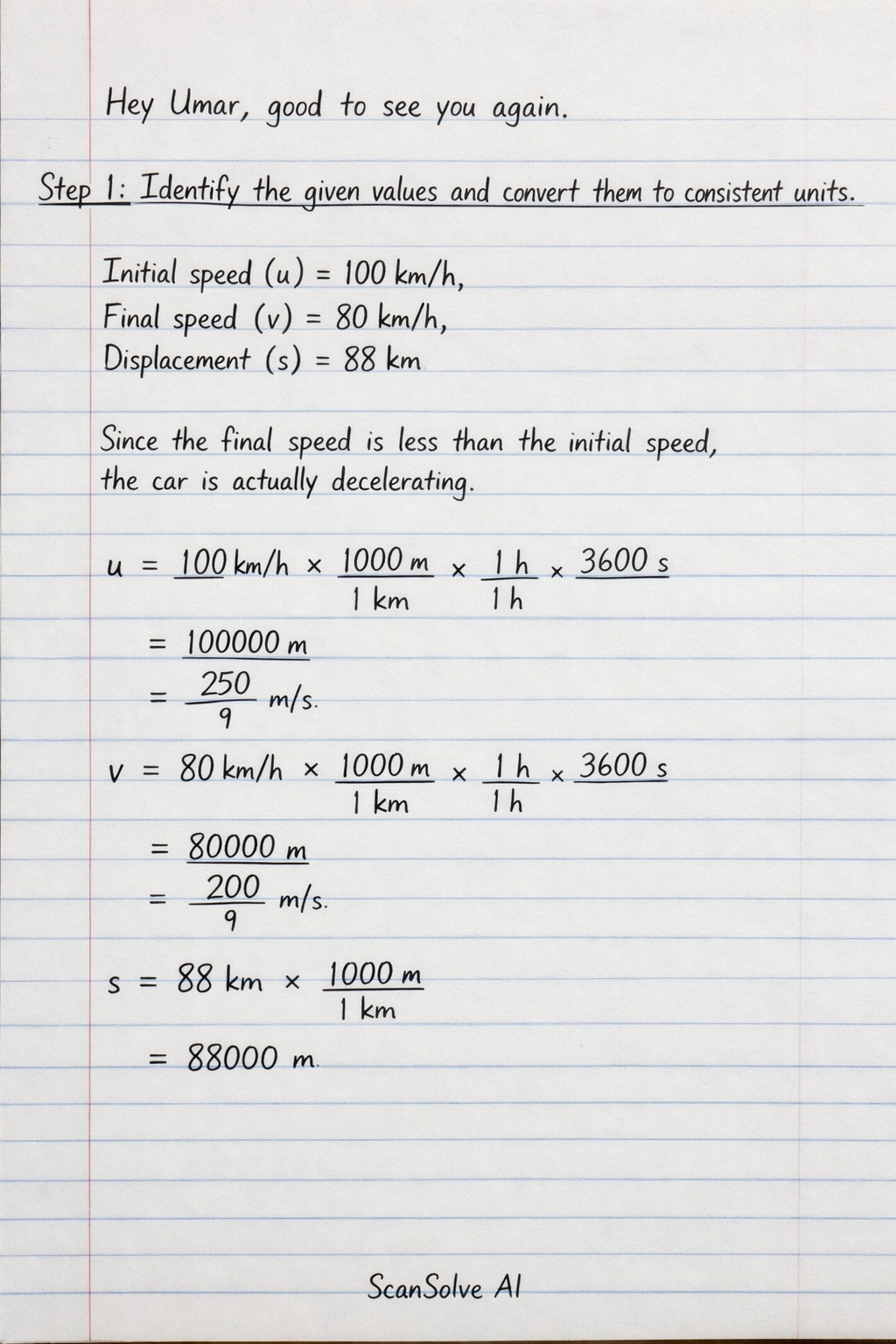
Step 1: Identify the given values and convert them to consistent units. The problem states the initial speed (u) is 100 km/h, the final speed (v) is 80 km/h, and the displacement (s) is 88 km. Although the problem says "speeds up", the final speed is less than the initial speed, which means the car is actually decelerating. Convert speeds from km/h to m/s and displacement from km to m: u = 100 km/h × 1000 m1 km × 1 h3600 s = (100000)/(3600) m/s = (250)/(9) m/s v = 80 km/h × 1000 m1 km × 1 h3600 s = (80000)/(3600) m/s = (200)/(9) m/s s = 88 km × 1000 m1 km = 88000 m Step 2: Choose the appropriate kinematic equation. To find the constant acceleration (a) given initial velocity (u), final velocity (v), and displacement (s), we use the following kinematic equation: v^2 = u^2 + 2as Step 3: Substitute the converted values into the equation. ((200)/(9) m/s)^2 = ((250)/(9) m/s)^2 + 2 · a · (88000 m) (40000)/(81) m^2/s^2 = (62500)/(81) m^2/s^2 + 176000a m Step 4: Solve for the acceleration (a). Subtract (62500)/(81) from both sides of the equation: 176000a = (40000)/(81) - (62500)/(81) 176000a = (40000 - 62500)/(81) 176000a = (-22500)/(81) Divide both sides by 176000: a = (-22500)/(81 × 176000) a = (-225)/(81 × 1760) Simplify the fraction by dividing the numerator and denominator by 9: a = (-25)/(9 × 1760) a = (-25)/(15840) Simplify further by dividing the numerator and denominator by 5: a = (-5)/(3168) m/s^2 The negative sign indicates that the acceleration is in the opposite direction to the initial velocity, meaning it is a deceleration. The acceleration of the car is -(5)/(3168) m/s^2. Send me the next one 📸