

This physics problem tests your understanding of fundamental physical laws and their applications. The step-by-step solution below breaks down the problem using relevant equations and physical reasoning.
ScanSolve AI Answer
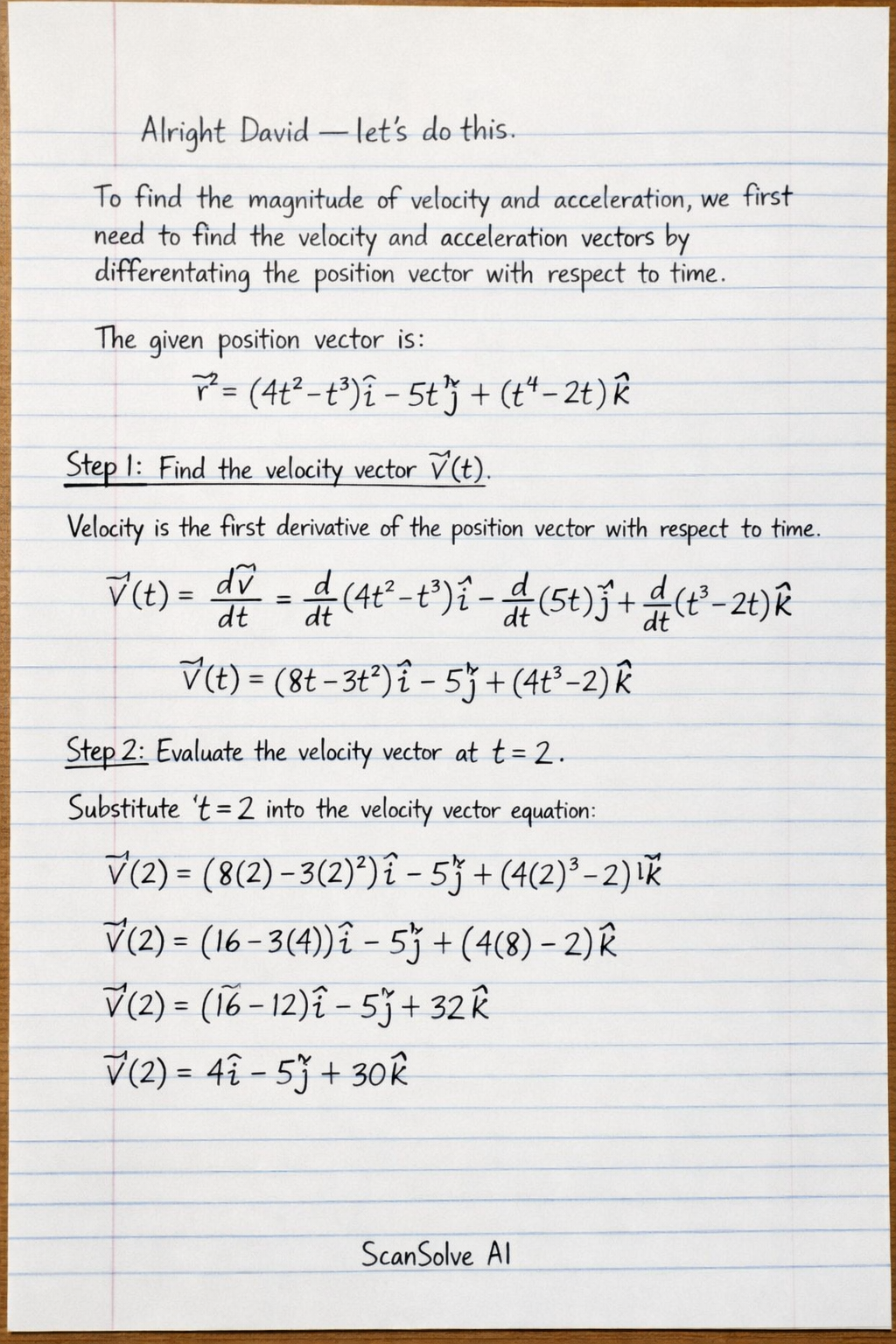
To find the magnitude of velocity and acceleration, we first need to find the velocity and acceleration vectors by differentiating the position vector with respect to time. The given position vector is: r = (4t^2 - t^3)i - 5tj + (t^4 - 2t)k Step 1: Find the velocity vector v(t). Velocity is the first derivative of the position vector with respect to time. v(t) = drdt = (d)/(dt)(4t^2 - t^3)i - (d)/(dt)(5t)j + (d)/(dt)(t^4 - 2t)k v(t) = (8t - 3t^2)i - 5j + (4t^3 - 2)k Step 2: Evaluate the velocity vector at t=2. Substitute t=2 into the velocity vector equation: v(2) = (8(2) - 3(2)^2)i - 5j + (4(2)^3 - 2)k v(2) = (16 - 3(4))i - 5j + (4(8) - 2)k v(2) = (16 - 12)i - 5j + (32 - 2)k v(2) = 4i - 5j + 30k Step 3: Calculate the magnitude of the velocity at t=2. The magnitude of a vector A = A_xi + A_yj + A_zk is |A| = sqrt(A_x^2 + A_y^2 + A_z^2). |v(2)| = sqrt(4^2 + (-5)^2 + 30^2) |v(2)| = sqrt(16 + 25 + 900) |v(2)| = sqrt(941) The magnitude of velocity at t=2 is sqrt(941). Step 4: Find the acceleration vector a(t). Acceleration is the first derivative of the velocity vector with respect to time. a(t) = dvdt = (d)/(dt)(8t - 3t^2)i - (d)/(dt)(5)j + (d)/(dt)(4t^3 - 2)k a(t) = (8 - 6t)i - 0j + (12t^2)k a(t) = (8 - 6t)i + 12t^2k Step 5: Evaluate the acceleration vector at t=2. Substitute t=2 into the acceleration vector equation: a(2) = (8 - 6(2))i + 12(2)^2k a(2) = (8 - 12)i + 12(4)k a(2) = -4i + 48k Step 6: Calculate the magnitude of the acceleration at t=2. |a(2)| = sqrt((-4)^2 + 0^2 + 48^2) |a(2)| = sqrt(16 + 0 + 2304) |a(2)| = sqrt(2320) The magnitude of acceleration at t=2 is sqrt(2320). Drop the next question! 📸