
We read your photo as:
Find the velocity vector v(t) given the position vector r(t) = (((t)/(2))i + ((t)/(2))j) m.
Physics
ScanSolve AI Answer
Step-by-step solution
3 stepsGiven the position vector:
To differentiate this vector, we differentiate each component with respect to . This will give us the velocity vector .
Differentiate the component.
Using the chain rule, . Here, .
Differentiate the component.
Using the chain rule, . Here, .
Combine the differentiated components to form the velocity vector.
Was this helpful?
Still stuck on this one?
Ask a follow-up, and the answer starts from this question.
Got a different question?Ask your own question
More Physics Questions
QThe position vector of the particle is given by r(t) = (2 2t)i + (1- 2t)j m.QFind the magnitude of velocity and acceleration at t=2 if r = (4t2 - t3)i - 5t j + (t2 - 2t)kQA particle of mass m = 3 kg has position vector r(t) = [t2 i + t(1+t)j + 2t2 k] m. Find the velocity…QFind the velocity vector v(t) and acceleration vector a(t).QFind the position vector of P at t=3. The position vector of particle P at t seconds is given by rP…
Browse by topic:Mechanics
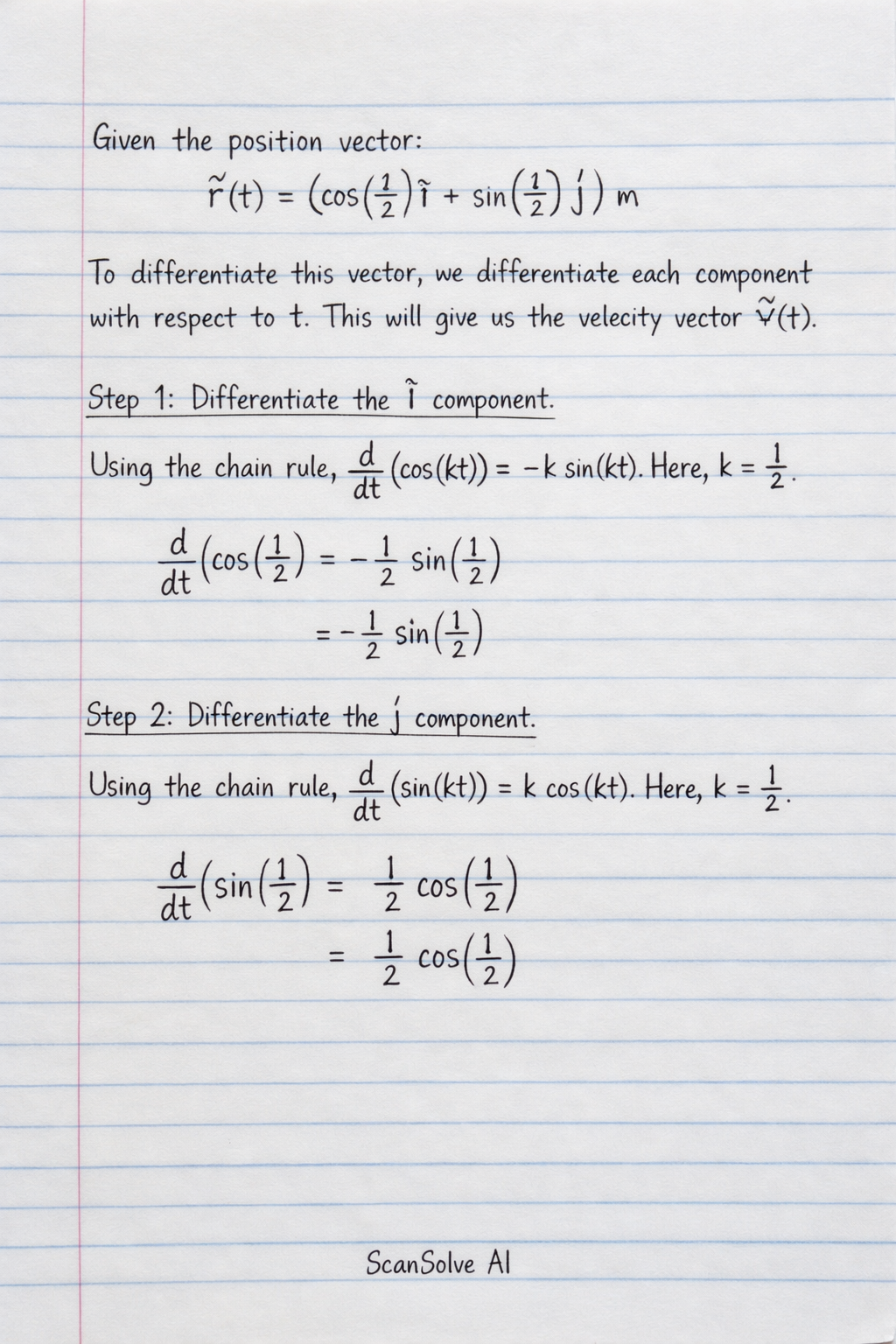
Handwritten Step-by-Step Solution
Get this as a handwritten image on WhatsApp — like a tutor wrote it for you.
Try on WhatsApp