
We read your photo as:
Draw a large labeled diagram of the male reproductive system and define reproduction, fertilization, pollination, and copulation.
ScanSolve AI Answer
here are the answers to your questions:
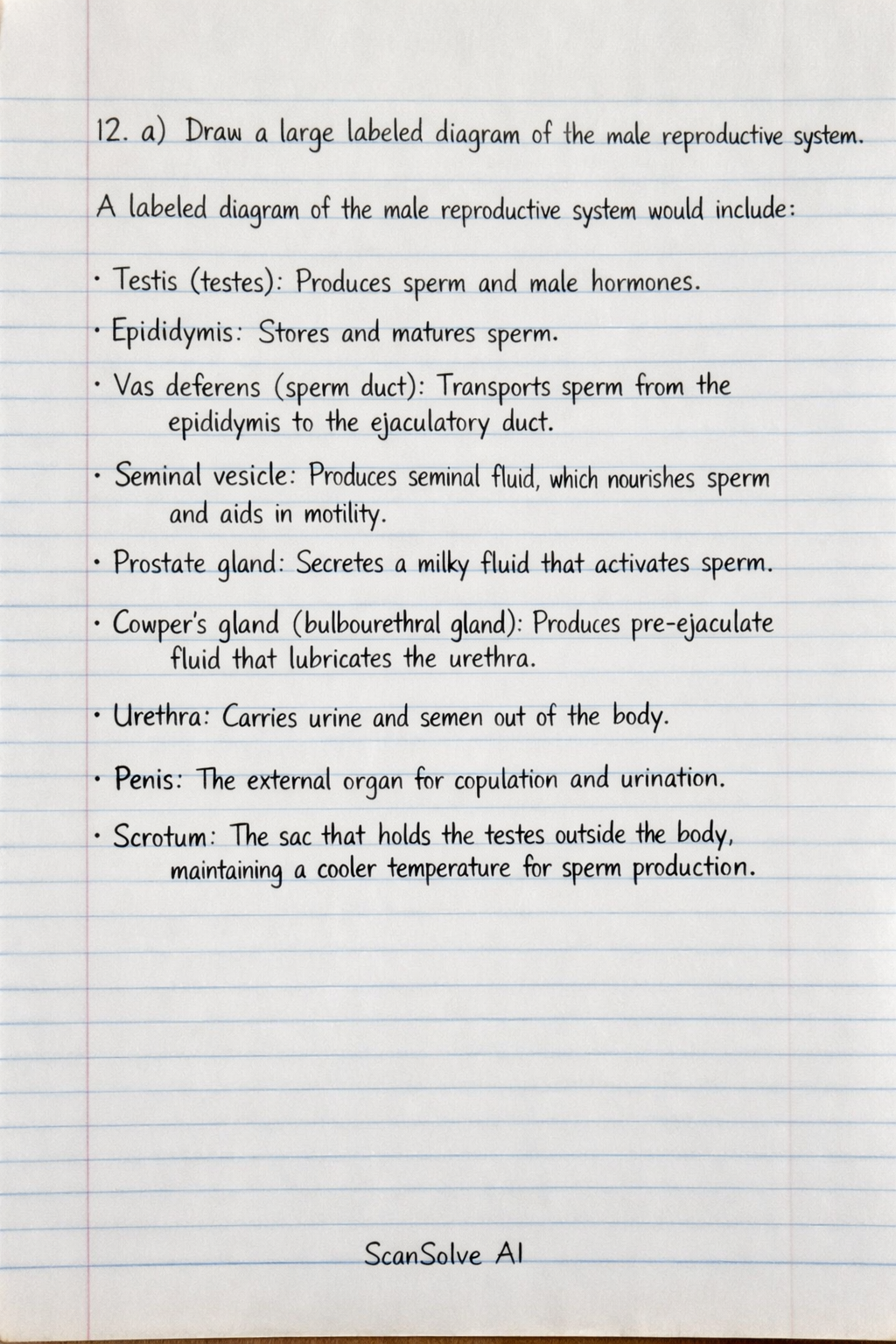
12. a) Draw a large labeled diagram of the male reproductive system.
I cannot create diagrams, but a large labeled diagram of the male reproductive system would typically include:
- Testis (plural: testes): Produces sperm and male hormones.
- Epididymis: Stores and matures sperm.
- Vas deferens (sperm duct): Transports sperm from the epididymis to the ejaculatory duct.
- Seminal vesicle: Produces seminal fluid, which nourishes sperm and aids in motility.
- Prostate gland: Secretes a milky fluid that activates sperm.
- Cowper's gland (bulbourethral gland): Produces pre-ejaculate fluid that lubricates the urethra.
- Urethra: Carries urine and semen out of the body.
- Penis: The external organ for copulation and urination.
- Scrotum: The sac that holds the testes outside the body, maintaining a cooler temperature for sperm production.
12. b) Define the following:
- i) Reproduction: The biological process by which new individual organisms (offspring) are produced from their parents, ensuring the continuation of species.
- ii) Fertilization: The fusion of male and female gametes (sperm and egg) to form a zygote.
- iii) Pollination: The transfer of pollen grains from the anther (male part) to the stigma (female part) of a flower.
- iv) Copulation: The act of sexual intercourse, involving the insertion of the male's penis into the female's vagina, leading to the transfer of sperm.
12. c) Where does meiosis occur in:
- i) Flowering plants: Meiosis occurs in the anthers to produce pollen grains (male gametes) and in the ovules to produce embryo sacs (female gametes).
- ii) Mammals: Meiosis occurs in the testes to produce sperm and in the ovaries to produce ova (eggs).
13. a) Define the following terms:
- i) Copulation: The act of sexual intercourse, involving the insertion of the male's penis into the female's vagina, leading to the transfer of sperm.
- ii) Ovulation: The release of a mature egg (ovum) from the ovary into the fallopian tube.
- iii) Fertilization: The fusion of male and female gametes (sperm and egg) to form a zygote.
13. b) Describe the process of birth in humans.
The process of birth (parturition) in humans typically occurs in three main stages:
- Dilation stage: Uterine contractions begin, causing the cervix to gradually thin (effacement) and open (dilate) to about 10 cm. This stage is often the longest.
- Expulsion stage: Once the cervix is fully dilated, strong uterine contractions, aided by the mother's pushing efforts, propel the baby through the birth canal (vagina). This stage ends with the delivery of the baby.
- Placental stage (afterbirth): After the baby is born, the uterus continues to contract, expelling the placenta and other fetal membranes from the body.
13. c) State two functions of the placenta.
- The placenta facilitates the exchange of substances between the mother and the fetus, including oxygen and nutrients from the mother to the fetus, and waste products (like carbon dioxide and urea) from the fetus to the mother.
- The placenta produces hormones, such as progesterone and estrogen, which are essential for maintaining the pregnancy and preparing the mother's body for birth and lactation.
14. a) Make a large labelled diagram of the longitudinal section of the male reproductive system.
I cannot create diagrams, but a large labeled diagram of the longitudinal section of the male reproductive system would typically include:
- Testis (plural: testes): Produces sperm and male hormones.
- Epididymis: Stores and matures sperm.
- Vas deferens (sperm duct): Transports sperm from the epididymis to the ejaculatory duct.
- Seminal vesicle: Produces seminal fluid, which nourishes sperm and aids in motility.
- Prostate gland: Secretes a milky fluid that activates sperm.
- Cowper's gland (bulbourethral gland): Produces pre-ejaculate fluid that lubricates the urethra.
- Urethra: Carries urine and semen out of the body.
- Penis: The external organ for copulation and urination.
- Scrotum: The sac that holds the testes outside the body, maintaining a cooler temperature for sperm production.
14. b) what is meant by
- i) Ovulation: The release of a mature egg (ovum) from the ovary into the fallopian tube.
- ii) Fertilization: The fusion of male and female gametes (sperm and egg) to form a zygote.
- iii) Pollination: The transfer of pollen grains from the anther (male part) to the stigma (female part) of a flower.
14. c) Bring out four differences between an insect pollinated flower and a wind pollinated flower.
| Feature | Insect Pollinated Flower | Wind Pollinated Flower |
|---|---|---|
| Petals | Large, brightly colored, often scented | Small, dull, or absent |
| Nectaries/Scent | Present, produce nectar and often a strong scent | Absent |
| Pollen | Sticky, spiky, or heavy; produced in small amounts | Light, smooth, abundant; easily carried by wind |
| Stigma | Small, sticky, often enclosed within the flower | Large, feathery, exposed to catch airborne pollen |
| Anthers | Small, firm, often enclosed within the flower | Large, versatile, hang outside the flower to release pollen |
15. a) Define
- i) Seed dispersal: The process by which seeds are carried away from the parent plant to new locations, reducing competition for resources and promoting the colonization of new areas.
- ii) Gestation: The period of development of an embryo or fetus inside the mother's womb, from conception to birth.
15. b) State the agents of seed dispersal.
- Wind: Seeds with wings or feathery structures (e.g., dandelion, maple).
- Water: Seeds that float (e.g., coconut).
- Animals:
- Internal dispersal: Seeds eaten by animals and passed through their digestive system (e.g., berries).
- External dispersal: Seeds with hooks or barbs that attach to animal fur (e.g., burdock).
- Explosion/Self-dispersal: Pods that burst open, scattering seeds (e.g., pea, bean).
- Humans: Intentional or unintentional transport of seeds.
15. c) Differentiate between insect and wind pollinated flowers.
- Petals: Insect-pollinated flowers usually have large, brightly colored petals to attract insects, while wind-pollinated flowers have small, dull, or absent petals.
- Nectaries/Scent: Insect-pollinated flowers often possess nectaries to produce nectar and emit a scent to attract pollinators, whereas wind-pollinated flowers lack these features.
- Pollen: Insect-pollinated flowers produce sticky, spiky, or heavy pollen in relatively small amounts. Wind-pollinated flowers produce light, smooth, and abundant pollen that is easily carried by the wind.
- Stigma: Insect-pollinated flowers typically have small, sticky stigmas that are often enclosed within the flower. Wind-pollinated flowers have large, feathery, and exposed stigmas to efficiently catch airborne pollen.
15. d) How is the human embryo protected?
The human embryo (and later fetus) is protected in several ways:
- Uterus: The muscular walls of the uterus provide a strong, protective enclosure.
- Amniotic fluid: The embryo is suspended in amniotic fluid
Still stuck on this one?
Ask a follow-up, and the answer starts from this question.
More Biology Questions
Handwritten Step-by-Step Solution
Get this as a handwritten image on WhatsApp — like a tutor wrote it for you.
Try on WhatsApp