
We read your photo as:
Draw specimen H (Chick) and list differences between Earthworm and Millipede.
Biology
ScanSolve AI Answer
Step-by-step solution
3 stepsHere are the answers to the questions:
Address part a) - Drawing of specimen H (Chick).
The question asks for a drawing of "specimen H (Chick)". While the list at the top identifies "H = Tilapia", the explicit mention of "Chick" in parentheses indicates that a chick should be drawn. Since I cannot create a drawing, I will describe the key features that should be included in a large, fully labelled lateral view drawing of a chick.
- Head: Include the beak, eye, and a developing comb.
- Neck: Connects the head to the body.
- Body: Show the main torso, covered in downy feathers.
- Wings: Depict the developing wings, typically held close to the body.
- Tail: Indicate the short, developing tail feathers.
- Legs and Feet: Draw the two legs with scales, ending in three forward-pointing toes and one backward-pointing toe, with claws.
- Overall Shape: An oval-shaped body with a distinct head and neck.
Address part b) - Differences between Earthworm and Millipede.
Here are some key differences between an Earthworm (Specimen E) and a Millipede:
- Phylum: Earthworms belong to Phylum Annelida, while Millipedes belong to Phylum Arthropoda (Subphylum Myriapoda).
- Body Covering: Earthworms have a soft, moist cuticle, whereas Millipedes have a hard, chitinous exoskeleton.
- Appendages: Earthworms have small bristles called setae on each segment. Millipedes have many legs, typically two pairs per body segment, and a pair of antennae.
- Body Segmentation: Earthworms have numerous similar segments without a distinct head region. Millipedes have a distinct head and a segmented body where segments are fused in pairs.
Address part c) - Specific habitat of Specimen A, B, E, F & G.
Here are the specific habitats for the listed specimens:
- A = Daphnia: Found in freshwater environments such as ponds, lakes, and ditches.
- B = Moss: Thrives in damp, shaded terrestrial environments, often on rocks, tree trunks, or soil.
- E = Earthworm: Lives in moist soil rich in organic matter, where it burrows and feeds.
- F = Honey bee: Resides in hives or nests, typically in trees or man-made structures, and forages in areas with flowering plants.
- G = Sea anemone: Inhabits marine environments, attaching to rocks, coral reefs, or other substrates in shallow coastal waters.
Was this helpful?
Still stuck on this one?
Ask a follow-up, and the answer starts from this question.
Got a different question?Ask your own question
More Biology Questions
QClassify the following specimens into major groups and subgroups: Cowpea, Cockroach, Earthworm…QProvide the Phylum and Class for each specimen listed: Golden Spider, Salmonella, Woodlouse…QS-CUPREC SPECIMEN Specimens: A : grasshopper. E: mushroom B: garden snail. F: spider C: toad. G…QClassify Ascaris lumbricoides and distinguish differences/similarities between its sexes.QIdentify and label the key anatomical features of the provided diagrams of an insect, spider…
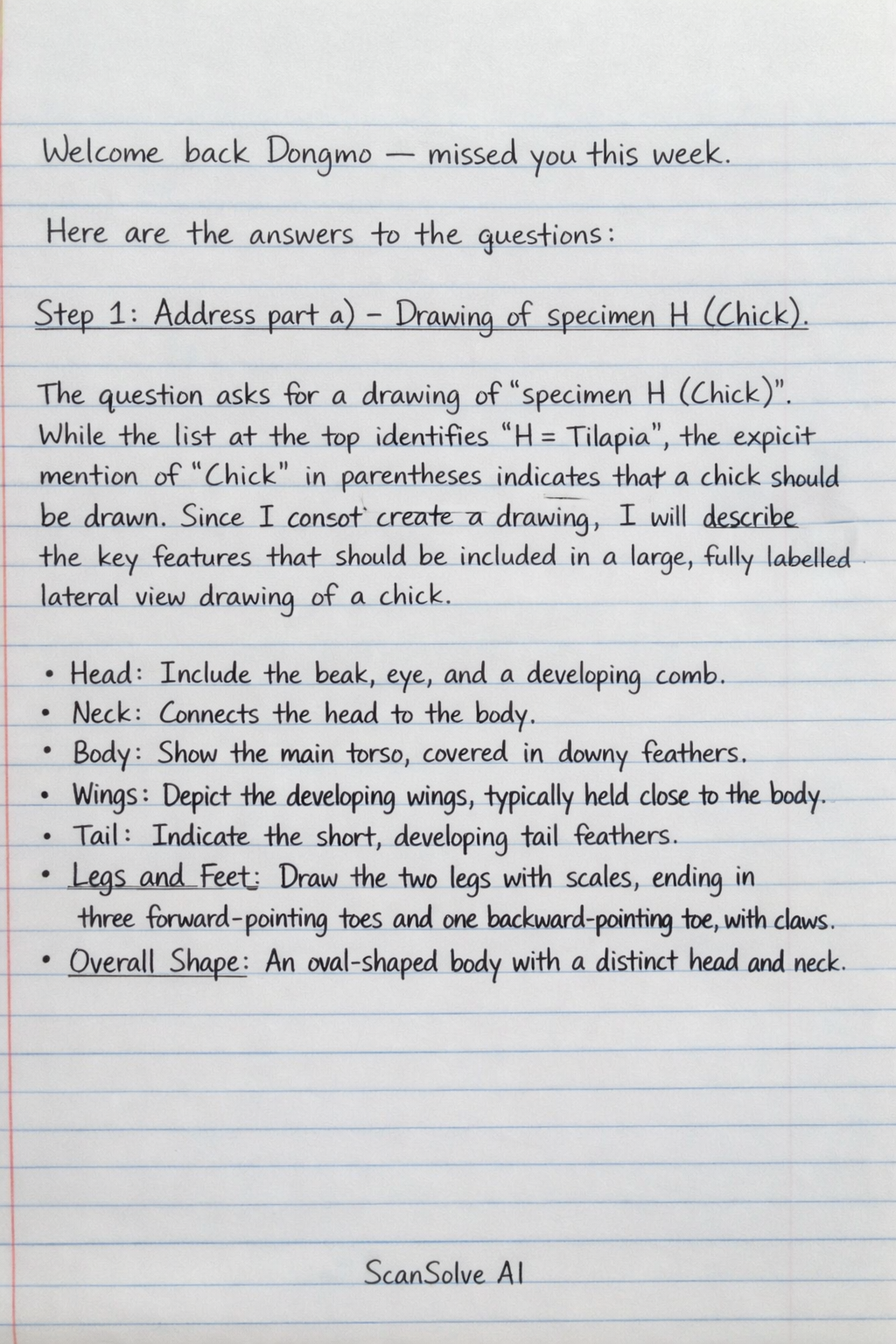
Handwritten Step-by-Step Solution
Get this as a handwritten image on WhatsApp — like a tutor wrote it for you.
Try on WhatsApp