
We read your photo as:
Which enzyme is regulated by allosteric inhibitors like alanine, glycine, and carbamoyl phosphate, signaling nitrogen and energy status?
ScanSolve AI Answer
Step-by-step solution
8 stepsPart 33
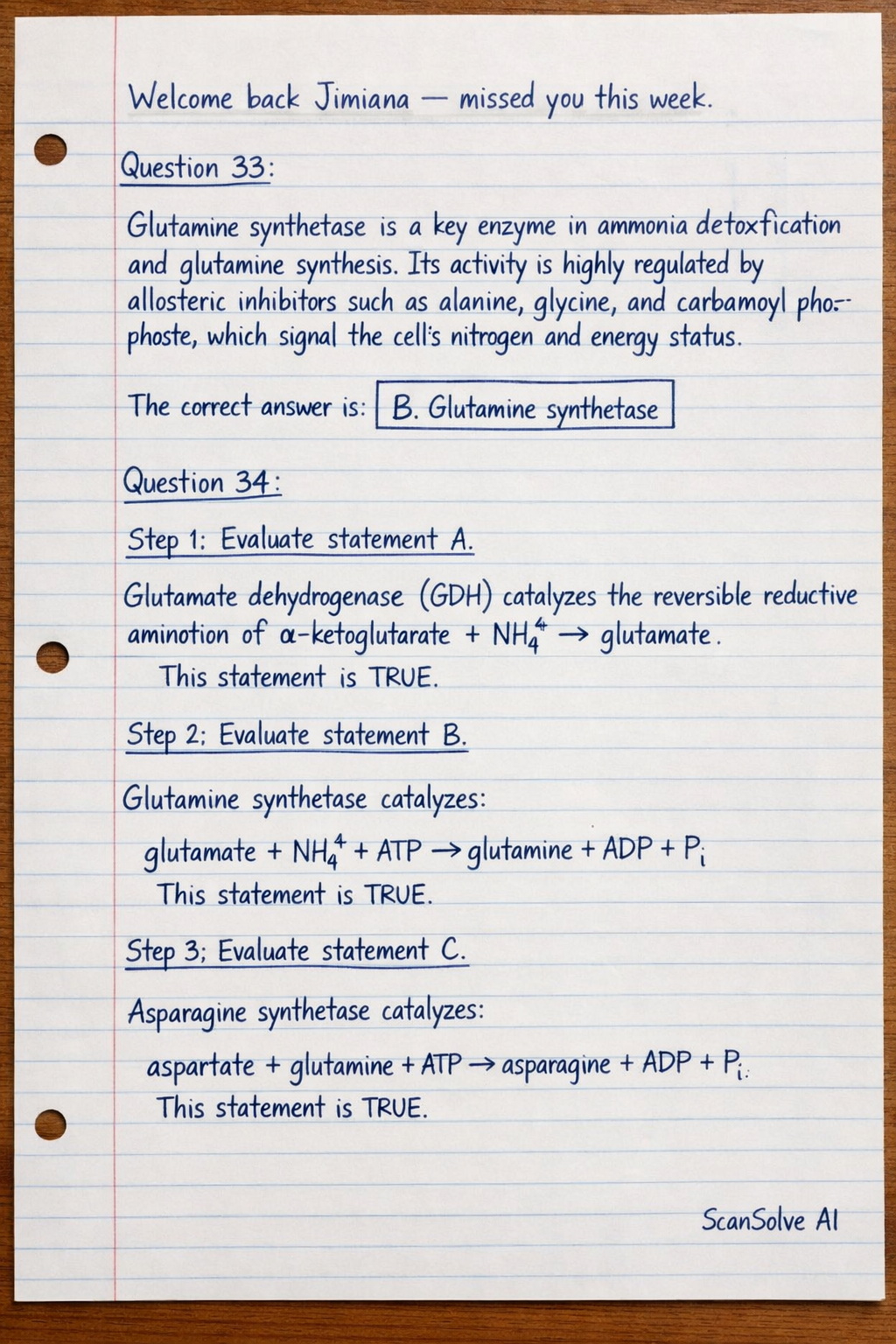
Glutamine synthetase is a key enzyme in ammonia detoxification and glutamine synthesis. Its activity is highly regulated by allosteric inhibitors such as alanine, glycine, and carbamoyl phosphate, which signal the cell's nitrogen and energy status.
The correct answer is
Part 34· 5 steps
Evaluate statement A.
Glutamate dehydrogenase (GDH) catalyzes the reversible reductive amination of -ketoglutarate with free ammonium ions to form glutamate. This statement is TRUE.
Evaluate statement B.
Glutamine synthetase catalyzes the ATP-dependent amidation of glutamate with ammonium ions to form glutamine. This statement is TRUE.
Evaluate statement C.
Asparagine synthetase catalyzes the ATP-dependent amidation of aspartate with ammonium ions (or glutamine) to form asparagine. This statement is TRUE.
Evaluate statement D.
Asparagine dehydrogenase is not a common enzyme involved in the incorporation of free ammonium ions to form aspartate. Dehydrogenases typically remove hydrogen atoms, often in oxidative deamination reactions. Aspartate is primarily formed via transamination. This statement is NOT TRUE.
Evaluate statement E.
Glutamate dehydrogenase is unique in its ability to use both NAD and NADP as coenzymes, depending on the direction of the reaction and the metabolic needs of the cell. This statement is TRUE.
The statement that is NOT TRUE is
Part 1· 3 steps
(from image)
Identify intermediates of the TCA cycle.
The TCA cycle intermediates include citrate, isocitrate, -ketoglutarate, succinyl CoA, succinate, fumarate, malate, and oxaloacetate.
Identify intermediates of the Urea cycle.
The Urea cycle intermediates include ornithine, citrulline, argininosuccinate, arginine, and fumarate.
Find the common compound.
Comparing the lists, fumarate is an intermediate in both the TCA cycle and the Urea cycle. In the urea cycle, argininosuccinate is cleaved to arginine and fumarate, and the fumarate can then enter the TCA cycle.
The correct answer is
Part 5
(from image)
In cases of liver cirrhosis, the liver's ability to detoxify ammonia is impaired, leading to hyperammonemia, which is toxic to the brain. The body's primary mechanism to transport and store ammonia in a non-toxic form is by converting it to glutamine. Glutamine synthetase catalyzes the ATP-dependent covalent binding of ammonia to glutamate to form glutamine.
The correct answer is
Still stuck on this one?
Ask a follow-up, and the answer starts from this question.
More Biology Questions
Handwritten Step-by-Step Solution
Get this as a handwritten image on WhatsApp — like a tutor wrote it for you.
Try on WhatsApp