
Find the equation whose root are 5/6 and -3/4
ScanSolve AI Answer
Answer
Step-by-step solution
4 stepsTo find the equation whose roots are and , we can use the relationship between the roots and coefficients of a quadratic equation. For a quadratic equation , or (when ).
Calculate the sum of the roots.
Let the roots be and .
To add these fractions, find a common denominator, which is 12.
Calculate the product of the roots.
Simplify the fraction by dividing the numerator and denominator by their greatest common divisor, which is 3.
Form the quadratic equation.
The general form of a quadratic equation with roots and is .
Substitute the sum and product calculated in the previous steps:Clear the denominators to obtain an equation with integer coefficients.
The least common multiple (LCM) of the denominators 12 and 8 is 24. Multiply the entire equation by 24:
The equation whose roots are and is:
Try one yourself
A new problem that tests the same skill.
Still stuck on this one?
Ask a follow-up, and the answer starts from this question.
More Biology Questions
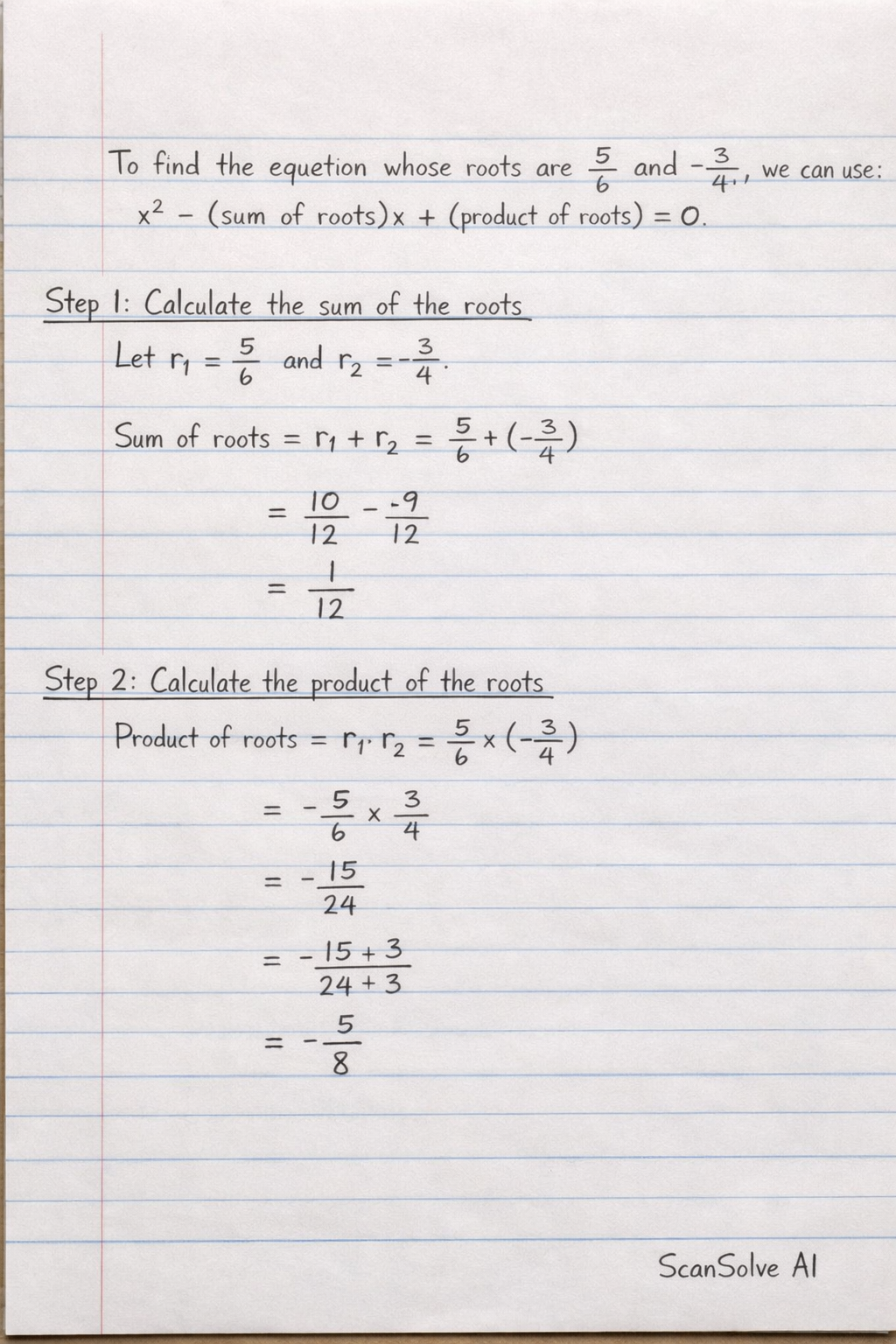
Handwritten Step-by-Step Solution
Get this as a handwritten image on WhatsApp — like a tutor wrote it for you.
Try on WhatsApp