
We read your photo as:
What does checking expiry dates primarily prevent, and what is a key characteristic of enzymes?
ScanSolve AI Answer
Step-by-step solution
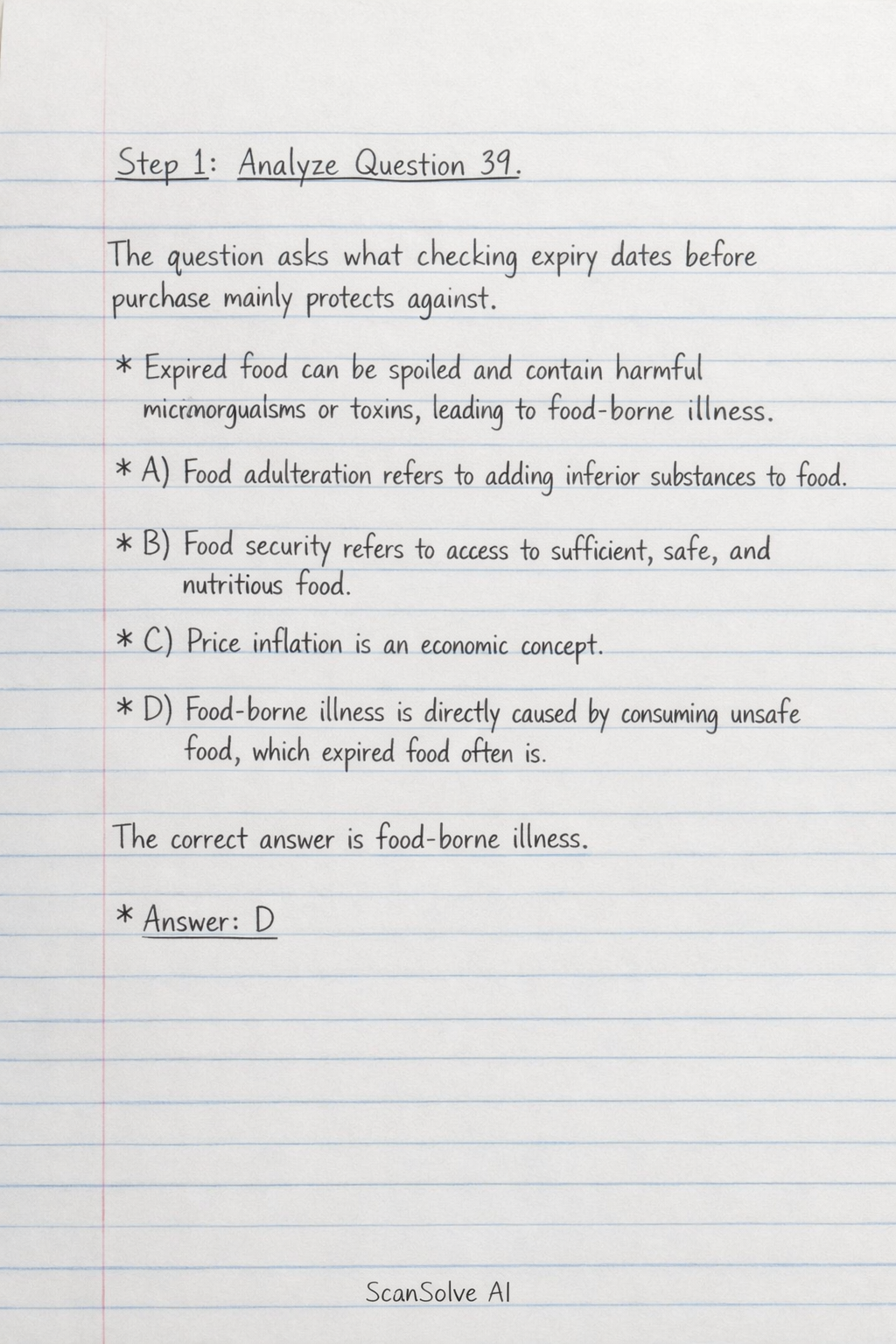
7 stepsAnalyze Question 39.
The question asks what checking expiry dates before purchase mainly protects against.
- Expired food can be spoiled and contain harmful microorganisms or toxins, leading to food-borne illness.
- A) Food adulteration refers to adding inferior substances to food.
- B) Food security refers to access to sufficient, safe, and nutritious food.
- C) Price inflation is an economic concept.
- D) Food-borne illness is directly caused by consuming unsafe food, which expired food often is.
The correct answer is food-borne illness.
- Answer: D
Analyze Question 40.
The question asks which option specifically describes enzymes.
- A) Lipase acting on fats only describes the specificity of enzymes, meaning each enzyme typically acts on a particular substrate or type of substrate. This is a defining characteristic of enzymes.
- B) Heat generally denatures and kills enzymes, but this isn't a description of their active state.
- C) Acids can denature enzymes, but "lowly reacting" is vague and not a specific description of enzymes.
- D) Enzymes are biological catalysts and, like all catalysts, are reused in reactions. While true, their high degree of specificity is a more distinguishing characteristic among catalysts.
The most specific description among the options, highlighting a unique property of enzymes, is their specificity of action.
- Answer: A
Analyze Question 41.
The question asks which observation would likely indicate spoilage in packaged meat.
- A) Firm texture is generally a sign of fresh meat.
- B) Normal smell indicates freshness.
- C) Cold from freezer indicates proper storage.
- D) Greenish colour is a common visual sign of meat spoilage, often due to microbial growth.
The correct answer is greenish colour.
- Answer: D
Analyze Question 42.
The question asks which setup best prevents cross-contamination.
- Cross-contamination is the transfer of harmful bacteria from one food item (often raw) to another (often cooked or ready-to-eat).
- A) Storing all food together increases the risk of cross-contamination.
- B) Using separate cutting boards and utensils for different types of food (e.g., raw meat and vegetables) is a key practice to prevent cross-contamination.
- C) Washing hands occasionally is insufficient; hands should be washed frequently and thoroughly.
- D) Cooking food at room temperature promotes bacterial growth and increases risk, rather than preventing cross-contamination.
The correct answer is using separate cutting boards and utensils.
- Answer: B
Analyze Question 43.
The question asks about the use of coagulation during water treatment.
- Coagulation is a process in water treatment where chemicals (coagulants) are added to water to neutralize the electrical charges of suspended particles. This causes the particles to come together.
- C) These smaller particles then clump together into larger, heavier flocs (flocculation), which can then be easily removed by sedimentation or filtration.
- A) Coagulation primarily removes particles, not directly kills microorganisms, although some may be trapped in flocs.
- B) It does not remove dissolved salts.
- D) It does not directly improve water hardness (which is due to dissolved minerals).
The correct answer is to clump fine particles into large flocs.
- Answer: C
Analyze Question 44.
The question asks which beverage best demonstrates a natural non-alcoholic drink.
- A) Beer is an alcoholic beverage.
- B) Juice is a general category, some of which can be natural and non-alcoholic.
- C) Fresh orange juice is a specific example of a natural beverage that is non-alcoholic.
- D) Brandy is an alcoholic beverage.
Fresh orange juice is the most specific and accurate example among the options.
- Answer: C
Analyze Question 45.
The question asks which event occurs first during digestion after food enters the mouth.
- Digestion begins in the mouth.
- B) The very first process is mechanical breakdown (chewing or mastication), which physically breaks down food into smaller pieces.
- A) Protein hydrolysis (breakdown) primarily begins in the stomach.
- C) Fat emulsification primarily occurs in the small intestine.
- D) Absorption of glucose primarily occurs in the small intestine.
The correct answer is mechanical breakdown.
- Answer: B
Still stuck on this one?
Ask a follow-up, and the answer starts from this question.
More Biology Questions
Handwritten Step-by-Step Solution
Get this as a handwritten image on WhatsApp — like a tutor wrote it for you.
Try on WhatsApp