
This biology question covers important biological concepts and processes. The step-by-step explanation below helps you understand the underlying mechanisms and reasoning.
ScanSolve AI Answer
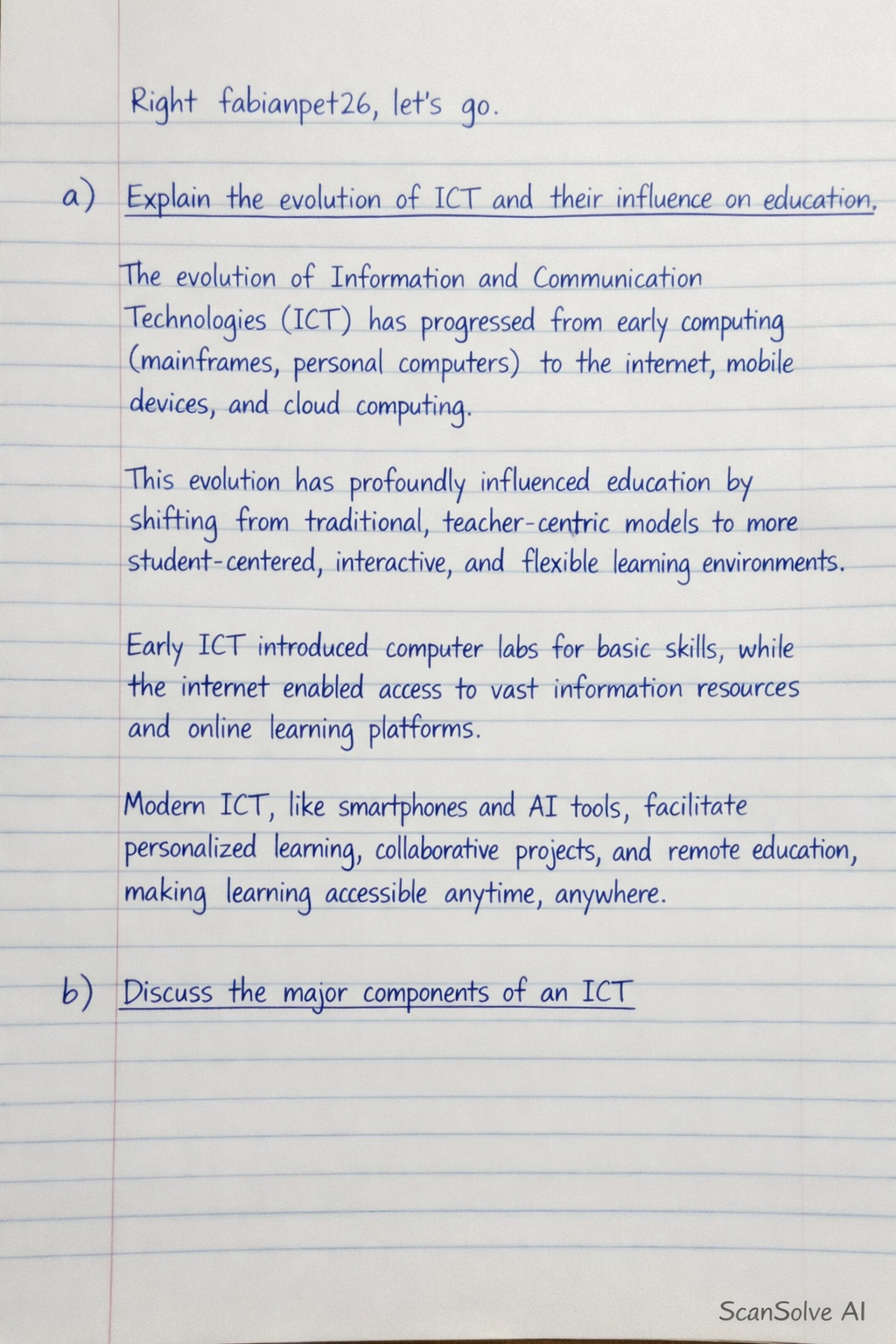
a) Explain the evolution of ICT and their influence on education The evolution of Information and Communication Technologies (ICT) has progressed from early computing (mainframes, personal computers) to the internet, mobile devices, and cloud computing. This evolution has profoundly influenced education by shifting from traditional, teacher-centric models to more student-centered, interactive, and flexible learning environments. Early ICT introduced computer labs for basic skills, while the internet enabled access to vast information resources and online learning platforms. Modern ICT, like smartphones and AI tools, facilitate personalized learning, collaborative projects, and remote education, making learning accessible anytime, anywhere. b) Discuss the major components of an ICT The major components of ICT typically include: Hardware: Physical components such as computers, servers, networking devices (routers, switches), mobile phones, and peripherals (printers, scanners). Software: Programs and applications that run on hardware, including operating systems (Windows, macOS), application software (word processors, browsers), and specialized educational software. Data: Raw facts, figures, and information that are processed, stored, and transmitted by ICT systems. Networks: Systems that connect computers and devices, enabling communication and data sharing, such as the internet, intranets, and local area networks (LANs). People: Users, administrators, and developers who interact with and manage ICT systems. Processes: The methods and procedures used to operate, manage, and secure ICT systems and data. c) Examine the role of ICT in education transformation ICT plays a transformative role in education by enhancing learning experiences, improving administrative efficiency, and broadening access. It enables personalized learning paths, allowing students to learn at their own pace and style through adaptive software and online resources. ICT facilitates collaborative learning through virtual platforms and digital tools, fostering critical thinking and problem-solving skills. For educators, ICT provides tools for creating engaging content, assessing student progress, and managing classrooms more effectively. Furthermore, it breaks down geographical barriers, making education accessible to remote populations and promoting lifelong learning. d) Differentiate between digital literacy and digital citizenship. Digital literacy refers to the ability to find, evaluate, create, and communicate information using digital technologies. It encompasses technical skills like operating software and hardware, as well as cognitive skills such as critical thinking about online content and understanding digital media. Digital citizenship, on the other hand, refers to the responsible, ethical, and safe use of technology. It involves understanding one's rights and responsibilities in the digital world, practicing appropriate online behavior (e.g., netiquette, privacy protection), and contributing positively to digital communities. While digital literacy focuses on the ability to use technology, digital citizenship focuses on how one uses it responsibly and ethically.