
We read your photo as:
Expand the expression inside the square root.
Biology
ScanSolve AI Answer
Answer
Step-by-step solution
14 stepsHere are the solutions for the integrals:
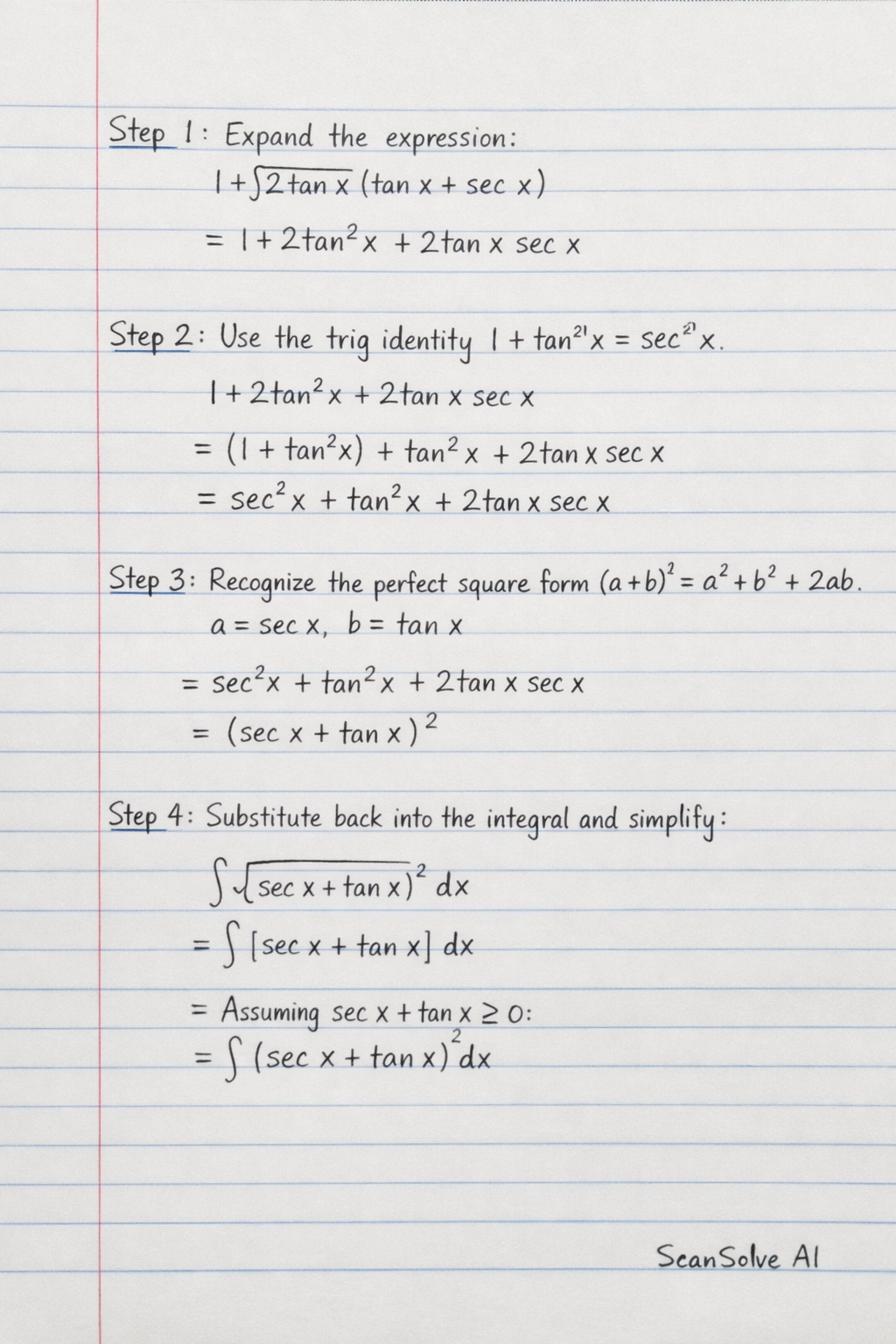
Expand the expression inside the square root.
$$ 1 + 2\tan x (\tan x + \sec x) = 1 + 2\tan^2 x + 2\tan x \sec x $$Use the trigonometric identity .
$$ 1 + 2\tan^2 x + 2\tan x \sec x = (1 + \tan^2 x) + \tan^2 x + 2\tan x \sec x $$ $$ = \sec^2 x + \tan^2 x + 2\tan x \sec x $$Recognize the perfect square form .
Here, $a = \sec x$ and $b = \tan x$. $$ \sec^2 x + \tan^2 x + 2\tan x \sec x = (\sec x + \tan x)^2 $$Substitute back into the integral and simplify the square root.
$$ \int \sqrt{(\sec x + \tan x)^2}\,dx = \int |\sec x + \tan x|\,dx $$ Assuming $\sec x + \tan x \ge 0$ for the domain of integration, we can remove the absolute value. $$ \int (\sec x + \tan x)\,dx $$Integrate each term.
Recall that $\int \sec x\,dx = \ln|\sec x + \tan x| + C$ and $\int \tan x\,dx = \ln|\sec x| + C$. $$ \int (\sec x + \tan x)\,dx = \ln|\sec x + \tan x| + \ln|\sec x| + C $$Combine the logarithmic terms using .
$$ \ln|\sec x (\sec x + \tan x)| + C = \ln|\sec^2 x + \sec x \tan x| + C $$ $$ \boxed{\ln|\sec^2 x + \sec x \tan x| + C} $$2.
Use substitution.
Let .
Find the differential .
$$ du = \frac{d}{dx}(x^2 - 2x + 26)\,dx = (2x - 2)\,dx = 2(x-1)\,dx $$ From this, we have $(x-1)\,dx = \frac{1}{2}\,du$.Substitute and into the integral.
$$ \int \frac{1}{u} \cdot \frac{1}{2}\,du = \frac{1}{2} \int \frac{1}{u}\,du $$Integrate with respect to .
$$ \frac{1}{2} \ln|u| + C $$Substitute back .
The discriminant of $x^2 - 2x + 26$ is $(-2)^2 - 4(1)(26) = 4 - 104 = -100$, which is negative. Since the leading coefficient is positive, $x^2 - 2x + 26$ is always positive, so $|x^2 - 2x + 26| = x^2 - 2x + 26$. $$ \boxed{\frac{1}{2} \ln(x^2 - 2x + 26) + C} $$3.
Recognize this as a standard integral form for .
The general form is $\int \frac{1}{\sqrt{a^2 - x^2}}\,dx = \arcsin\left(\frac{x}{a}\right) + C$.Identify .
In this integral, $a^2 = 4$, so $a = 2$.Apply the formula.
$$
\int \frac{1}{\sqrt{2^2 - x^2}}\,dx = \arcsin\left(\frac{x}{2}\right) + C
$$
$$
\boxed{\arcsin\left(\frac{x}{2}\right) + C}
$$
Was this helpful?
Try one yourself
A new problem that tests the same skill.
Still stuck on this one?
Ask a follow-up, and the answer starts from this question.
Got a different question?Ask your own question
More Biology Questions
Handwritten Step-by-Step Solution
Get this as a handwritten image on WhatsApp — like a tutor wrote it for you.
Try on WhatsApp