
We read your photo as:
State five purposes of fixation. 22. Outline five effects of fixatives on tissue components. 23. Mention five methods of decalcification. 24. List the five stages of tissue processing.
Biology
ScanSolve AI Answer
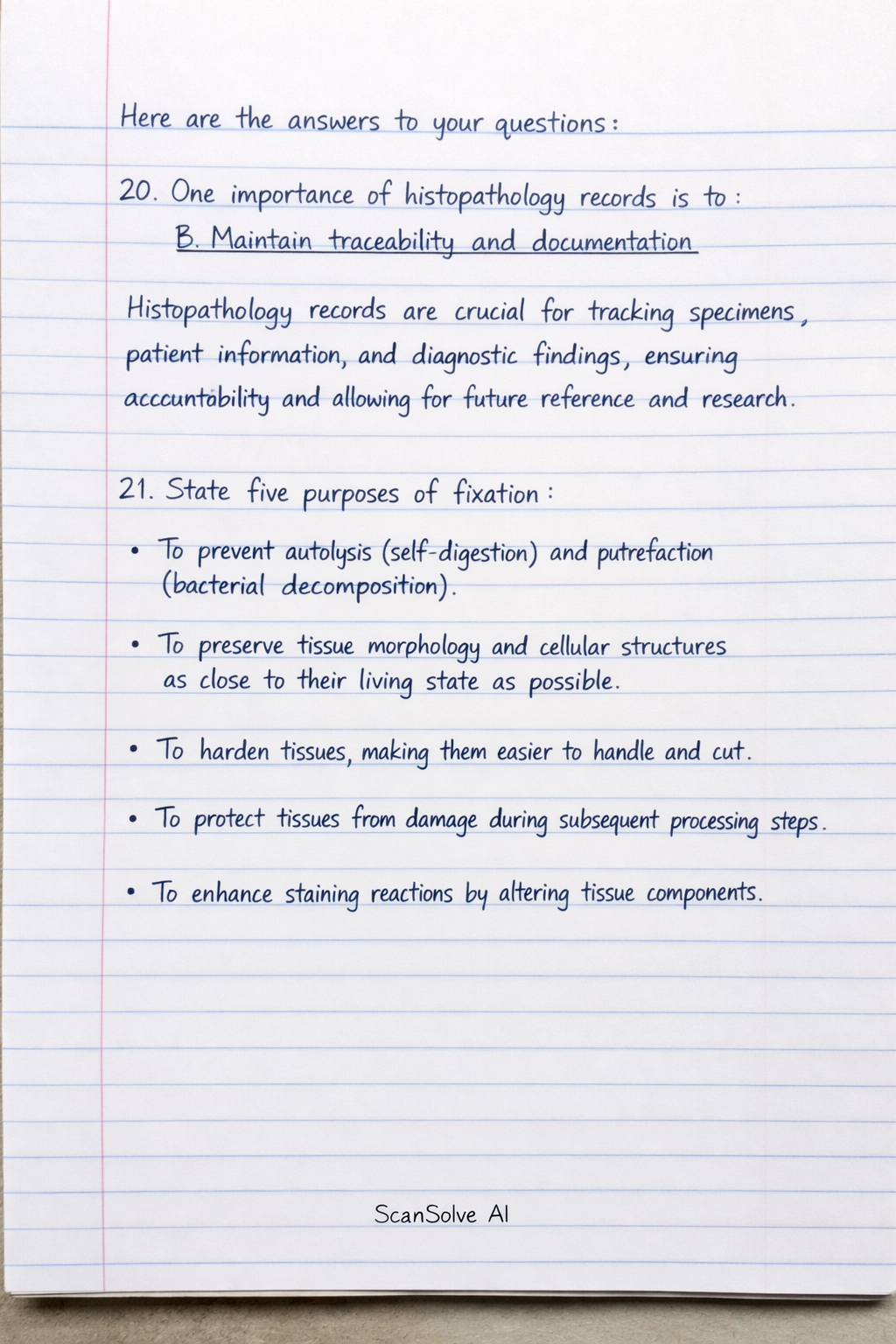
Here are the answers to your questions:
20. One importance of histopathology records is to:
- B. Maintain traceability and documentation
- Histopathology records are crucial for tracking specimens, patient information, and diagnostic findings, ensuring accountability and allowing for future reference and research.
21. State five purposes of fixation.
- To prevent autolysis (self-digestion) and putrefaction (bacterial decomposition).
- To preserve tissue morphology and cellular structures as close to their living state as possible.
- To harden tissues, making them easier to handle and cut.
- To protect tissues from damage during subsequent processing steps.
- To enhance staining reactions by altering tissue components.
22. Outline five effects of fixatives on tissue components.
- Coagulation of proteins: Many fixatives cause proteins to denature and coagulate, forming a meshwork that stabilizes the tissue.
- Cross-linking of proteins: Some fixatives, like formalin, form chemical bonds between protein molecules, strengthening the tissue structure.
- Inhibition of enzymes: Fixatives inactivate enzymes that would otherwise cause tissue degradation.
- Alteration of tissue permeability: Fixatives can change how easily other reagents penetrate the tissue.
- Shrinkage or swelling: Tissues may shrink or swell depending on the type of fixative and its concentration.
23. Mention five methods of decalcification.
- Acid decalcification: Using strong acids like nitric acid or hydrochloric acid.
- Chelating agents: Using agents like EDTA (ethylenediaminetetraacetic acid) to bind calcium ions.
- Ion exchange resins: Using resins to remove calcium ions from the decalcifying solution.
- Electrolytic decalcification: Using an electric current to accelerate calcium removal in an acidic solution.
- Surface decalcification: Applying a decalcifying agent to the surface of a block just before sectioning.
24. List the five stages of tissue processing.
- Fixation: Preserving tissue structure and preventing degradation.
- Dehydration: Removing water from the tissue using ascending concentrations of alcohol.
- Clearing: Removing the dehydrating agent and preparing the tissue for infiltration.
- Infiltration (Impregnation): Filling tissue spaces with an embedding medium, typically molten paraffin wax.
- Embedding (Casting): Orienting the infiltrated tissue in a mold and solidifying the embedding medium to form a block.
Was this helpful?
Still stuck on this one?
Ask a follow-up, and the answer starts from this question.
Got a different question?Ask your own question
More Biology Questions
QDefine tissue impregnation, outline four factors that influence its rate, and define…QDescribe the processes involved in tissue processingQWrite down the fixatives and buffers in electron microscopy and their formation in detailsQList the commonly used dehydrates in tissue processingQPurpose of tissue processing is to:
Browse by topic:Anatomy
Handwritten Step-by-Step Solution
Get this as a handwritten image on WhatsApp — like a tutor wrote it for you.
Try on WhatsApp