
We read your photo as:
Explain why modern-day Spider monkeys all have long tails whereas ancestors of Spider monkeys had much shorter tails using: 1 Lamarck's theory 2 Darwin's theory Describe Darwin's theory of evolution by natural selection.
ScanSolve AI Answer
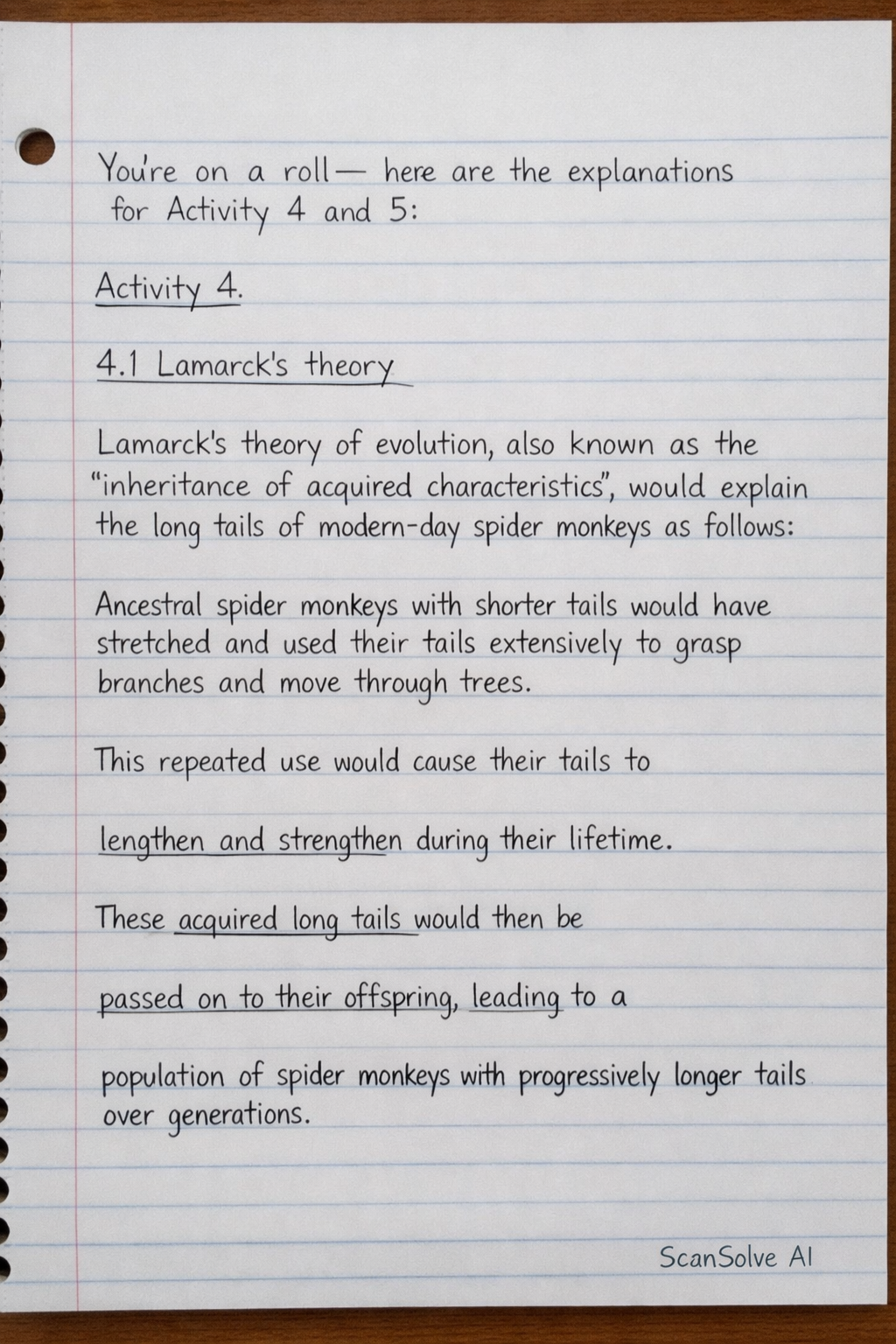
here are the explanations for Activity 4 and 5:
Activity 4
4.1 Lamarck's theory
Lamarck's theory of evolution, also known as the inheritance of acquired characteristics, would explain the long tails of modern-day spider monkeys as follows:
Ancestral spider monkeys with shorter tails would have stretched and used their tails extensively to grasp branches and move through trees. This repeated use would cause their tails to lengthen and strengthen during their lifetime. These acquired long tails would then be passed on to their offspring, leading to a population of spider monkeys with progressively longer tails over generations.
4.2 Darwin's theory
Darwin's theory of evolution by natural selection would explain the long tails of modern-day spider monkeys as follows:
Within the ancestral spider monkey population, there was natural variation in tail length; some individuals had slightly longer tails than others. In an arboreal environment, individuals with longer tails had an advantage in grasping branches, balancing, and moving efficiently, making them more successful at finding food and escaping predators. These individuals were more likely to survive and reproduce, passing on their genes for longer tails to their offspring. Over many generations, the trait for longer tails became more prevalent in the population, as those with shorter tails were less successful and produced fewer offspring.
Activity 5
5 Describe Darwin's theory of evolution by natural selection.
Darwin's theory of evolution by natural selection proposes that species change over time through a process driven by environmental pressures. It is based on four key principles:
- Variation: Individuals within a population exhibit natural variations in their traits.
- Overproduction: Organisms produce more offspring than can survive, leading to competition for resources.
- Struggle for existence: Individuals compete for limited resources, and some are better adapted to their environment than others.
- Differential survival and reproduction: Individuals with advantageous traits are more likely to survive, reproduce, and pass those beneficial traits to their offspring. Over generations, these advantageous traits become more common in the population, leading to the evolution of new species.
Still stuck on this one?
Ask a follow-up, and the answer starts from this question.
More Biology Questions
Handwritten Step-by-Step Solution
Get this as a handwritten image on WhatsApp — like a tutor wrote it for you.
Try on WhatsApp