
We read your photo as:
Use Darwin's theory of natural selection to explain the development of immunity to cancer in these wolves.
ScanSolve AI Answer
Step-by-step solution
18 stepsActivity 6
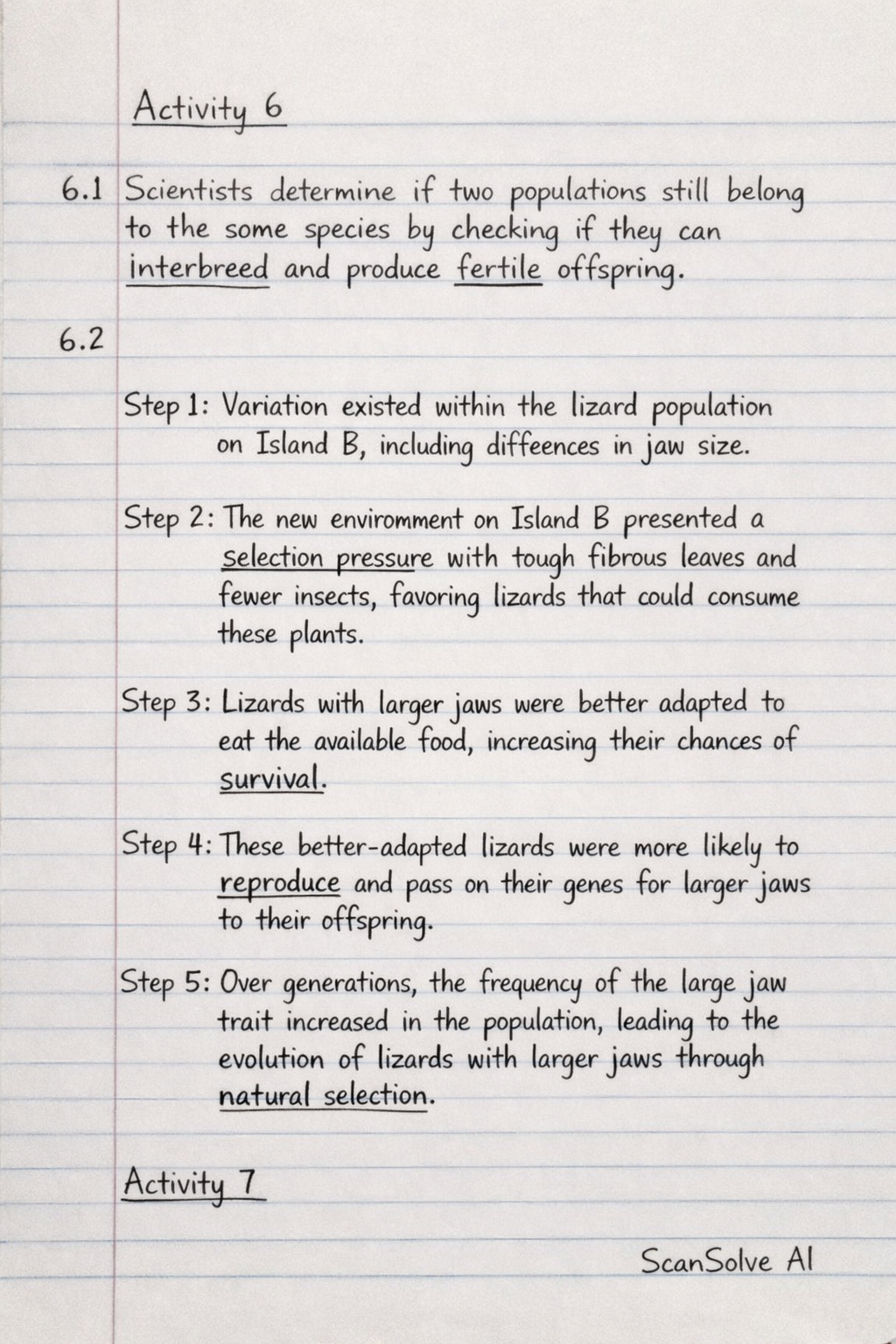
6.1 Scientists determine if two populations still belong to the same species by checking if they can interbreed and produce fertile offspring.
6.2
Variation* existed within the lizard population on Island B, including differences in jaw size.
The new environment on Island B presented a selection pressure with tough fibrous leaves and fewer insects, favoring lizards that could consume these plants.
Lizards with larger jaws were better adapted to eat the available food, increasing their chances of survival.
These better-adapted lizards were more likely to reproduce and pass on their genes for larger jaws to their offspring.
Over generations, the frequency of the large jaw trait increased in the population, leading to the evolution of lizards with larger jaws through natural selection.
Activity 7
Within the wolf population, there was natural variation in genetic resistance to cancer.
The high radiation in Chernobyl acted as a strong selection pressure, causing cancer in many wolves.
Wolves with genetic mutations providing immunity or resistance to cancer were more likely to survive the radiation exposure.
These surviving, immune wolves were able to reproduce and pass on their advantageous genes to their offspring.
Over time, the frequency of these genes for cancer immunity increased in the population, leading to the development of immunity to cancer through natural selection.
Activity 9
9.1
The common ancestor of pottos and lemurs existed when Africa and Madagascar were connected.
Continental drift* caused Madagascar to separate from the African mainland.
This geographical separation isolated populations of the common ancestor, leading to independent evolutionary paths on the two landmasses.
9.2
Geographical isolation* occurred when Madagascar drifted away from Africa, separating populations of the common ancestor.
This isolation prevented gene flow between the populations on the mainland and Madagascar.
Different environmental conditions and selection pressures on each landmass favored different traits.
Over long periods, natural selection acted differently on each population, leading to the accumulation of genetic differences.
Eventually, these differences resulted in reproductive isolation, meaning the populations could no longer interbreed, thus forming two distinct species
pottos in Africa and lemurs in Madagascar.
Activity 10
10.1
- Temporal isolation: Datura flowers open only in the evening, attracting nocturnal hawk moths and preventing pollination by diurnal pollinators.
- Pollinator specificity/Behavioral isolation: The addictive nectar ensures hawk moths stay longer and only visit Datura flowers, preventing pollen transfer to other plant species.
10.2
- Habitat isolation: Different plant species grow in different habitats, reducing the chance of interbreeding.
- Mechanical isolation: The physical structure of the flowers may prevent certain pollinators from accessing the reproductive parts, or pollen may not fit the stigma of another species.
Still stuck on this one?
Ask a follow-up, and the answer starts from this question.
More Biology Questions
Handwritten Step-by-Step Solution
Get this as a handwritten image on WhatsApp — like a tutor wrote it for you.
Try on WhatsApp