

This biology question covers important biological concepts and processes. The step-by-step explanation below helps you understand the underlying mechanisms and reasoning.
ScanSolve AI Answer
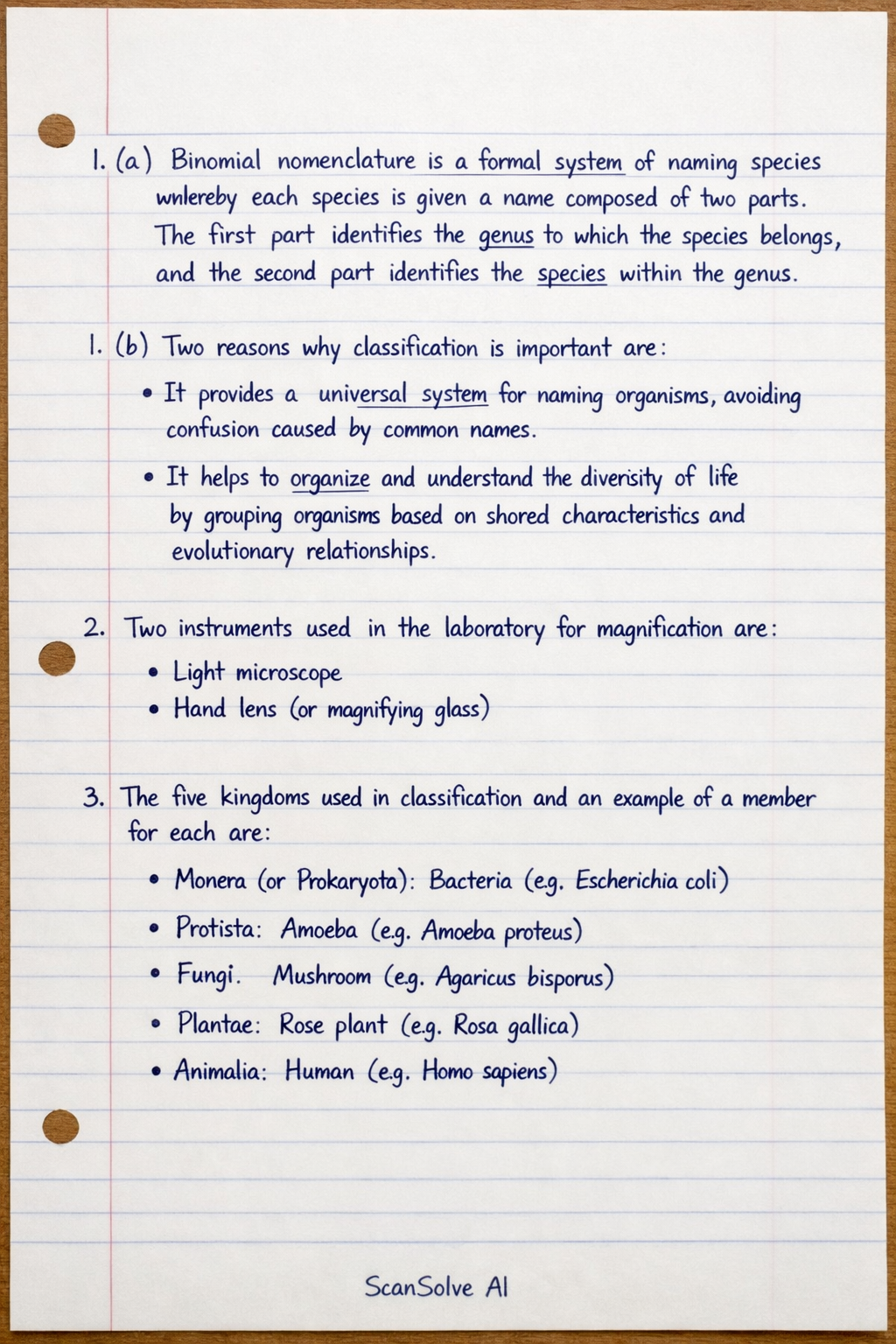
1. (a) Binomial nomenclature is a formal system of naming species whereby each species is given a name composed of two parts. The first part identifies the genus to which the species belongs, and the second part identifies the species within the genus. 1. (b) Two reasons why classification is important are: • It provides a universal system for naming organisms, avoiding confusion caused by common names. • It helps to organize and understand the diversity of life by grouping organisms based on shared characteristics and evolutionary relationships. 2. Two instruments used in the laboratory for magnification are: • Light microscope • Hand lens (or magnifying glass) 3. The five kingdoms used in classification and an example of a member for each are: • Monera (or Prokaryota): Bacteria (e.g., Escherichia coli) • Protista: Amoeba (e.g., Amoeba proteus) • Fungi: Mushroom (e.g., Agaricus bisporus) • Plantae: Rose plant (e.g., Rosa gallica) • Animalia: Human (e.g., Homo sapiens) 4. A species is defined as a group of organisms that can interbreed in nature to produce fertile offspring. They share common characteristics and are reproductively isolated from other such groups. 5. The formula for working out the magnification of a drawing of a specimen observed using a magnifying lens/hand lens is: Magnification = Length of drawingActual length of specimen 6. The scientific name of the dog is Canis familiaris. The name Canis refers to the Genus taxonomic group. 7. (a) The taxonomic group with more common characteristics among its members is the species. Organisms within the same species share the most specific traits. 7. (b) The taxonomic group that has the largest number of members is the Kingdom. As you move up the taxonomic hierarchy from species to kingdom, the number of members increases, while the shared characteristics become less specific. 8. Four principles used in binomial nomenclature are: • Each species name consists of two parts: the genus name and the species epithet. • The genus name is always capitalized, and the species epithet is always lowercase. • Both parts of the name are italicized when typed or underlined when handwritten. • The name is unique for each species. 9. The main differences between animals and plants are: • Cell wall: Plant cells have a cell wall made of cellulose, while animal cells do not. • Chloroplasts: Plant cells contain chloroplasts for photosynthesis, while animal cells do not. • Nutrition: Plants are autotrophic (produce their own food), while animals are heterotrophic (obtain food from external sources). • Movement: Most animals are motile (can move from place to place), while most plants are sessile (fixed in one place). • Growth: Plants exhibit indeterminate growth throughout their lives, while animals have determinate growth (growth stops after reaching a certain size). 10. (a) Reproduction: It is essential for the continuation of the species. Without reproduction, a species would eventually die out. 10. (b) Excretion: It is essential for removing metabolic waste products from the body. Accumulation of these toxic wastes can harm or kill the organism. 10. (c) Respiration: It is essential for releasing energy from food molecules. This energy is vital for all life processes, including growth, movement, and maintenance. 10. (d) Irritability (or sensitivity): It is essential for an organism to detect and respond to changes in its environment. This allows organisms to find food, avoid danger, and maintain homeostasis. 11. A jet aeroplane can move and oxidize fuel, but it is not classified as a living thing. Other characteristics of living things that are not shown by a jet aeroplane include: • Growth: Living things increase in size and complexity. • Reproduction: Living things produce offspring. • Nutrition: Living things take in and use nutrients for energy and growth. • Excretion: Living things remove waste products. • Sensitivity/Irritability: Living things respond to stimuli. • Respiration: Living things exchange gases to release energy from food. • Organization: Living things are made of cells and have a complex, organized structure. 12. (a) The organism most closely related to the wolf is the Red Fox. Reason: They both belong to the same Family, Canidae, and the same Order, Carnivora. The Red Fox's genus is Vulpes, which is distinct from the wolf's genus Canis, but they share a more recent common ancestor than with the other animals listed. 12. (b) The organism most distantly related to the wolf is the Fruit fly. Reason: The fruit fly belongs to the Phylum Arthropoda and Class Insecta, while the wolf belongs to Phylum Chordata and Class Mammalia. They share very few common taxonomic groups, indicating a distant evolutionary relationship.