

This biology question covers important biological concepts and processes. The step-by-step explanation below helps you understand the underlying mechanisms and reasoning.
ScanSolve AI Answer
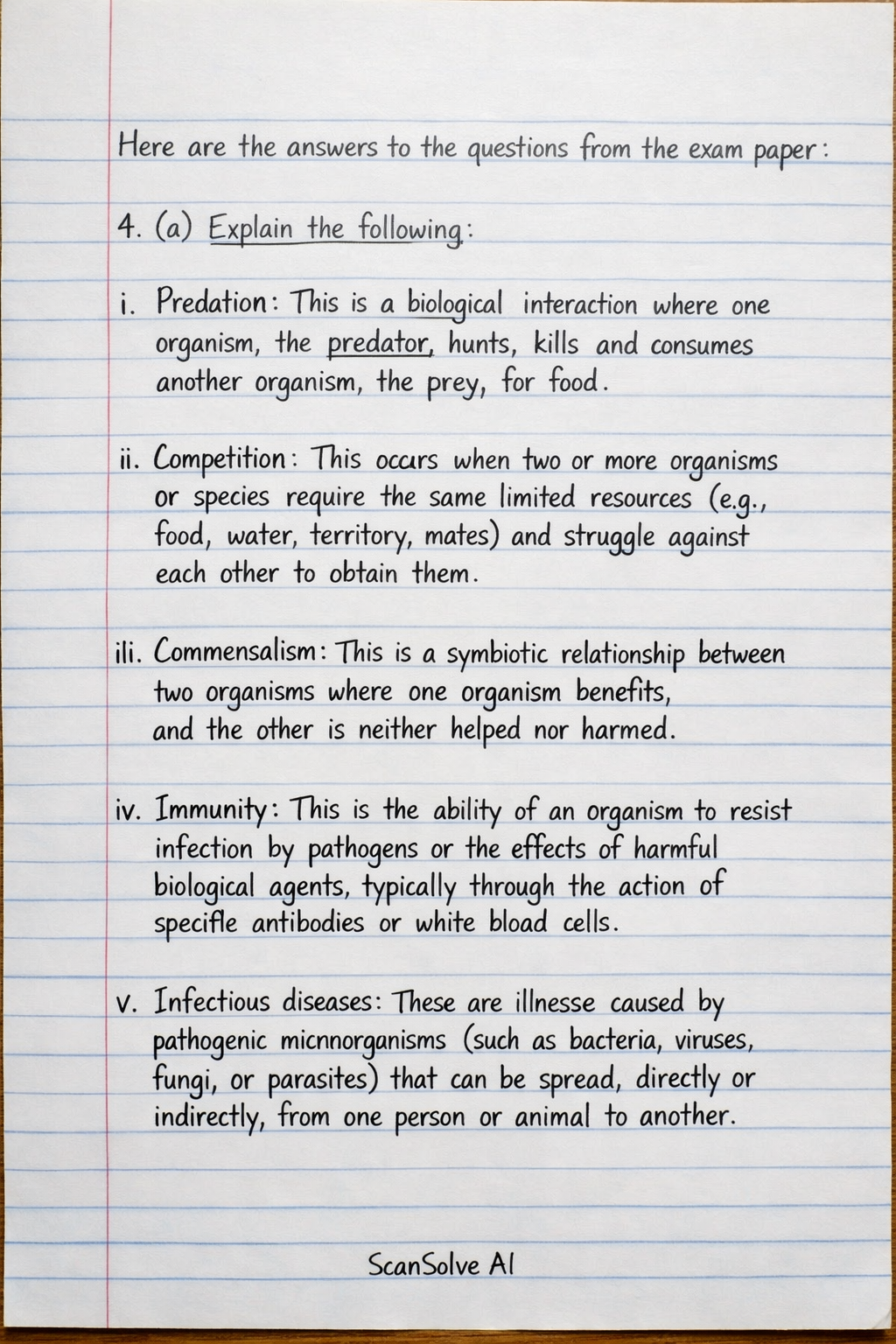
Here are the answers to the questions from the exam paper: 4. (a) Explain the following: i. Predation: This is a biological interaction where one organism, the predator, hunts, kills, and consumes another organism, the prey*, for food. ii. Competition: This occurs when two or more organisms or species require the same limited resources (e.g., food, water, territory, mates) and struggle against each other to obtain them. iii. Commensalism: This is a symbiotic relationship between two organisms where one organism benefits, and the other is neither helped nor harmed. iv. Immunity: This is the ability of an organism to resist infection by pathogens or the effects of harmful biological agents, typically through the action of specific antibodies or white blood cells. v. Infectious diseases: These are illnesses caused by pathogenic microorganisms (such as bacteria, viruses, fungi, or parasites) that can be spread, directly or indirectly, from one person or animal to another. 4. (b) Explain three DNA enzymes and list out 4 characteristics of DNA: DNA Enzymes: i. DNA Polymerase: This enzyme is primarily responsible for synthesizing new DNA strands by adding nucleotides one by one to a growing DNA chain, using an existing DNA strand as a template. It also has proofreading capabilities to correct errors. ii. DNA Ligase: This enzyme catalyzes the formation of phosphodiester bonds to join DNA fragments, particularly during DNA replication (joining Okazaki fragments) and DNA repair processes. iii. Helicase: This enzyme unwinds the double-stranded DNA helix by breaking the hydrogen bonds between complementary base pairs, separating the two strands to allow replication or transcription to occur. Characteristics of DNA: i. DNA is a double helix* structure, consisting of two polynucleotide strands coiled around a central axis. ii. It carries genetic information* in the sequence of its nitrogenous bases (Adenine, Guanine, Cytosine, Thymine). iii. The two strands are antiparallel*, meaning they run in opposite 5' to 3' directions. iv. The base pairing is complementary*: Adenine (A) always pairs with Thymine (T), and Guanine (G) always pairs with Cytosine (C). 5. (a) State the theory of spontaneous generation: The theory of spontaneous generation was an obsolete scientific theory which stated that living organisms could arise spontaneously and directly from non-living matter. For example, it was believed that maggots could arise from rotting meat or mice from grain and dirty rags. 5. (b) Differentiate between Gram positive and Gram-negative bacteria, giving TWO (2) examples each: | Feature | Gram-Positive Bacteria | Gram-Negative Bacteria | | :------------------ | :--------------------------------------------------- | :--------------------------------------------------- | | Cell Wall | Thick peptidoglycan layer | Thin peptidoglycan layer, with an outer membrane | | Teichoic Acids | Present | Absent | | LPS (Endotoxin) | Absent | Present in the outer membrane | | Staining | Retain crystal violet stain, appear purple | Do not retain crystal violet, appear pink/red | Examples: Gram-Positive: Staphylococcus aureus, Bacillus subtilis* Gram-Negative: Escherichia coli, Salmonella typhi* 5. (c) State the Koch's Postulates: Koch's Postulates are four criteria designed to establish a causal relationship between a microbe and a disease: i. The microorganism must be found in abundance in all organisms suffering from the disease, but should not be found in healthy organisms. ii. The microorganism must be isolated from a diseased organism and grown in pure culture. iii. The cultured microorganism should cause disease when introduced into a healthy organism. iv. The microorganism must be reisolated from the inoculated, diseased experimental host and identified as being identical to the original specific causative agent. 5. (d) State four examples of culture media used in growing bacteria in the laboratory: i. Nutrient Agar (NA)* ii. MacConkey Agar (MAC)* iii. Blood Agar (BA)* iv. Mannitol Salt Agar (MSA)* 5. (e) Explain bacterial growth curve: The bacterial growth curve illustrates the population dynamics of bacteria in a batch culture over time, typically divided into four phases: i. Lag Phase: Bacteria adapt to the new environment; little to no cell division occurs, but cells are metabolically active, synthesizing enzymes and molecules. ii. Log (Exponential) Phase: Cells divide rapidly at a constant rate, doubling in number at regular intervals. The population increases exponentially as resources are abundant. iii. Stationary Phase: The rate of cell division equals the rate of cell death. This occurs due to nutrient depletion, accumulation of toxic waste products, or limited space, leading to a plateau in population size. iv. Death (Decline) Phase: The number of viable cells decreases exponentially as the death rate exceeds the growth rate, often due to severe nutrient depletion and accumulation of toxic waste.