

This biology question covers important biological concepts and processes. The step-by-step explanation below helps you understand the underlying mechanisms and reasoning.
ScanSolve AI Answer
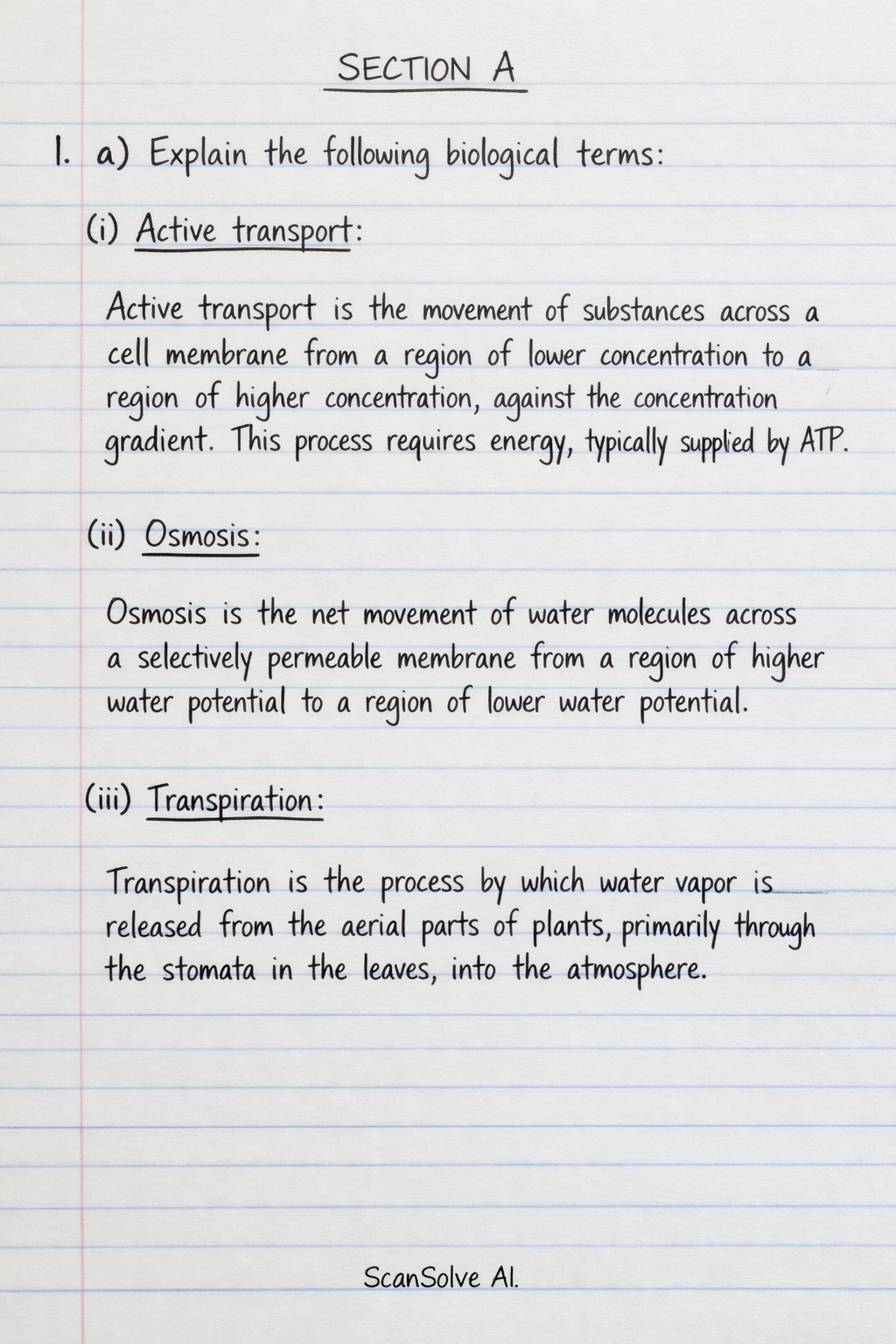
SECTION A 1. a) Explain the following biological terms: (i) Active transport: Active transport* is the movement of substances across a cell membrane from a region of lower concentration to a region of higher concentration, against the concentration gradient. This process requires energy, typically supplied by ATP. (ii) Osmosis: Osmosis* is the net movement of water molecules across a selectively permeable membrane from a region of higher water potential to a region of lower water potential. (iii) Transpiration: Transpiration* is the process by which water vapor is released from the aerial parts of plants, primarily through the stomata in the leaves, into the atmosphere. b) How does carbon circulate in nature? Carbon circulates through the carbon cycle. Atmospheric carbon dioxide (CO_2) is absorbed by plants during photosynthesis to produce organic compounds. Animals obtain carbon by consuming plants or other animals. Both plants and animals release CO_2 back into the atmosphere through respiration. When organisms die, decomposers break down their organic matter, releasing carbon into the soil and atmosphere. Additionally, the combustion of fossil fuels (formed from ancient organic matter) releases large amounts of CO_2 into the atmosphere. c) Describe an experiment to demonstrate diffusion using ink. Place a drop of ink carefully into a beaker of still water. Observe the ink over time. The ink will gradually spread out and mix with the water until the entire volume of water is uniformly colored. This demonstrates diffusion, as the ink particles move from a region of high concentration (where the ink drop was placed) to a region of lower concentration (the surrounding water) until they are evenly distributed. d) How is water important to Plants? Water is crucial for plants as it acts as a solvent for nutrients, allowing them to be transported throughout the plant. It is a reactant in photosynthesis, the process by which plants produce food. Water also maintains turgor pressure within plant cells, providing structural support and preventing wilting. Furthermore, water loss through transpiration helps to cool the plant and drives the upward movement of water and minerals from the roots. 2. a) What is excretion? Excretion is the biological process by which an organism eliminates metabolic waste products and excess substances from its body. b) How is urine produced in the kidney of man? Urine production in the kidney involves three main stages: 1. Ultrafiltration: Blood enters the glomerulus under high pressure, forcing water, salts, glucose, amino acids, and urea out of the capillaries and into Bowman's capsule, forming the glomerular filtrate. 2. Selective Reabsorption: As the filtrate passes through the renal tubules, essential substances like all glucose, most amino acids, some salts, and a significant amount of water are reabsorbed back into the blood capillaries. 3. Secretion: Additional waste products and excess ions (e.g., hydrogen ions, potassium ions, some drugs) are actively secreted from the blood into the renal tubule, further modifying the filtrate. The remaining fluid, now concentrated, is urine. c) State the activities that bring the body back to normal after the body suffer from dehydration? When the body is dehydrated, two main activities occur to restore normal water balance: The pituitary gland releases more Antidiuretic Hormone (ADH)*, which increases the permeability of the kidney tubules and collecting ducts to water, leading to greater water reabsorption and less water loss in urine. The sensation of thirst* is stimulated, prompting the individual to drink more water, thereby increasing water intake. d) Suggest two reasons why there is no excretory system in plants. 1. Plants generally produce less metabolic waste compared to animals because their metabolic rate is lower and they do not produce nitrogenous wastes like urea. 2. Many plant waste products are reused (e.g., carbon dioxide from respiration is used in photosynthesis) or stored in non-toxic forms within vacuoles or in parts that are shed, such as old leaves or bark. 3. a) What do you understand by each of the following terms as used in environmental Biology: (i) Population: A population* is a group of individuals of the same species living in the same geographical area at the same time, capable of interbreeding. (ii) Community: A community* consists of all the different populations of various species living and interacting within a particular area. (iii) Habitat: A habitat* is the natural environment or place where an organism or a population normally lives. b) How does energy flow in an ecosystem? Energy flow in an ecosystem is typically unidirectional, starting with the sun. Producers (e.g., plants) capture solar energy through photosynthesis and convert it into chemical energy. This energy is then transferred to primary consumers (herbivores) when they eat producers. Secondary consumers (carnivores) obtain energy by eating primary consumers, and so on up the food chain. At each trophic level, a significant portion of energy is lost as heat due to metabolic processes, and decomposers break down dead organic matter, releasing nutrients but dissipating the remaining energy. c) State the negative impact of air pollution. Air pollution has several negative impacts, including: Respiratory and cardiovascular diseases* in humans (e.g., asthma, bronchitis, heart attacks). Acid rain*, which damages forests, aquatic ecosystems, and infrastructure. Global warming and climate change* due to the accumulation of greenhouse gases. Damage to crops and vegetation, reducing agricultural yields. d) How can air pollution be prevented? Air pollution can be prevented by: Reducing the reliance on fossil fuels* by promoting renewable energy sources (solar, wind) and improving energy efficiency. Implementing stricter emission controls* for industries and vehicles, such as catalytic converters and scrubbers. Encouraging public transportation*, cycling, and walking to reduce vehicle emissions. Promoting afforestation* (planting trees) to absorb carbon dioxide and filter pollutants. SECTION B 4. a) Define the following terms used in genetics: *