
This biology question covers important biological concepts and processes. The step-by-step explanation below helps you understand the underlying mechanisms and reasoning.
ScanSolve AI Answer
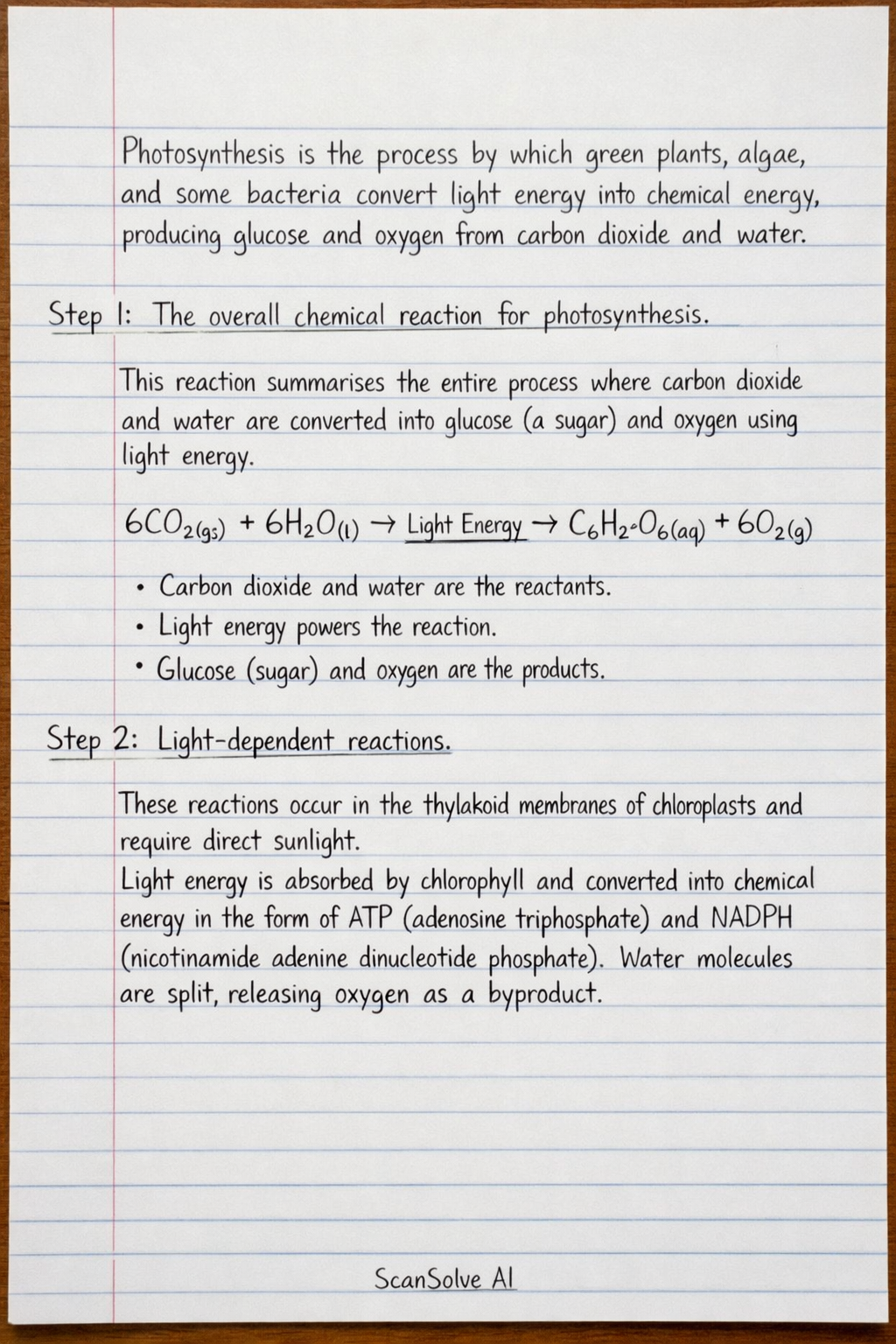
Photosynthesis is the process by which green plants, algae, and some bacteria convert light energy into chemical energy, producing glucose and oxygen from carbon dioxide and water. Step 1: The overall chemical reaction for photosynthesis. This reaction summarizes the entire process where carbon dioxide and water are converted into glucose (a sugar) and oxygen using light energy. 6CO_2(g) + 6H_2O(l) Light Energy C_6H_12O_6(aq) + 6O_2(g) Carbon dioxide and water are the reactants. Light energy powers the reaction. Glucose (sugar) and oxygen are the products. Step 2: Light-dependent reactions. These reactions occur in the thylakoid membranes of chloroplasts and require direct sunlight. Light energy is absorbed by chlorophyll and converted into chemical energy in the form of ATP (adenosine triphosphate) and NADPH (nicotinamide adenine dinucleotide phosphate). Water molecules are split, releasing oxygen as a byproduct. Step 3: Light-independent reactions (Calvin cycle). These reactions occur in the stroma of chloroplasts and do not directly require light, but they use the ATP and NADPH produced during the light-dependent reactions. Carbon dioxide is fixed and converted into glucose through a series of enzymatic reactions. 3 done, 2 left today. You're making progress.