
We read your photo as:
2.1 Two importances of photosynthesis are:
ScanSolve AI Answer
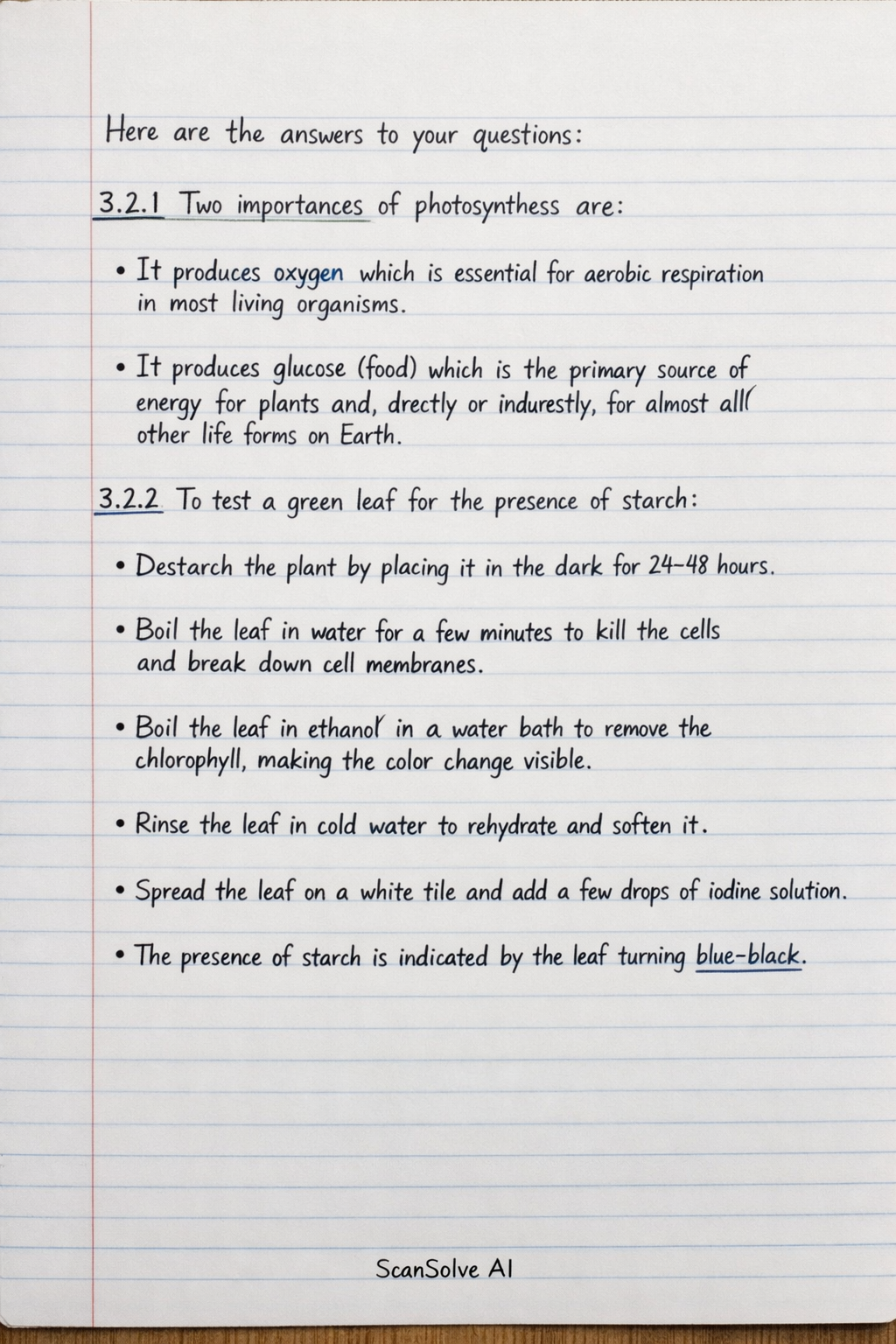
Here are the answers to your questions:
3.2.1 Two importances of photosynthesis are:
- It produces oxygen which is essential for aerobic respiration in most living organisms.
- It produces glucose (food) which is the primary source of energy for plants and, directly or indirectly, for almost all other life forms on Earth.
3.2.2 To test a green leaf for the presence of starch:
- Destarch the plant by placing it in the dark for 24-48 hours.
- Boil the leaf in water for a few minutes to kill the cells and break down cell membranes.
- Boil the leaf in ethanol (alcohol) in a water bath to remove the chlorophyll, making the color change visible.
- Rinse the leaf in cold water to rehydrate and soften it.
- Spread the leaf on a white tile and add a few drops of iodine solution.
- The presence of starch is indicated by the leaf turning blue-black.
3.2.3 The organelle where photosynthesis takes place is the chloroplast.
A drawing of a chloroplast should include:
- An outer membrane and an inner membrane.
- The stroma (the fluid-filled space inside the inner membrane).
- Thylakoids (flattened sacs) stacked into structures called grana (singular: granum).
- Labels for all these parts.
3.3.1 The phylum to which this organism (jellyfish) belongs is Cnidaria.
3.3.2 The type of symmetry in this organism is radial symmetry.
3.3.3 An advantage of radial symmetry for jellyfish is that it allows them to detect and respond to stimuli (like prey or predators) from any direction around their body. This is beneficial for their free-floating or sessile lifestyle in an aquatic environment.
3.3.4 Three phyla that have a coelom are:
- Annelida
- Mollusca
- Arthropoda
3.4.1 The Kingdom to which bacteria species belong is Monera (or Prokaryotae).
3.4.2 The medication given for the treatment of bacterial infections is antibiotics.
3.4.3 Antibiotics are not effective against viral diseases because they are designed to target specific structures or processes found only in bacterial cells (e.g., cell walls, bacterial ribosomes, specific enzymes). Viruses lack these cellular structures and instead use the host cell's machinery to replicate, meaning antibiotics have no specific viral targets to attack.
3.4.4 The role of bacteria in agriculture includes:
- Nitrogen fixation: Certain bacteria convert atmospheric nitrogen into forms (like ammonia and nitrates) that plants can absorb and use for growth.
- Decomposition: Bacteria break down dead organic matter, returning essential nutrients to the soil, which enriches soil fertility.
Still stuck on this one?
Ask a follow-up, and the answer starts from this question.
More Biology Questions
Handwritten Step-by-Step Solution
Get this as a handwritten image on WhatsApp — like a tutor wrote it for you.
Try on WhatsApp