
We read your photo as:
Explain the process of photosynthesis and its importance. Also, describe what enzymes are and how they function.
ScanSolve AI Answer
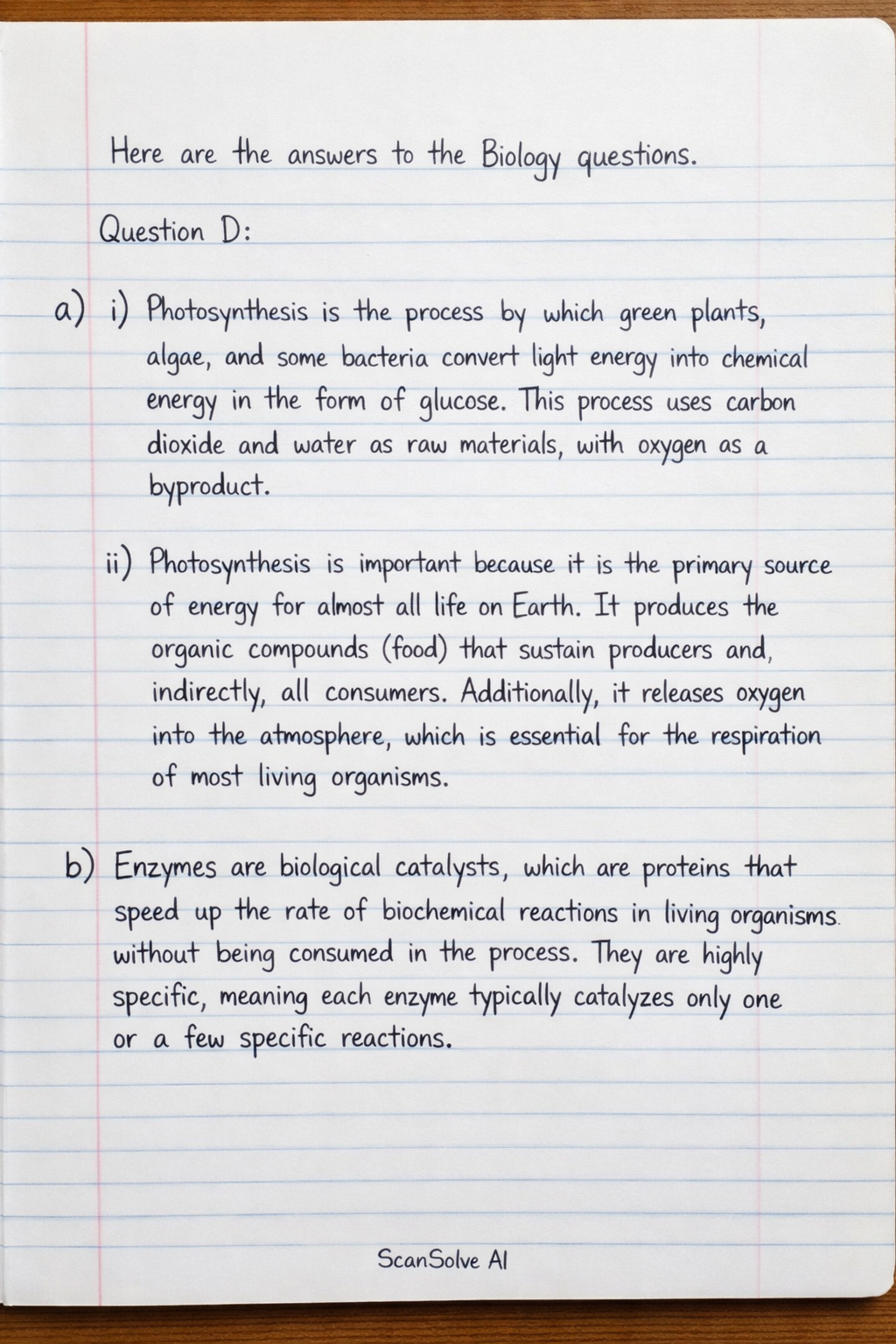
Here are the answers to the Biology questions.
Question D:
a)
i) Photosynthesis is the process by which green plants, algae, and some bacteria convert light energy into chemical energy, in the form of glucose. This process uses carbon dioxide and water as raw materials, with oxygen as a byproduct.
ii) Photosynthesis is important because it is the primary source of energy for almost all life on Earth. It produces the organic compounds (food) that sustain producers and, indirectly, all consumers. Additionally, it releases oxygen into the atmosphere, which is essential for the respiration of most living organisms.
b) Enzymes are biological catalysts, which are proteins that speed up the rate of biochemical reactions in living organisms without being consumed in the process. They are highly specific, meaning each enzyme typically catalyzes only one or a few specific reactions.
c) Enzymes work by binding to specific reactant molecules, called substrates, at a region known as the active site. This binding forms an enzyme-substrate complex, which lowers the activation energy required for the reaction to proceed, thereby increasing the reaction rate. After the reaction, the products are released, and the enzyme is free to catalyze another reaction. This mechanism is often described by the "lock and key" or "induced fit" model.
Still stuck on this one?
Ask a follow-up, and the answer starts from this question.
More Biology Questions
Handwritten Step-by-Step Solution
Get this as a handwritten image on WhatsApp — like a tutor wrote it for you.
Try on WhatsApp