
We read your photo as:
What is photosynthesis? State its importance. How does it differ from respiration? How do you test for protein using Biuret reagent?
ScanSolve AI Answer
Step-by-step solution
4 stepshere are the solutions to your homework problems.
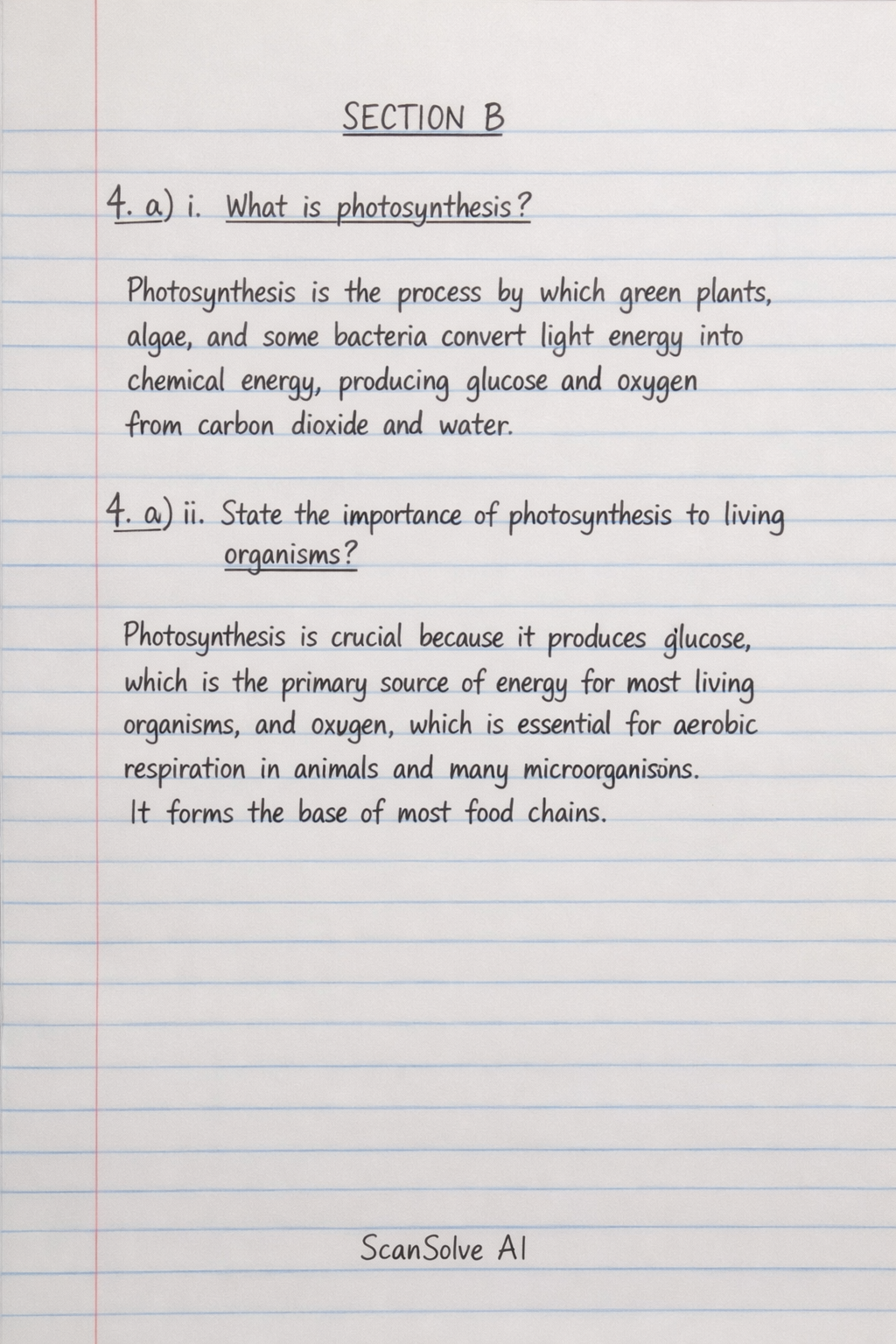
SECTION B
4. a) i. What is photosynthesis?
Photosynthesis is the process by which green plants, algae, and some bacteria convert light energy into chemical energy, producing glucose and oxygen from carbon dioxide and water.
4. a) ii. State the importance of photosynthesis to living organisms.
Photosynthesis is crucial because it produces glucose, which is the primary source of energy for most living organisms, and oxygen, which is essential for aerobic respiration in animals and many microorganisms. It forms the base of most food chains.
4. b) How is photosynthesis different from respiration?
- Photosynthesis uses carbon dioxide and water to produce glucose and oxygen, storing energy from sunlight. It occurs in chloroplasts.
- Respiration uses glucose and oxygen to produce carbon dioxide and water, releasing energy. It occurs in the cytoplasm and mitochondria.
- Photosynthesis is an anabolic process (builds molecules), while respiration is a catabolic process (breaks down molecules).
4. c) Using the Biuret reagent only, describe experimentally how you would test for the presence of protein in a food sample.
Prepare a solution of the food sample by crushing it and mixing it with a small amount of water.
Add an equal volume of Biuret reagent (which contains copper(II) sulfate and potassium hydroxide) to the food sample solution in a test tube.
Shake the test tube gently and observe the color change.
A purple or violet color indicates the presence of protein, while a blue color indicates its absence.
5. a) Define the following:
i. Reflex action: A reflex action is an involuntary, rapid, and automatic response of the body to a stimulus, without conscious thought.
ii. Reflex arc: A reflex arc is the neural pathway that mediates a reflex action, typically involving a sensory neuron, an interneuron (in the spinal cord), and a motor neuron.
iii. Tropism: Tropism is a growth response of a plant towards or away from an external stimulus, such as light (phototropism) or gravity (geotropism).5. b) Describe how movement is brought about at the elbow joint in the fore arm.
Movement at the elbow joint is brought about by the antagonistic action of the biceps and triceps muscles. When the biceps muscle (flexor) contracts, it pulls the forearm upwards, causing flexion at the elbow. Simultaneously, the triceps muscle (extensor) relaxes. Conversely, when the triceps muscle contracts, it pulls the forearm downwards, causing extension, while the biceps relaxes.5. c) How is the human skeleton adapted to perform its function?
The human skeleton is adapted for several functions:- Support: Bones provide a rigid framework that supports the body's weight and maintains its shape.
- Protection: Hard bones like the skull and rib cage protect vital internal organs from injury.
- Movement: Joints allow for articulation, and muscles attach to bones via tendons, enabling movement when muscles contract.
- Blood cell production: Bone marrow within certain bones produces red blood cells, white blood cells, and platelets.
- Storage: Bones store minerals like calcium and phosphorus.
6. a) What are the characteristics of insect pollinated flowers?
Insect-pollinated flowers typically have:- Large, brightly colored petals to attract insects.
- A strong scent to attract insects from a distance.
- Nectar guides (patterns on petals) to direct insects to the nectar.
- Nectar as a reward for pollinators.
- Sticky or spiky pollen grains that easily attach to insect bodies.
- Stamens and stigmas positioned inside the flower to brush against the insect.
6. b) Cell division is fundamental to the life cycle of a flowering plant.
i. Briefly explain the significance of mitosis in plant growth.
Mitosis is significant in plant growth because it produces genetically identical daughter cells, leading to an increase in cell number. This process is essential for the growth of roots, stems, and leaves, as well as for repairing damaged tissues and asexual reproduction.6. b) ii. Describe the process and importance of meiosis in the formation of gametes in flowering plants.
Meiosis is a type of cell division that occurs in the anthers (to form pollen grains containing male gametes) and ovules (to form embryo sacs containing female gametes) of flowering plants. It involves two rounds of division, resulting in four haploid daughter cells from a single diploid parent cell. Its importance lies in reducing the chromosome number by half (from diploid to haploid), ensuring that when male and female gametes fuse during fertilization, the resulting zygote has the correct diploid chromosome number. Meiosis also introduces genetic variation through crossing over and independent assortment.6. c) State how fertilization occurs in a flowering plant.
After pollination, a pollen grain lands on the stigma and germinates, forming a pollen tube. This pollen tube grows down through the style, guided by chemical signals, towards the ovule in the ovary. Two male gametes travel down the pollen tube. One male gamete fuses with the egg cell (ovum) to form a diploid zygote, which develops into the embryo. The other male gamete fuses with the central cell (containing two polar nuclei) to form the triploid endosperm, which provides nourishment for the developing embryo. This process is called double fertilization.6. d) How is water important in seed germination?
Water is crucial for seed germination because:- It allows the seed to imbibe (absorb) water, causing it to swell and rupture the seed coat, enabling the radicle to emerge.
- It activates enzymes within the seed, which break down stored food reserves (like starch and proteins) into soluble forms (sugars and amino acids) that the embryo can use for energy and growth.
- It acts as a transport medium for these dissolved nutrients to the growing embryo.
- It is essential for cell expansion and the turgidity required for the growth of the radicle and plumule.
7. a) Define the following terms as used in genetics:
i. Gene: A gene is a segment of DNA that carries the genetic information for a specific trait or protein. It is the basic unit of heredity.
ii. Mutation: A mutation is a permanent change in the DNA sequence of an organism's genome. These changes can be small (e.g., a single base pair change) or large (e.g., chromosomal rearrangements).
iii. Phenotype: The phenotype is the observable physical or biochemical characteristics of an organism, resulting from the interaction of its genotype with the environment.
iv. Monohybrid cross: A monohybrid cross is a genetic cross between two individuals that involves only one pair of contrasting traits (e.g., tall vs. short).7. b) Albinism is a genetic condition caused by a recessive allele that results in the absence of melanin pigment.
This is a statement providing information about albinism.
Still stuck on this one?
Ask a follow-up, and the answer starts from this question.
More Biology Questions
Handwritten Step-by-Step Solution
Get this as a handwritten image on WhatsApp — like a tutor wrote it for you.
Try on WhatsApp