
We read your photo as:
The graph below shows how the number of families of species has changed over time. The arrows indicate periods of mass extinctions.
ScanSolve AI Answer
Answer
Step-by-step solution
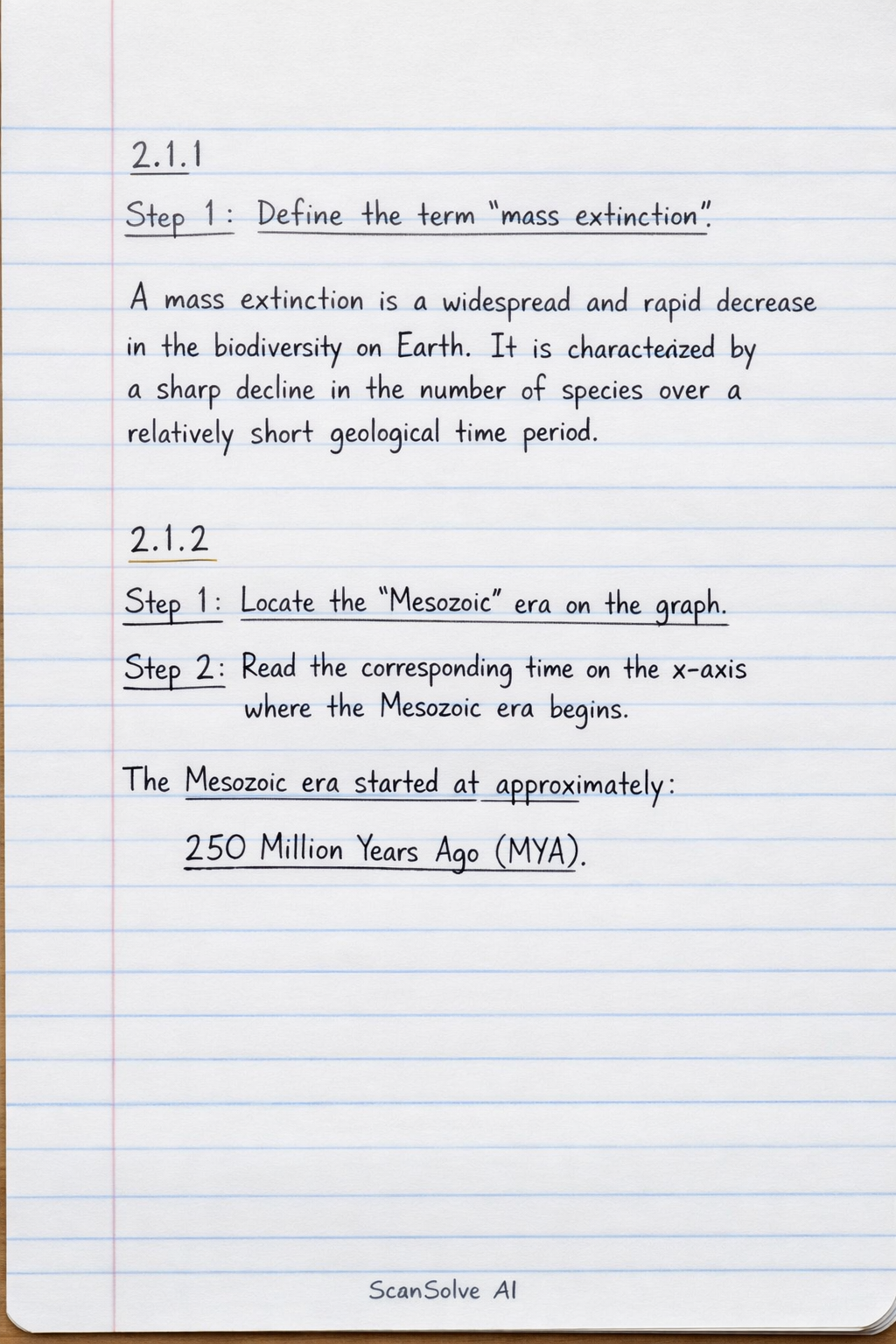
9 steps2.1.1
Define the term "mass extinction".
A mass extinction is a widespread and rapid decrease in the biodiversity on Earth. It is characterized by a sharp decline in the number of species over a relatively short geological time period.
2.1.2
Locate the "Mesozoic" era on the graph.
Read the corresponding time on the x-axis where the Mesozoic era begins.
The Mesozoic era started at approximately 250 Million Years Ago (MYA).
2.1.3
Identify the number of families before the mass extinction at the end of the Paleozoic era.
The Paleozoic era ends at the Permian (P) period.
Before the extinction (peak of Permian), the number of families was approximately 500.Identify the number of families after the mass extinction at the beginning of the Mesozoic era (Triassic, T).
After the extinction (trough of Triassic), the number of families was approximately 200.
Calculate the difference to find how many families died out.
2.1.4
Observe the trend of the graph after each downward arrow (indicating a mass extinction).
After each mass extinction, the number of families decreased sharply and then gradually increased over time.
2.1.5
Identify a natural cause that can lead to a mass extinction, as stated in the question.
The question states the 6th Mass Extinction is mainly caused by natural things. A significant natural cause of mass extinctions is large-scale volcanic eruptions.
2.1.6
Describe how large-scale volcanic eruptions threaten biodiversity and the natural environment.
Large-scale volcanic eruptions release massive amounts of ash and gases, such as sulfur dioxide and carbon dioxide, into the atmosphere. This can lead to a volcanic winter by blocking sunlight, causing global cooling and disrupting photosynthesis, which collapses food webs. Sulfur dioxide can also cause acid rain, damaging terrestrial and aquatic ecosystems. Increased carbon dioxide can lead to ocean acidification and global warming over longer periods, further stressing species and habitats. These combined effects lead to widespread habitat destruction, environmental changes that species cannot adapt to, and ultimately, mass extinctions.
Try one yourself
A new problem that tests the same skill.
Still stuck on this one?
Ask a follow-up, and the answer starts from this question.
More Biology Questions
Handwritten Step-by-Step Solution
Get this as a handwritten image on WhatsApp — like a tutor wrote it for you.
Try on WhatsApp