

This biology question covers important biological concepts and processes. The step-by-step explanation below helps you understand the underlying mechanisms and reasoning.
ScanSolve AI Answer
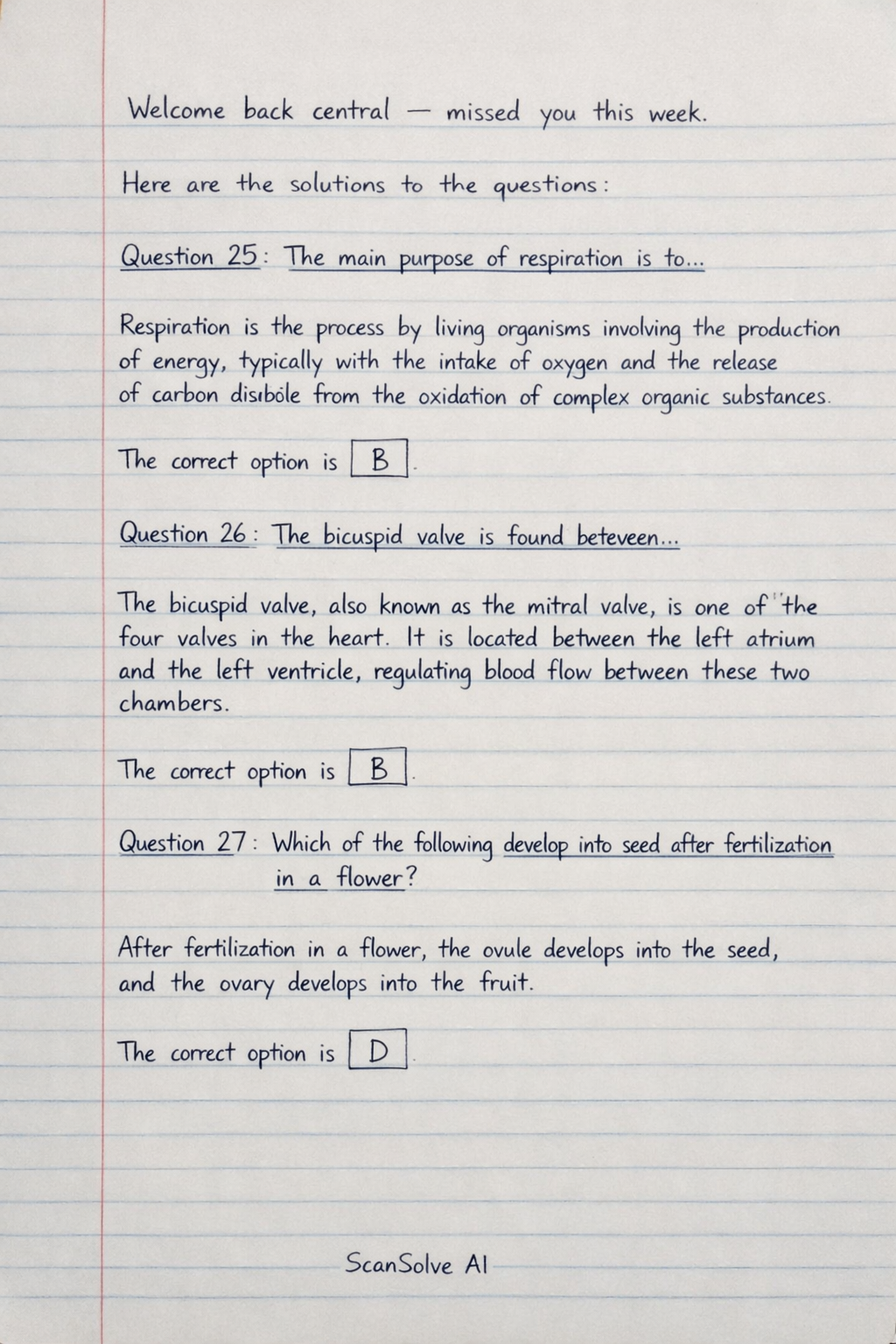
Here are the solutions to the questions: Question 25: The main purpose of respiration is to... Respiration is the process by living organisms involving the production of energy, typically with the intake of oxygen and the release of carbon dioxide from the oxidation of complex organic substances. The correct option is B. B Question 26: The bicuspid valve is found between... The bicuspid valve, also known as the mitral valve, is one of the four valves in the heart. It is located between the left atrium and the left ventricle, regulating blood flow between these two chambers. The correct option is B. B Question 27: Which of the following develop into seed after fertilization in a flower? After fertilization in a flower, the ovule develops into the seed, and the ovary develops into the fruit. The correct option is D. D Question 28: Which of the parts covers and protects the body of spirogyra? Spirogyra is a type of green algae that has a filamentous body covered by a protective layer of mucilage. The correct option is A. A Question 29: Which of the following is not a vitamin deficiency disease? Beri-beri (Vitamin B1 deficiency), Scurvy (Vitamin C deficiency), and Rickets (Vitamin D deficiency) are all diseases caused by a lack of specific vitamins. Kwashiorkor is a form of severe protein-energy malnutrition, not primarily a vitamin deficiency. The correct option is D. D Question 30: Which of the following is a tissue? A tissue is a group of similar cells that perform a specific function. Bone is a type of connective tissue. Sperm and egg are individual cells (gametes), and the heart is an organ composed of multiple tissues. The correct option is B. B Question 31: Which of the following sources of can be preserved by both canning and smoking? Meat is a food source that is commonly preserved using both canning (sealing in airtight containers) and smoking (exposing to smoke for flavor and preservation). The correct option is C. C Question 32: Which of the following tells that chemical change has occurred? A chemical change results in the formation of new substances with different properties. Rusting (the oxidation of iron) is a chemical change. Melting and changes in shape are physical changes. The correct option is C. C Question 33: Calculate the mass of an object which has a density of 100 kg/m^3 and volume of 8 m^3. Step 1: Recall the formula for mass, density, and volume. Mass (m) = Density () × Volume (V) Step 2: Substitute the given values. m = 100 kg/m^3 × 8 m^3 Step 3: Calculate the mass. m = 800 kg The calculated mass is 800 kg. This value is not among the provided options. 800 kg Question 34: A body of mass 225 kg has a volume of 15 m^3, calculate the density of the body. Step 1: Recall the formula for density. Density () = Mass (m)Volume (V) Step 2: Substitute the given values. = 225 kg15 m^3 Step 3: Calculate the density. = 15 kg/m^3 The correct option is A. A Question 35: Manjang lifted a stone of weight 100 N from a point 4 m using an effort of 25 N. Find the mechanical advantage. Step 1: Recall the formula for mechanical advantage (MA). Mechanical Advantage (MA) = LoadEffort Step 2: Substitute the given values for load and effort. MA = 100 N25 N Step 3: Calculate the mechanical advantage. MA = 4 The distance (4 m) is not needed to calculate mechanical advantage. The correct option is C. C Question 36: Which piece of equipment enables scientist to examine living cells? A compound microscope is commonly used by scientists to examine living cells, allowing for magnification of small biological specimens. The correct option is B. B Question 37: When solid turns into a liquid, it is said to... The process by which a substance changes from a solid state to a liquid state is called melting. The correct option is D. D Question 38: Which of the following metals rust easily? Rusting is a specific term for the corrosion of iron and its alloys (like steel) when exposed to oxygen and moisture. The correct option is C. C Question 39: In a plant cell, which of the following is found outside the cytoplasm? In a plant cell, the cell wall is a rigid outer layer that surrounds the cell membrane, thus being located outside the cytoplasm. The correct option is B. B Question 40: An element with atomic number 16 has a valency of... Step 1: Determine the electron configuration for an element with atomic number 16. Atomic number 16 means 16 protons and 16 electrons. Electron shells: • 1st shell: 2 electrons • 2nd shell: 8 electrons • 3rd shell: 6 electrons (valence electrons) Step 2: Determine the valency. Valency is the combining capacity of an element. To achieve a stable octet (8 electrons in the outermost shell), this element needs to gain 2 electrons. Therefore, its valency is 2. The correct option is B. B Question 41: The branch that deals with the study of the human mind is called... Psychology is the scientific study of the mind and behavior. The correct option is D. D Question 42: ...is the process that occur when a solid changes to a liquid. This question is a repeat of Question 37. The process of a solid changing to a liquid is melting. The correct option is A. A Question 43: The following are examples of birds except. An eel is a type of fish, while an owl, ostrich, and penguin are all birds. The correct option is B. B Question 44: Calculate the density of an object with volume 8 cm^3 and mass 20 g. Step 1: Recall the formula for density. Density () = Mass (m)Volume (V) Step 2: Substitute the given values. = 20 g8 cm^3 Step 3: Calculate the density. = 2.5 g/cm^3 The correct option is D. D Question 45: In the human eye, the part that controls the amount of light entering the eye is... The iris is the colored part of the eye that controls the size of the pupil, thereby regulating the amount of light that enters the eye. The correct option is A. A Question 46: Convert 100^ C to Fahrenheit. Step 1: Recall the formula for converting Celsius to Fahrenheit. F = C × (9)/(5) + 32 Step 2: Substitute the given Celsius temperature. F = 100 × (9)/(5) + 32 Step 3: Perform the calculation. F = (20 × 9) + 32 F = 180 + 32 F = 212^ F The correct option is C. C Question 47: Organisms that feed on both animals and plants are called... Omnivores are organisms whose diet consists of both plants and animals. The correct option is D. D Question 48: Which force do you experience in a car when the car suddenly stops? When a car suddenly stops, your body continues to move forward due to inertia, which is the tendency of an object to resist changes in its state of motion. The correct option is C. C Question 49: Tearing a paper is a good example of... Tearing paper changes its physical form (size and shape) but does not alter its chemical composition. This is a physical change. The correct option is A. A Question 50: Which of the following separation technique... The question is incomplete and cannot be answered. What's next? Send 'em! 📸