

This physics problem tests your understanding of fundamental physical laws and their applications. The step-by-step solution below breaks down the problem using relevant equations and physical reasoning.
ScanSolve AI Answer
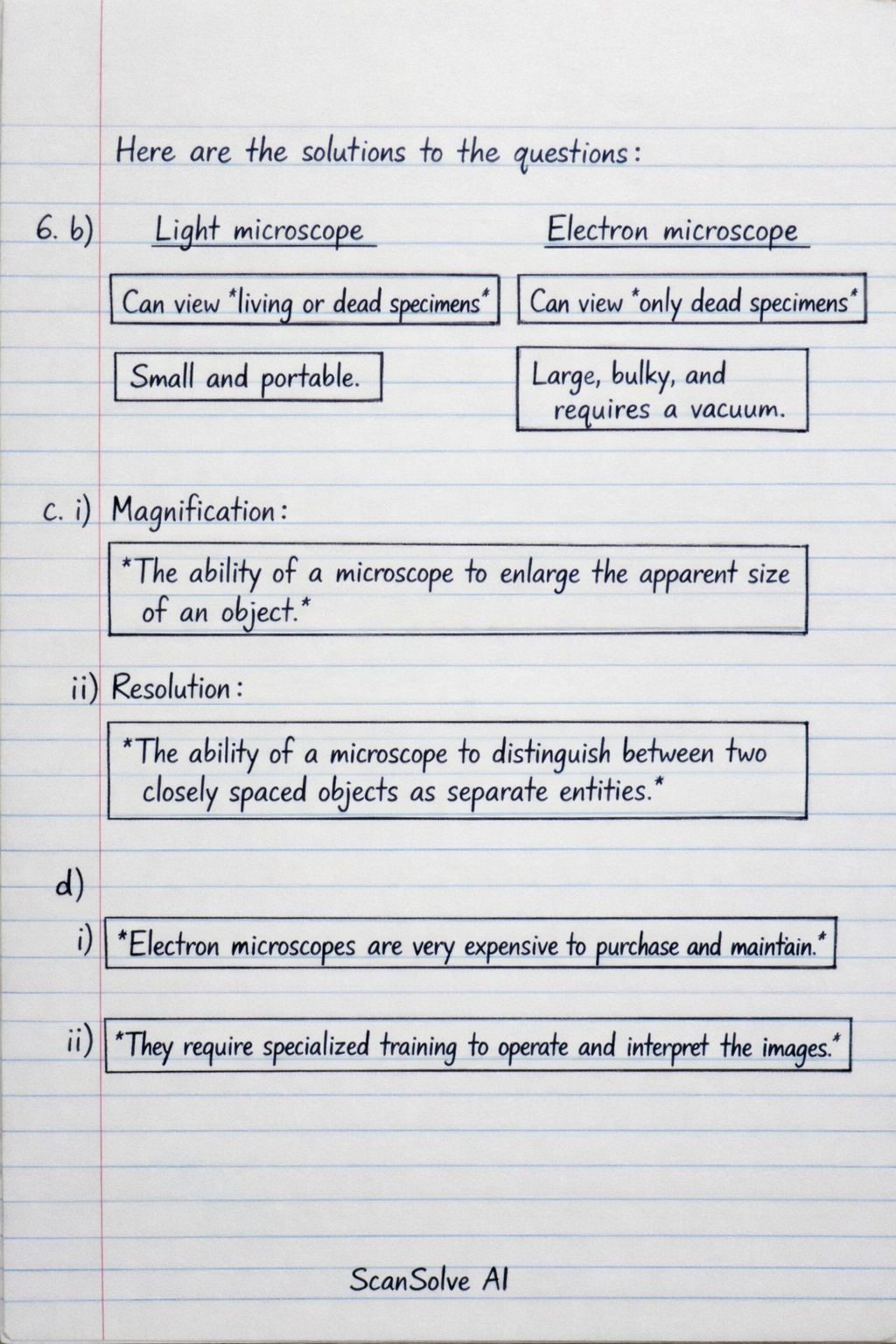
Here are the solutions to the questions: 6. b) | Light microscope | Electron microscope | | :------------------------------- | :------------------------------------------------ | | Can view living or dead specimens | Can view only dead specimens | | Small and portable | Large, bulky, and requires a vacuum | c) i) Magnification: The ability of a microscope to enlarge the apparent size of an object. ii) Resolution: The ability of a microscope to distinguish between two closely spaced objects as separate entities. d) i) Electron microscopes are very expensive to purchase and maintain. ii) They require specialized training to operate and interpret the images. 7. a) | specialized plant cell | specialized animal cell | | :--------------------- | :---------------------- | | n (Root hair cell) | m (Red blood cell) | | p (Guard cell) | o (Sperm cell) | b) i) Root hair cells have a long, narrow extension (root hair) that significantly increases the surface area for efficient absorption of water and mineral salts from the soil. ii) They have a thin cell wall and cell membrane, which allows for faster diffusion and osmosis of water and dissolved minerals into the cell. c) i) Nerve cells have a long axon that allows for the rapid transmission of electrical impulses over long distances throughout the body. ii) They possess numerous dendrites, which are branched extensions that increase the surface area for receiving signals from many other neurons or sensory receptors. Last free one today — make it count tomorrow, or type /upgrade for unlimited.