
We read your photo as:
State two functions of a microscope. (b) A cell magnified 800 times using a light microscope whose eye piece was x20. What was the magnification of the objective lens? 4. Name the gaseous exchange str
ScanSolve AI Answer
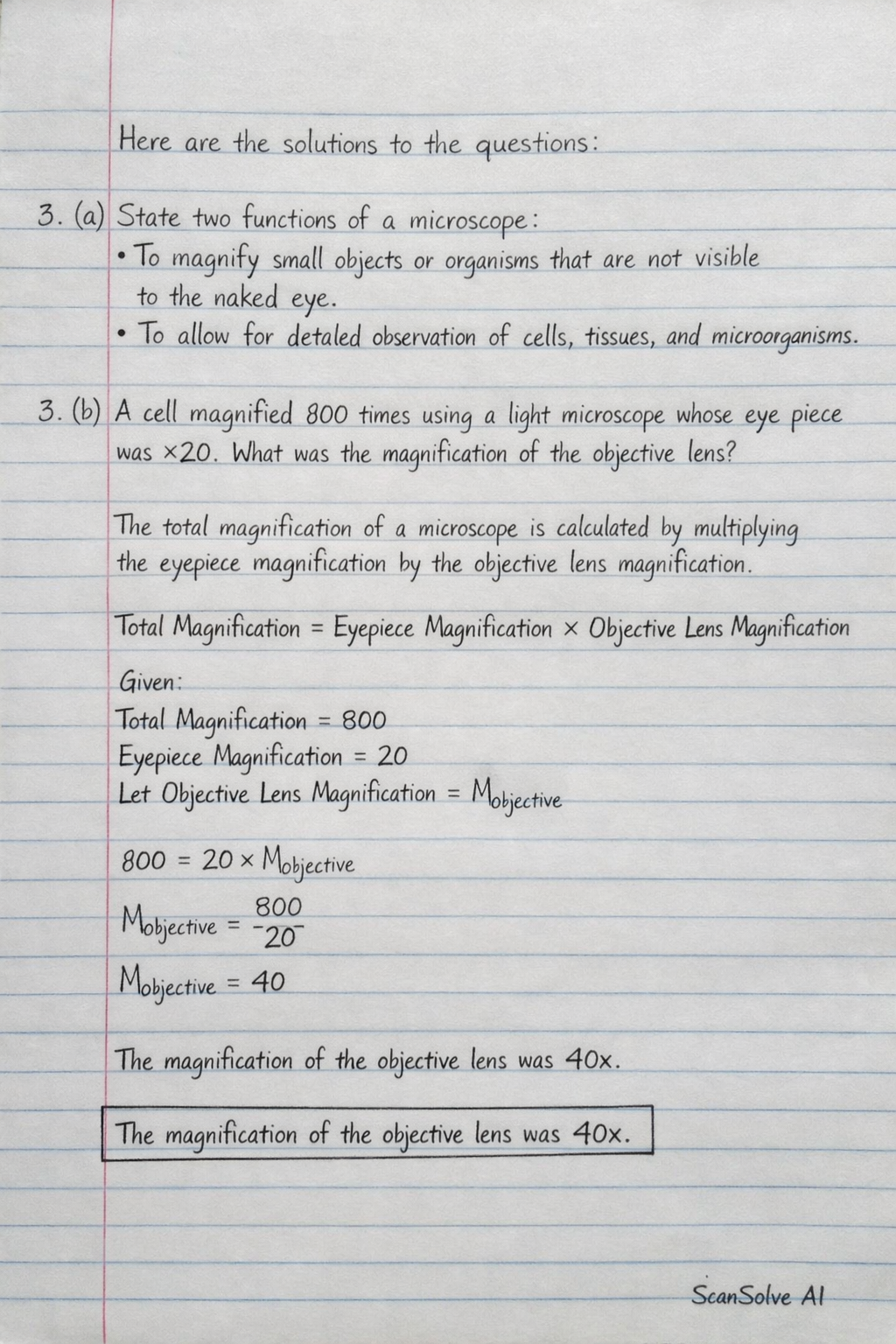
Here are the solutions to the questions:
3. (a) State two functions of a microscope.
- To magnify small objects or organisms that are not visible to the naked eye.
- To allow for detailed observation of cells, tissues, and microorganisms.
3. (b) A cell magnified 800 times using a light microscope whose eye piece was x20. What was the magnification of the objective lens?
The total magnification of a microscope is calculated by multiplying the eyepiece magnification by the objective lens magnification.
Given:
Total Magnification = 800
Eyepiece Magnification = 20
Let Objective Lens Magnification =
To find the objective lens magnification, divide the total magnification by the eyepiece magnification:
The magnification of the objective lens was 40x.
The magnification of the objective lens was .
4. Name the gaseous exchange structures in:
4. (a) Insects
Trachea and spiracles.
4. (b) Frogs
Skin, lungs, and buccal cavity lining.
5. A process that occurs in plants is represented by the equation below.
CHO (glucose) 2CHOH (ethanol) + 2CO (carbon (iv) Oxide) + Energy
5. (a) Name the process.
The process is alcoholic fermentation (or anaerobic respiration).
5. (b) State the economic importance of the process named in (a) above.
- It is used in the brewing industry for the production of alcoholic beverages like beer and wine.
- It is used in the baking industry for making bread rise due to the production of carbon dioxide.
- It is used in the production of biofuels such as ethanol.
6. Study the organelle below and answer the questions that follow.
The image shows a chloroplast. However, the specific questions that follow for this organelle are not visible in the provided image.
Unlabeled Question (b) Name one defect of the circulatory system in humans.
Hypertension (high blood pressure). Other examples include atherosclerosis, heart attack, stroke, and anemia.
12. Form One student set up an experiment shown below to investigate a certain physiological process. The set up was left for 30 minutes.
12. (a) Name the process under study.
The process under study is osmosis.
12. (b) State the expected results after 30 minutes.
The Visking tubing will swell and become turgid, and the volume of the sucrose solution inside will increase. The level of distilled water in the beaker will decrease slightly.
12. (c) Explain your answer in (b) above.
The Visking tubing acts as a partially permeable membrane. The sucrose solution inside the tubing has a lower water potential (higher solute concentration) compared to the distilled water outside, which has a higher water potential. Due to this water potential gradient, water molecules move by osmosis from the region of higher water potential (distilled water) to the region of lower water potential (sucrose solution) across the partially permeable membrane. This net movement of water into the Visking tubing causes it to swell.
Still stuck on this one?
Ask a follow-up, and the answer starts from this question.
More Biology Questions
Handwritten Step-by-Step Solution
Get this as a handwritten image on WhatsApp — like a tutor wrote it for you.
Try on WhatsApp