
We read your photo as:
Explain photosynthesis, its importance, how it differs from respiration, and how to test for protein using Biuret reagent.
ScanSolve AI Answer
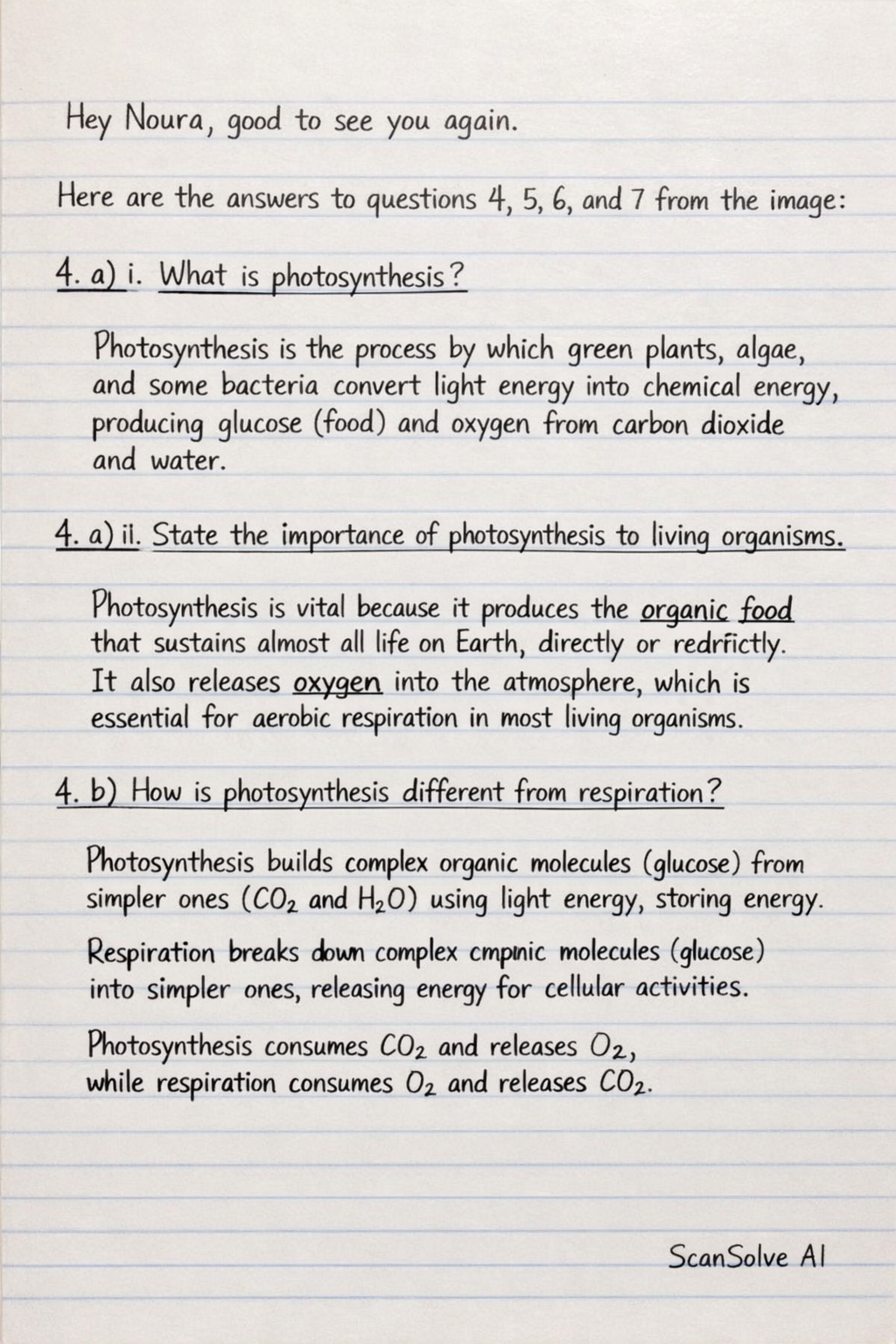
Here are the answers to questions 4, 5, 6, and 7 from the image:
4. a) i. What is photosynthesis?
Photosynthesis is the process by which green plants, algae, and some bacteria convert light energy into chemical energy, producing glucose (food) and oxygen from carbon dioxide and water.
4. a) ii. State the importance of photosynthesis to living organisms.
Photosynthesis is vital because it produces the organic food that sustains almost all life on Earth, directly or indirectly. It also releases oxygen into the atmosphere, which is essential for aerobic respiration in most living organisms.
4. b) How is photosynthesis different from respiration?
Photosynthesis builds complex organic molecules (glucose) from simpler ones (CO₂ and H₂O) using light energy, storing energy. Respiration breaks down complex organic molecules (glucose) into simpler ones, releasing energy for cellular activities. Photosynthesis consumes CO₂ and releases O₂, while respiration consumes O₂ and releases CO₂.
4. c) Using the Biuret reagent only, describe experimentally how you would test for the presence of protein in a food sample.
To test for protein using Biuret reagent:
- Place a small amount of the food sample into a test tube. If solid, crush it and add a little water to make a suspension.
- Add a few drops of Biuret reagent (which contains copper sulfate and potassium hydroxide) to the test tube.
- Shake gently and observe the color change. A purple or violet color indicates the presence of protein. A blue color indicates no protein.
5. a) Define the following:
- i. Reflex action: A reflex action is a rapid, involuntary, and automatic response to a stimulus that does not involve conscious thought.
- ii. Reflex arc: A reflex arc is the neural pathway that mediates a reflex action, typically involving a sensory neuron, an interneuron (in some cases), and a motor neuron.
- iii. Tropism: Tropism is a growth movement of a plant in response to an external stimulus, where the direction of growth is determined by the direction of the stimulus.
5. b) Describe how movement is brought about at the elbow joint in the fore arm.
Movement at the elbow joint, a hinge joint, is brought about by the antagonistic action of muscles. The biceps brachii muscle (flexor) contracts to bend (flex) the arm, while the triceps brachii muscle (extensor) relaxes. To straighten (extend) the arm, the triceps contracts, and the biceps relaxes. These muscles are attached to the bones (humerus, ulna, radius) via tendons, pulling on them to create movement.
5. c) How is the human skeleton adapted to perform its function?
The human skeleton is adapted for its functions in several ways:
- Support: Its rigid structure provides a framework that supports the body against gravity.
- Protection: Bones like the skull and rib cage enclose and protect vital organs.
- Movement: Joints allow for a wide range of motion, and muscles attach to bones to facilitate movement.
- Blood cell production: Bone marrow within certain bones produces blood cells.
- Mineral storage: Bones store essential minerals like calcium and phosphorus.
6. a) What are the characteristics of insect pollinated flowers?
Insect-pollinated flowers typically have:
- Large, brightly colored petals to attract insects.
- Scent to attract insects.
- Nectaries that produce nectar as a reward.
- Sticky or spiky pollen grains that easily attach to insect bodies.
- Stamens and stigmas positioned inside the flower to brush against insects.
6. b) Cell division is fundamental to the life cycle of a flowering plant.
- i. Briefly explain the significance of mitosis in plant growth. Mitosis is significant in plant growth because it produces genetically identical daughter cells, allowing for the increase in cell number necessary for the plant to grow in size, develop new tissues, and repair damaged parts.
- ii. Describe the process and importance of meiosis in the formation of gametes in flowering plants. Meiosis is a cell division process that produces four haploid cells (gametes) from a single diploid cell. In flowering plants, it occurs in the anthers to form pollen grains (male gametes) and in the ovules to form egg cells (female gametes). Its importance lies in halving the chromosome number to maintain a constant chromosome count across generations and in introducing genetic variation through crossing over.
6. c) State how fertilization occurs in a flowering plant.
Fertilization in a flowering plant occurs when a pollen grain lands on the stigma, germinates to form a pollen tube, which grows down through the style to the ovule. The male gametes (sperm nuclei) travel down the pollen tube, and one fuses with the egg cell (forming a zygote) and another fuses with the central cell (forming the endosperm), a process called double fertilization.
6. d) How is water important in seed germination?
Water is crucial for seed germination because it activates enzymes within the seed that break down stored food reserves (e.g., starch, proteins) into usable forms. It also softens the seed coat, allowing the embryo to emerge, and provides the necessary turgor pressure for the radicle to break through the seed coat and for cell expansion.
7. a) Define the following terms as used in genetics:
- i. Gene: A gene is a segment of DNA that carries the genetic information for a specific trait or protein.
- ii. Mutation: A mutation is a permanent change in the DNA sequence of an organism's genome.
- iii. Phenotype: The phenotype is the observable physical or biochemical characteristics of an organism, resulting from the interaction of its genotype with the environment.
- iv. Monohybrid cross: A monohybrid cross is a genetic cross between two individuals that involves only one pair of contrasting traits.
7. b) Albinism is a genetic condition caused by a recessive allele that results in the absence of melanin pigment.
This statement defines albinism as a genetic condition caused by a recessive allele, leading to a lack of melanin pigment.
Still stuck on this one?
Ask a follow-up, and the answer starts from this question.
More Biology Questions
Handwritten Step-by-Step Solution
Get this as a handwritten image on WhatsApp — like a tutor wrote it for you.
Try on WhatsApp