
We read your photo as:
Explain the following terms related to seed physiology and plant propagation: Viviparous seeds, Stratification, Apomixis, In vitro culture systems, Orthodox seeds, Cryopreservation.
ScanSolve AI Answer
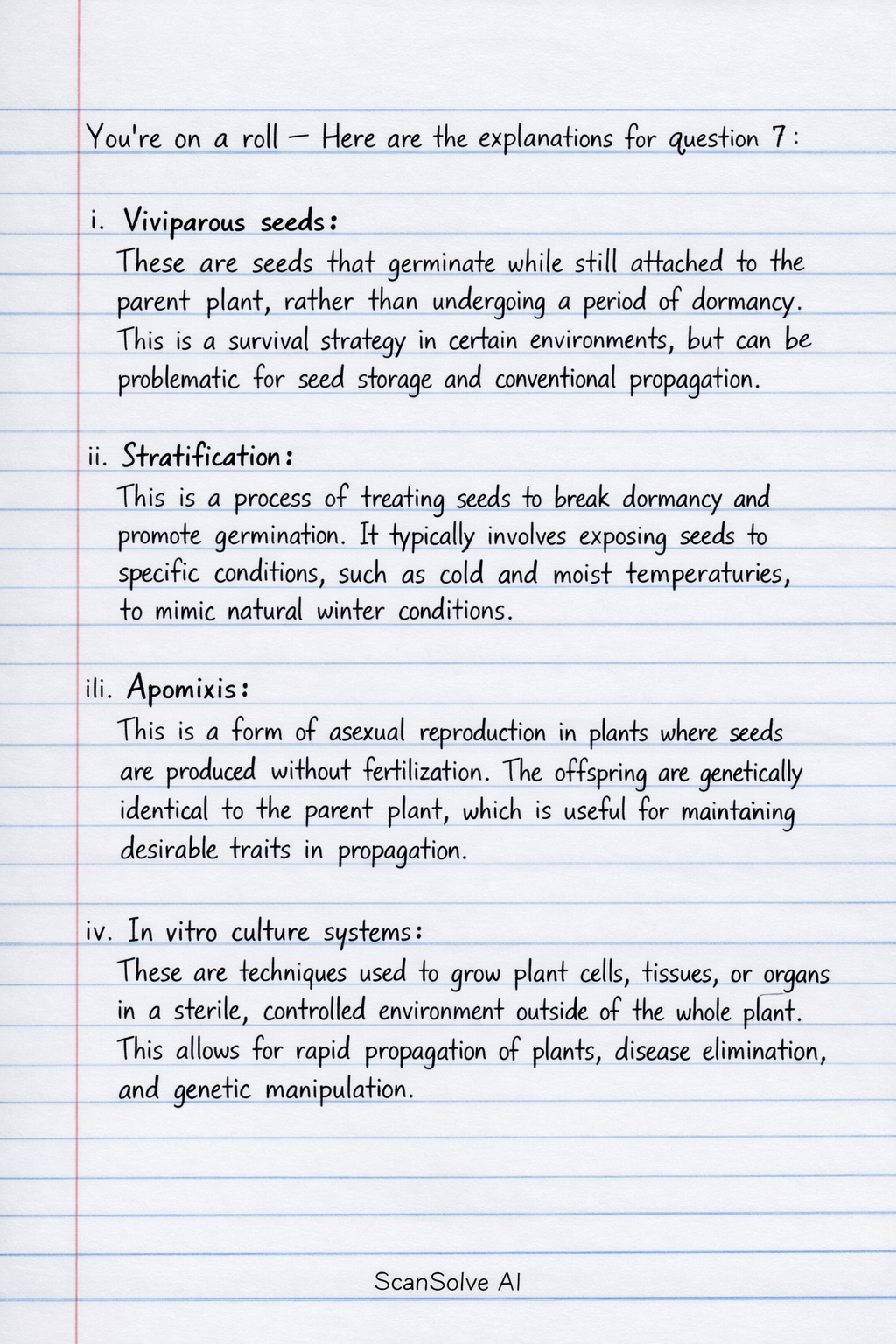
Here are the explanations for question 7:
i. Viviparous seeds: These are seeds that germinate while still attached to the parent plant, rather than undergoing a period of dormancy. This is a survival strategy in certain environments, but can be problematic for seed storage and conventional propagation.
ii. Stratification: This is a process of treating seeds to break dormancy and promote germination. It typically involves exposing seeds to specific conditions, such as cold and moist temperatures, to mimic natural winter conditions.
iii. Apomixis: This is a form of asexual reproduction in plants where seeds are produced without fertilization. The offspring are genetically identical to the parent plant, which is useful for maintaining desirable traits in propagation.
iv. In vitro culture systems: These are techniques used to grow plant cells, tissues, or organs in a sterile, controlled environment outside of the whole plant. This allows for rapid propagation of plants, disease elimination, and genetic manipulation.
v. Orthodox seeds: These are seeds that can tolerate drying to low moisture content (typically 5-10%) and can be stored at low temperatures for extended periods without losing viability. Most crop seeds are orthodox, making long-term seed banking possible.
vi. Cryopreservation: This is a method of preserving plant genetic material (like seeds, pollen, or tissue cultures) by storing it at ultra-low temperatures, typically in liquid nitrogen (). It's used for long-term conservation of valuable plant germplasm.
vii. Greenhouses: These are structures, typically made of transparent materials like glass or plastic, that provide a controlled environment for growing plants. They protect plants from adverse weather and allow for manipulation of temperature, humidity, and light for optimal growth and propagation.
viii. Parthenocarpy: This is the natural or artificially induced production of fruit without fertilization of ovules, resulting in seedless fruits. While not directly a propagation method, it's a desirable trait in many cultivated fruits, often achieved through hormonal treatments.
ix. Scarification: This is a process of weakening, opening, or breaking the hard outer seed coat to allow water and oxygen to penetrate, thereby breaking seed dormancy and promoting germination. It can be done mechanically, chemically, or by hot water treatment.
Still stuck on this one?
Ask a follow-up, and the answer starts from this question.
More Biology Questions
Handwritten Step-by-Step Solution
Get this as a handwritten image on WhatsApp — like a tutor wrote it for you.
Try on WhatsApp