
We read your photo as:
Define a food group, classify food groups with their main nutrients, and describe fat-soluble vitamins (functions, deficiency diseases) and the role of Vitamin C.
ScanSolve AI Answer
SECTION A
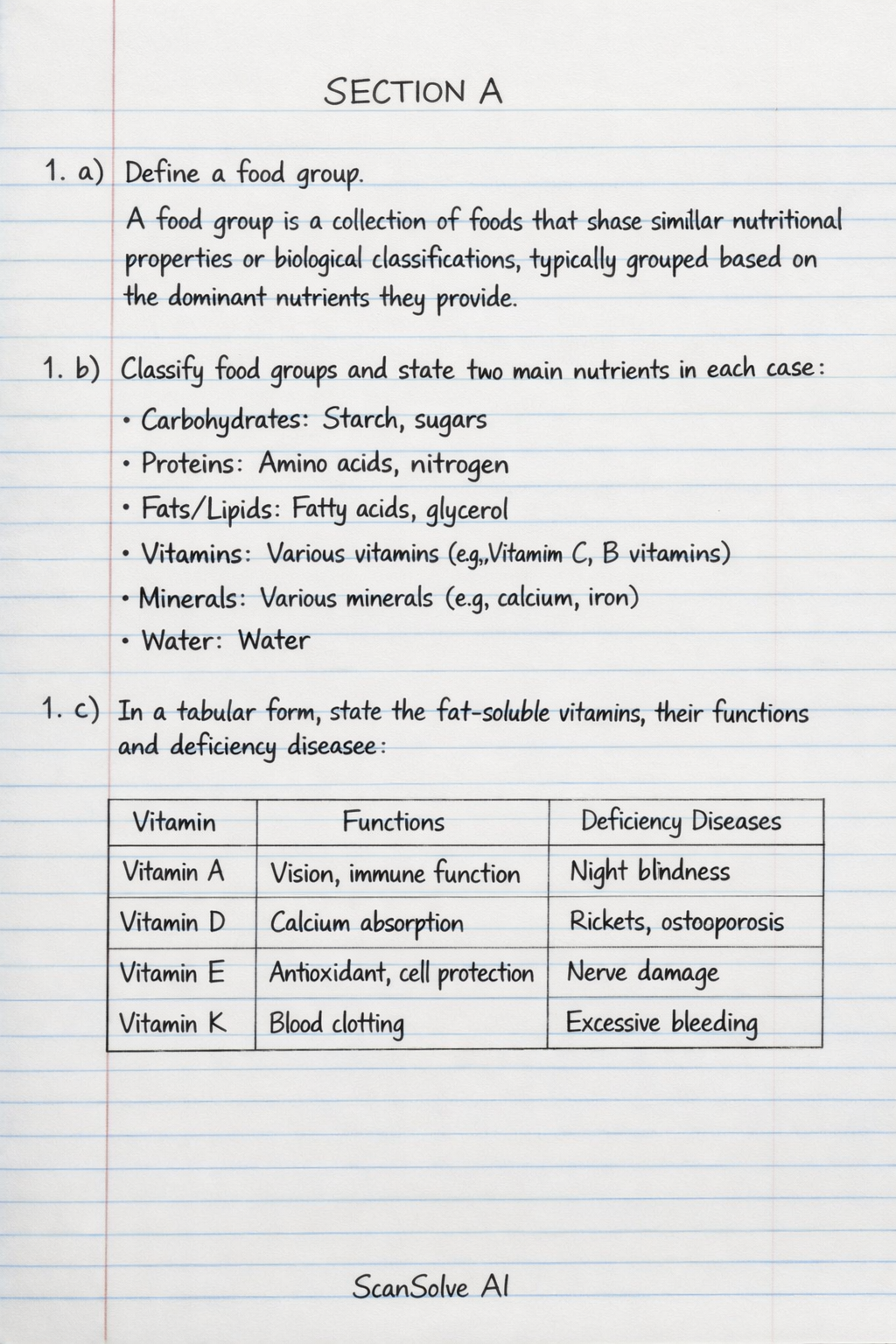
1. a) Define a food group
A food group is a collection of foods that share similar nutritional properties or biological classifications, typically grouped based on the dominant nutrients they provide.
1. b) Classify food groups and state two main nutrients in each case
- Carbohydrates: Starch, sugars
- Proteins: Amino acids, nitrogen
- Fats/Lipids: Fatty acids, glycerol
- Vitamins: Various vitamins (e.g., Vitamin C, B vitamins)
- Minerals: Various minerals (e.g., calcium, iron)
- Water: Water
1. c) In a tabular form, state the fat-soluble vitamins, their functions and deficiency diseases.
| Fat-Soluble Vitamin | Function | Deficiency Disease |
|---|---|---|
| Vitamin A | Vision, immune function, cell growth | Night blindness, xerophthalmia |
| Vitamin D | Calcium absorption, bone health | Rickets (children), osteomalacia (adults) |
| Vitamin E | Antioxidant, protects cells | Nerve damage, muscle weakness |
| Vitamin K | Blood clotting, bone metabolism | Hemorrhage, impaired clotting |
1. d) State the role of vitamin C in the body.
Vitamin C is crucial for the formation of collagen, a protein essential for skin, tendons, ligaments, and blood vessels. It also aids in iron absorption, supports the immune system, and acts as an antioxidant to protect cells from damage.
2. a) Describe the structure of amino acid.
An amino acid consists of a central carbon atom (alpha-carbon) bonded to four distinct groups: an amino group (), a carboxyl group (), a hydrogen atom (), and a variable side chain (R-group). The R-group determines the specific properties of each amino acid.
2. b) Differentiate between essential and non-essential amino acids giving four examples of each.
- Essential amino acids: These cannot be synthesized by the human body and must be obtained through the diet.
- Examples: Leucine, Lysine, Methionine, Valine.
- Non-essential amino acids: These can be synthesized by the human body from other amino acids or precursors.
- Examples: Alanine, Asparagine, Glycine, Serine.
2. c) Mention four advantages and four disadvantages of the food composition.
Advantages of a balanced food composition:
- Provides energy for daily activities and metabolic processes.
- Supports growth and repair of tissues.
- Ensures proper immune function and disease prevention.
- Maintains organ function and overall physiological balance.
Disadvantages of an unbalanced food composition:
- Leads to nutrient deficiencies or excesses.
- Contributes to obesity and related metabolic disorders.
- Increases risk of chronic diseases like heart disease and diabetes.
- Can cause digestive problems.
2. d) Discuss the effects of heat on carbohydrates.
Heat causes several changes in carbohydrates:
- Gelatinization: Starch granules absorb water and swell when heated in liquid, leading to thickening.
- Dextrinization: Dry heat breaks down starch into smaller, sweeter dextrins, causing browning.
- Caramelization: Sugars, when heated to high temperatures, undergo chemical reactions that result in browning and new flavor compounds.
- Maillard reaction: Sugars and amino acids react under heat to produce brown pigments and distinct flavors.
SECTION B
3. a) Define the following terms as used in digestion: ingestion, absorption, assimilation.
- Ingestion: The process of taking food, drink, or other substances into the body by swallowing.
- Absorption: The process by which digested food molecules (nutrients) pass through the walls of the small intestine into the bloodstream or lymphatic system.
- Assimilation: The process by which absorbed nutrients are taken up by cells and converted into new protoplasm or used for energy, growth, and repair.
3. b) State the functions of hydrochloric acid in digestion.
- Denatures proteins, making them more accessible to enzymes.
- Activates pepsinogen into active pepsin, initiating protein digestion.
- Kills most microorganisms ingested with food, preventing infections.
- Provides the optimal acidic pH for pepsin's activity.
3. c) How is the ileum adapted to the process of absorption?
The ileum is highly adapted for absorption due to:
- Its long length, providing ample time and surface area.
- The presence of numerous villi (finger-like projections) that greatly increase surface area.
- Microvilli on the epithelial
Still stuck on this one?
Ask a follow-up, and the answer starts from this question.
More Biology Questions
Handwritten Step-by-Step Solution
Get this as a handwritten image on WhatsApp — like a tutor wrote it for you.
Try on WhatsApp