
We read your photo as:
For question 8: a) Why was Hydrochloric acid added to the sugar cane extract? b) Which type of carbohydrate does the sugar cane extract belong? c) Give the conclusion made when brown precipitate was o
ScanSolve AI Answer
Here are the answers to your questions:
-
An extract from sugar cane was added in a test tube followed by hydrochloric acid and heated. Then sodium hydrogen carbonate added until fizzing stops. Benedicts' solution was added and heated again. A brown precipitate was formed.
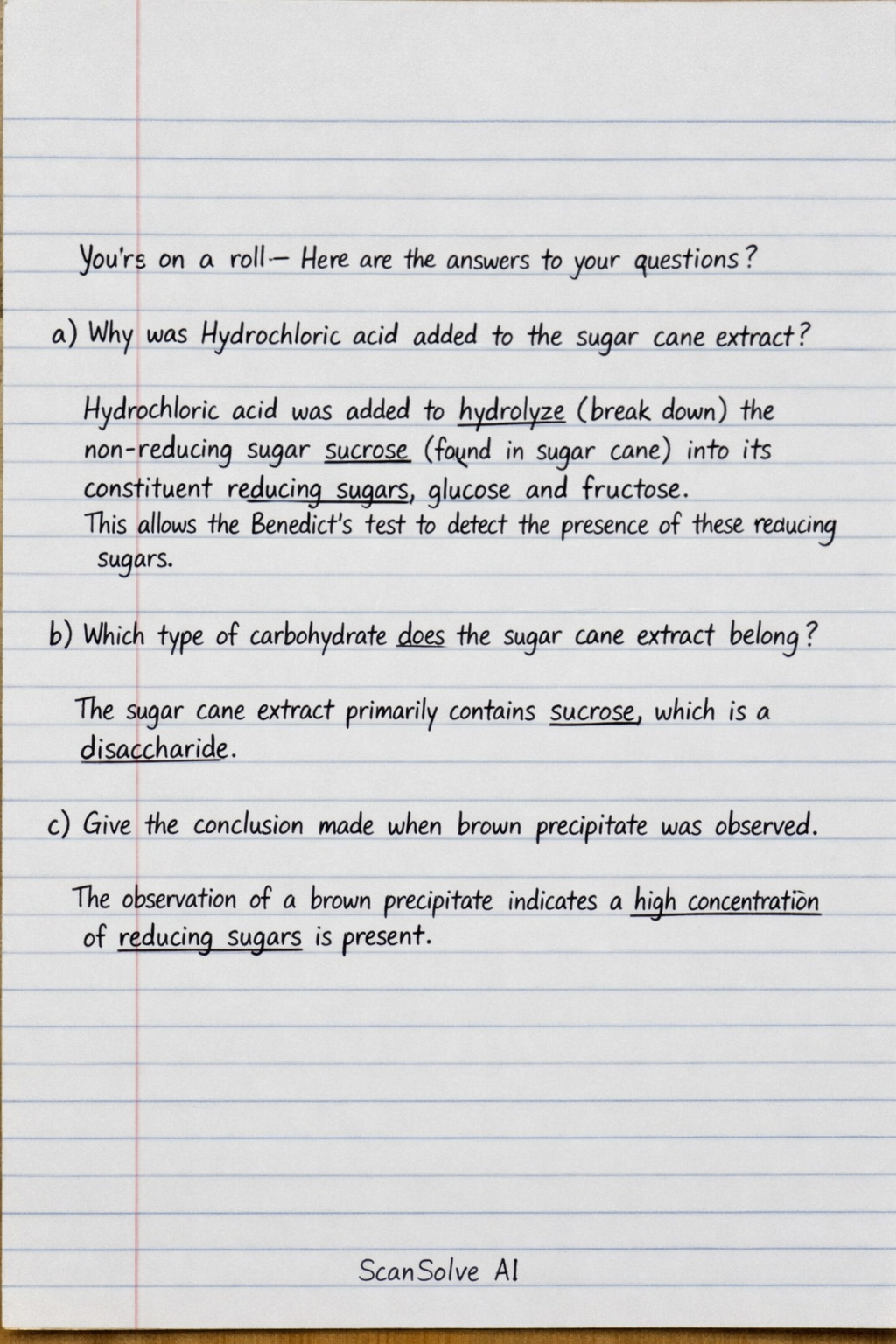
- a) Why was Hydrochloric acid added to the sugar cane extract? Hydrochloric acid was added to hydrolyze (break down) the non-reducing sugar sucrose (found in sugar cane) into its constituent reducing sugars, glucose and fructose. This allows the Benedict's test to detect the presence of these reducing sugars.
- b) Which type of carbohydrate does the sugar cane extract belong? The sugar cane extract primarily contains sucrose, which is a disaccharide.
- c) Give the conclusion made when brown precipitate was observed. The observation of a brown precipitate indicates a high concentration of reducing sugars is present.
-
a) What do you understand by the term mutation? A mutation is a permanent, heritable change in the DNA sequence of an organism.
b) Name the following mutation
- i) ABCDGFEHIJ (Original: ABCDEFGHIJ) This is an inversion mutation, where a segment of the chromosome (FGH) has been reversed.
- ii) ABCDHIJ (Original: ABCDEFGHIJ) This is a deletion mutation, where a segment of the chromosome (EFG) has been lost.
- iii) ABCDEFGHIJGHIJ (Original: ABCDEFGHIJ) This is a duplication mutation, where a segment of the chromosome (GHIJ) has been repeated.
-
Name the growth curve shown by Arthropods and Chordates
- Arthropods: Stepped growth curve (due to molting)
- Chordates: Sigmoid (S-shaped) growth curve
-
Explain how extreme temperature affect enzymatic activity. Extreme high temperatures cause enzymes to denature. Denaturation is the irreversible change in the enzyme's three-dimensional structure, particularly its active site, which leads to a loss of its catalytic activity. Extreme low temperatures reduce the kinetic energy of molecules, slowing down enzyme activity but generally not causing denaturation.
-
It is advantageous to breathe through the nose than the mouth. Explain. Breathing through the nose is advantageous because the nasal passages filter, warm, and humidify the inhaled air. Nasal hairs and mucus trap dust and microorganisms, blood vessels warm the air to body temperature, and mucus adds moisture, protecting the delicate lung tissues. The nose also contains olfactory receptors for smell.
Still stuck on this one?
Ask a follow-up, and the answer starts from this question.
More Biology Questions
Handwritten Step-by-Step Solution
Get this as a handwritten image on WhatsApp — like a tutor wrote it for you.
Try on WhatsApp