
We read your photo as:
A) Why is dilute hydrochloric acid preferred to dilute sulphuric acid? b) Calculate the rate of reaction after 10 seconds. c) Explain how temperature increase and reducing the size of lumps would chan
ScanSolve AI Answer
Answer
Question 5
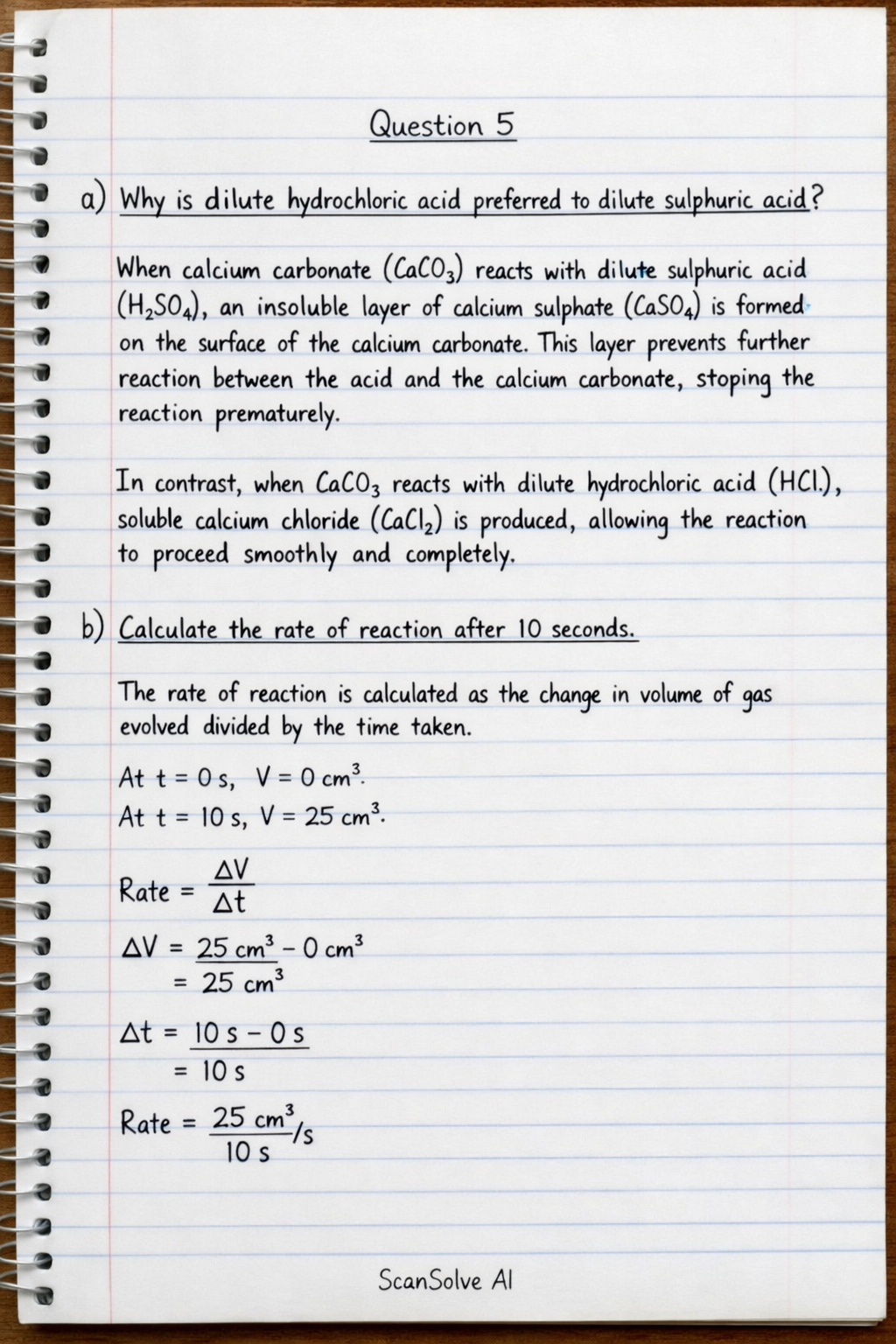
a) Why is dilute hydrochloric acid preferred to dilute sulphuric acid?
When calcium carbonate () reacts with dilute sulphuric acid (), an insoluble layer of calcium sulphate () is formed on the surface of the calcium carbonate. This layer prevents further reaction between the acid and the calcium carbonate, stopping the reaction prematurely. In contrast, when reacts with dilute hydrochloric acid (), soluble calcium chloride () is produced, allowing the reaction to proceed smoothly and completely.
b) Calculate the rate of reaction after 10 seconds.
The rate of reaction is calculated as the change in volume of gas evolved divided by the time taken.
From the table:
At s, .
At s, .
c) Explain how temperature increase and reducing the size of lumps would change the rate of reaction.
- Temperature increase: Increasing the temperature increases the kinetic energy of the reacting particles. This leads to more frequent and more energetic collisions between particles, increasing the rate of reaction.
- Reducing the size of lumps: Reducing the size of lumps (e.g., by crushing them into powder) increases the total surface area of the reactant. A larger surface area allows more particles to be exposed for reaction, leading to more frequent collisions and thus an increased rate of reaction.
Try one yourself
A new problem that tests the same skill.
Still stuck on this one?
Ask a follow-up, and the answer starts from this question.
More Chemistry Questions
Handwritten Step-by-Step Solution
Get this as a handwritten image on WhatsApp — like a tutor wrote it for you.
Try on WhatsApp