

This biology question covers important biological concepts and processes. The step-by-step explanation below helps you understand the underlying mechanisms and reasoning.
ScanSolve AI Answer
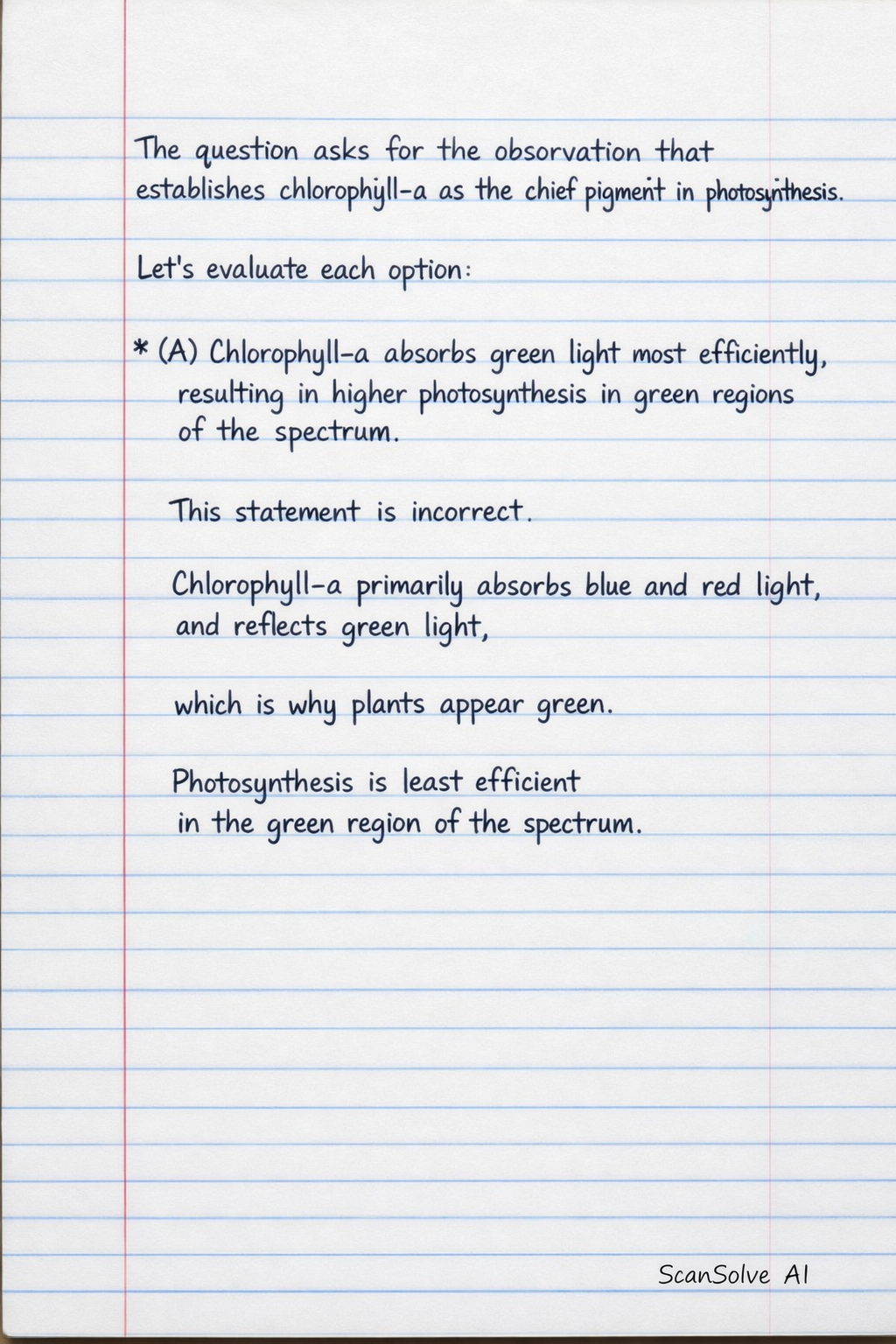
The question asks for the observation that establishes chlorophyll-a as the chief pigment in photosynthesis. Let's evaluate each option: (A) Chlorophyll-a absorbs green light most efficiently, resulting in higher photosynthesis in green regions of the spectrum. This statement is incorrect. Chlorophyll-a primarily absorbs blue and red light and reflects green light, which is why plants appear green. Photosynthesis is least efficient in the green region of the spectrum. (B) The rate of photosynthesis is highest at wavelengths where chlorophyll-a shows maximum absorption, particularly in the blue and red regions. This statement is correct. The action spectrum of photosynthesis (the rate of photosynthesis at different wavelengths) closely matches the absorption spectrum* of chlorophyll-a. Chlorophyll-a absorbs light most strongly in the blue-violet and red regions of the visible spectrum. The highest rates of photosynthesis are observed at these same wavelengths, indicating that chlorophyll-a is the primary pigment responsible for capturing light energy for photosynthesis. (C) Accessory pigments absorb light in the red and blue regions but do not transfer energy to chlorophyll-a. This statement is incorrect. Accessory pigments (like chlorophyll-b and carotenoids) absorb light at different wavelengths and do* transfer this energy to chlorophyll-a, broadening the range of light that can be used for photosynthesis. (D) Chlorophyll-a is the only pigment found in the chloroplasts of all plant cells, regardless of species or environment. This statement is incorrect. While chlorophyll-a is essential and widely present, chloroplasts also contain other pigments, such as chlorophyll-b and various carotenoids, which are accessory pigments. Therefore, the observation that establishes chlorophyll-a as the chief pigment is the strong correlation between its absorption spectrum and the overall rate of photosynthesis. The final answer is B