
We read your photo as:
Describe four common respiratory disorders, including their causes, symptoms, effects, and treatments.
ScanSolve AI Answer
Question 1:
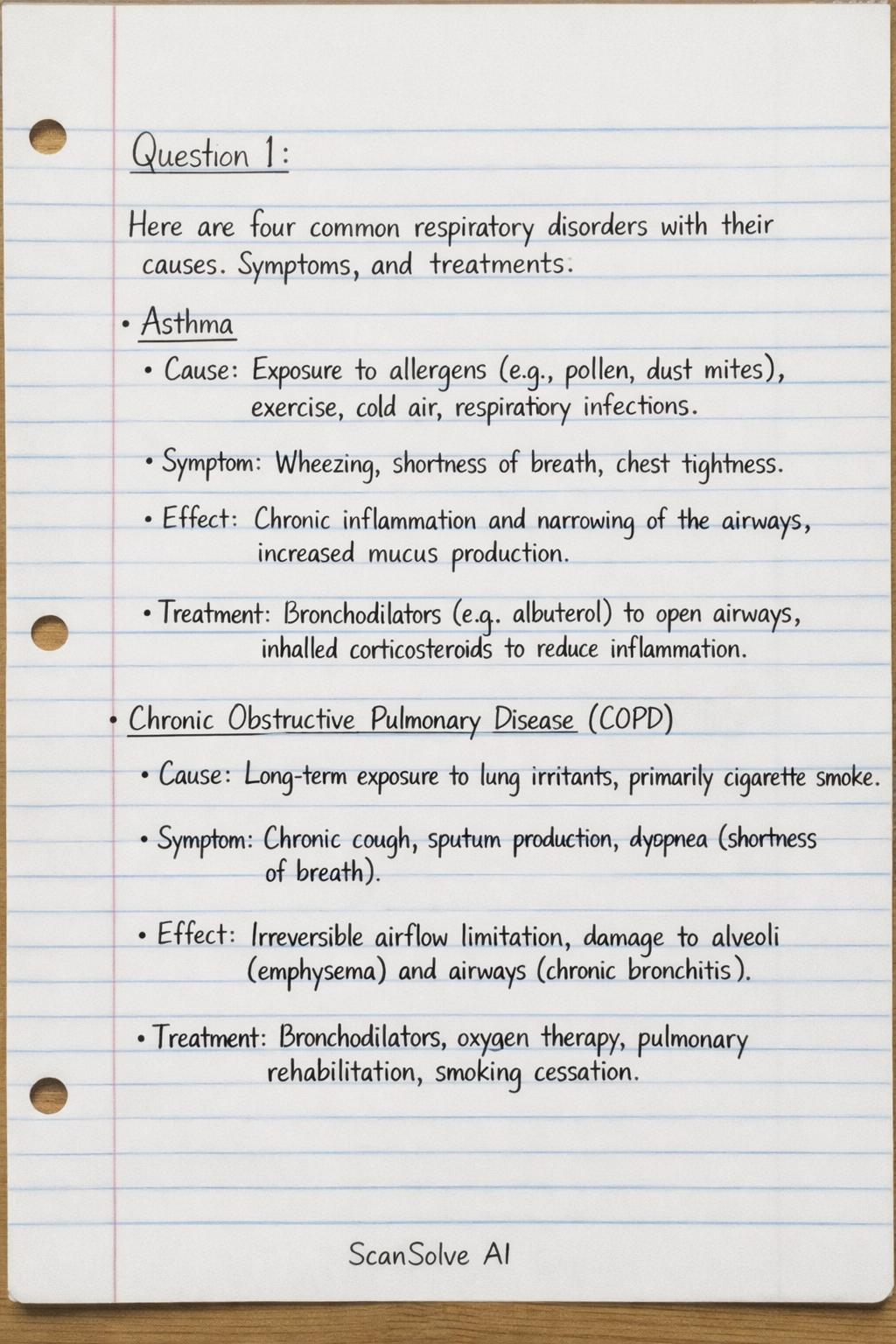
Here are four common respiratory disorders with their causes, symptoms, effects, and treatments:
-
Asthma
- Cause: Exposure to allergens (e.g., pollen, dust mites), exercise, cold air, respiratory infections.
- Symptom: Wheezing, shortness of breath, chest tightness.
- Effect: Chronic inflammation and narrowing of the airways, increased mucus production.
- Treatment: Bronchodilators (e.g., albuterol) to open airways, inhaled corticosteroids to reduce inflammation.
-
Chronic Obstructive Pulmonary Disease (COPD)
- Cause: Long-term exposure to lung irritants, primarily cigarette smoke.
- Symptom: Chronic cough, sputum production, dyspnea (shortness of breath).
- Effect: Irreversible airflow limitation, damage to alveoli (emphysema) and airways (chronic bronchitis).
- Treatment: Bronchodilators, oxygen therapy, pulmonary rehabilitation, smoking cessation.
-
Pneumonia
- Cause: Infection by bacteria (e.g., Streptococcus pneumoniae), viruses (e.g., influenza virus), or fungi.
- Symptom: Cough with phlegm, fever, chills, shortness of breath, chest pain.
- Effect: Inflammation of lung tissue, leading to fluid or pus filling the alveoli.
- Treatment: Antibiotics (for bacterial pneumonia), antiviral drugs (for viral pneumonia), rest, and fluids.
-
Bronchitis (Acute)
- Cause: Viral infections, often the same viruses that cause the common cold or flu.
- Symptom: Persistent cough (often producing mucus), chest discomfort, fatigue.
- Effect: Inflammation of the lining of the bronchial tubes, leading to increased mucus production.
- Treatment: Rest, fluids, cough suppressants, and pain relievers.
Question 2:
a) Five parts of the male reproductive organ and their functions:
- Testes: Produce sperm and male hormones (testosterone).
- Epididymis: Stores and matures sperm.
- Vas deferens: Transports mature sperm from the epididymis to the urethra.
- Seminal vesicles: Produce a fluid rich in fructose and other substances that nourish and protect sperm, contributing to semen volume.
- Prostate gland: Secretes a milky, slightly acidic fluid that activates sperm and contributes to semen volume.
b) Fertilization is the process where a male gamete (sperm) fuses with a female gamete (egg) to form a zygote.
c) Four characteristics of seeds dispersed by water:
- They are lightweight and buoyant, often having air sacs or spongy tissues to help them float.
- They possess a waterproof or resistant outer coating to prevent waterlogging and decay.
- They often have a fibrous or spongy mesocarp (middle layer) that aids in buoyancy, like a coconut.
- They can remain viable for extended periods while floating in water, allowing for dispersal over long distances.
Question 3:
a) Three chemical properties of water:
- Polarity: Water molecules are polar due to the uneven sharing of electrons between oxygen and hydrogen atoms, resulting in partial positive charges on hydrogen and a partial negative charge on oxygen.
- Excellent Solvent: Its polarity allows water to dissolve a wide range of ionic compounds and polar molecules, making it an excellent solvent often referred to as the "universal solvent."
- Amphoteric Nature: Water can act as both an acid (donating a proton, ) and a base (accepting a proton, ) in chemical reactions.
b) Precipitation is any form of water that falls from the atmosphere to the Earth's surface. This includes rain, snow, sleet, and hail.
c) The digestive and respiratory systems work together to provide the body with energy. The digestive system breaks down food into nutrients, which are then absorbed into the bloodstream. The respiratory system takes in oxygen, which is transported by the blood to cells throughout the body. This oxygen is crucial for cellular respiration, a process that uses the absorbed nutrients to produce energy (ATP) and releases carbon dioxide as a waste product, which is then expelled by the respiratory system.
Still stuck on this one?
Ask a follow-up, and the answer starts from this question.
More Biology Questions
Handwritten Step-by-Step Solution
Get this as a handwritten image on WhatsApp — like a tutor wrote it for you.
Try on WhatsApp