
We read your photo as:
State four methods used for water conservation. Explain four roles of plants in water purification. Define deforestation. How may deforestation affect water resources?
ScanSolve AI Answer
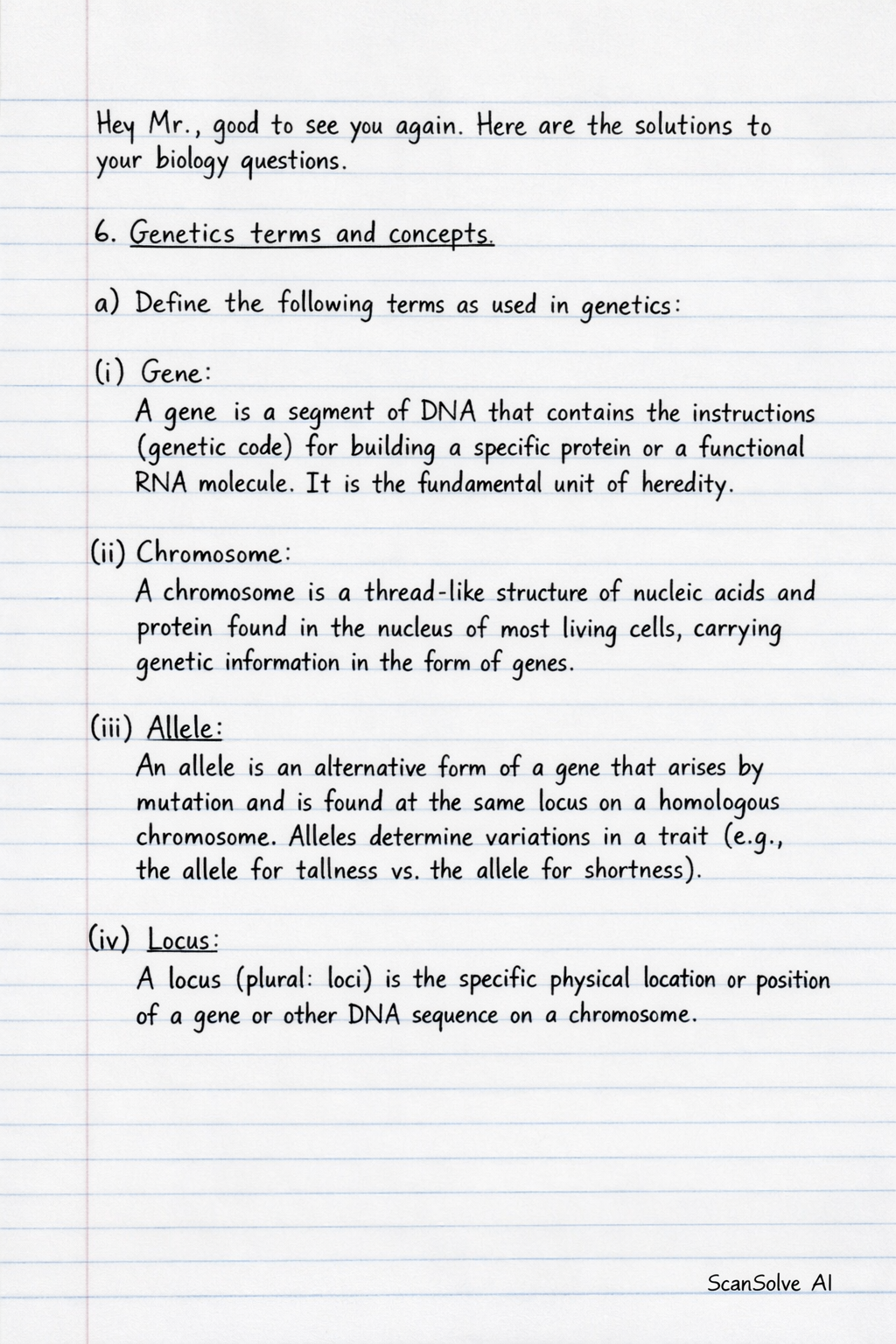
Here are the solutions to your biology questions.
6. Genetics terms and concepts
-
a) Define the following terms as used in genetics:
- (i) Gene: A gene is a segment of DNA that contains the instructions (genetic code) for building a specific protein or a functional RNA molecule. It is the fundamental unit of heredity.
- (ii) Chromosome: A chromosome is a thread-like structure of nucleic acids and protein found in the nucleus of most living cells, carrying genetic information in the form of genes.
- (iii) Allele: An allele is an alternative form of a gene that arises by mutation and is found at the same locus on a homologous chromosome. Alleles determine variations in a trait (e.g., the allele for tallness vs. the allele for shortness).
- (iv) Locus: A locus (plural: loci) is the specific physical location or position of a gene or other DNA sequence on a chromosome.
-
b) With the aid of diagrams, distinguish between a homozygous dominant and a heterozygous trait.
- Note: As an AI, I cannot provide diagrams. However, I will describe the concepts clearly.
- A homozygous dominant trait refers to an individual that carries two identical dominant alleles for a particular gene. For example, if 'T' represents the dominant allele for tallness, a homozygous dominant individual would have the genotype TT. This individual will express the dominant trait (tall).
- Diagrammatic representation (conceptual): Imagine two homologous chromosomes, each carrying the 'T' allele at the same locus.
- A heterozygous trait refers to an individual that carries two different alleles for a particular gene – one dominant allele and one recessive allele. For example, if 'T' is dominant for tallness and 't' is recessive for shortness, a heterozygous individual would have the genotype Tt. This individual will also express the dominant trait (tall), as the dominant allele masks the expression of the recessive allele.
- Diagrammatic representation (conceptual): Imagine two homologous chromosomes, one carrying the 'T' allele and the other carrying the 't' allele at the same locus.
-
c) What are lethal alleles? Lethal alleles are alleles that cause the death of the organism that carries them. This can occur either before or after birth, or at any stage of development, depending on the gene involved. Lethal alleles are often recessive, meaning an organism must inherit two copies (homozygous recessive) to be affected, but some dominant lethal alleles also exist.
Still stuck on this one?
Ask a follow-up, and the answer starts from this question.
More Biology Questions
Handwritten Step-by-Step Solution
Get this as a handwritten image on WhatsApp — like a tutor wrote it for you.
Try on WhatsApp