
We read your photo as:
Describe fowl typhoid (causal organism, symptoms, control/treatment) and general characteristics of dairy cattle.
ScanSolve AI Answer
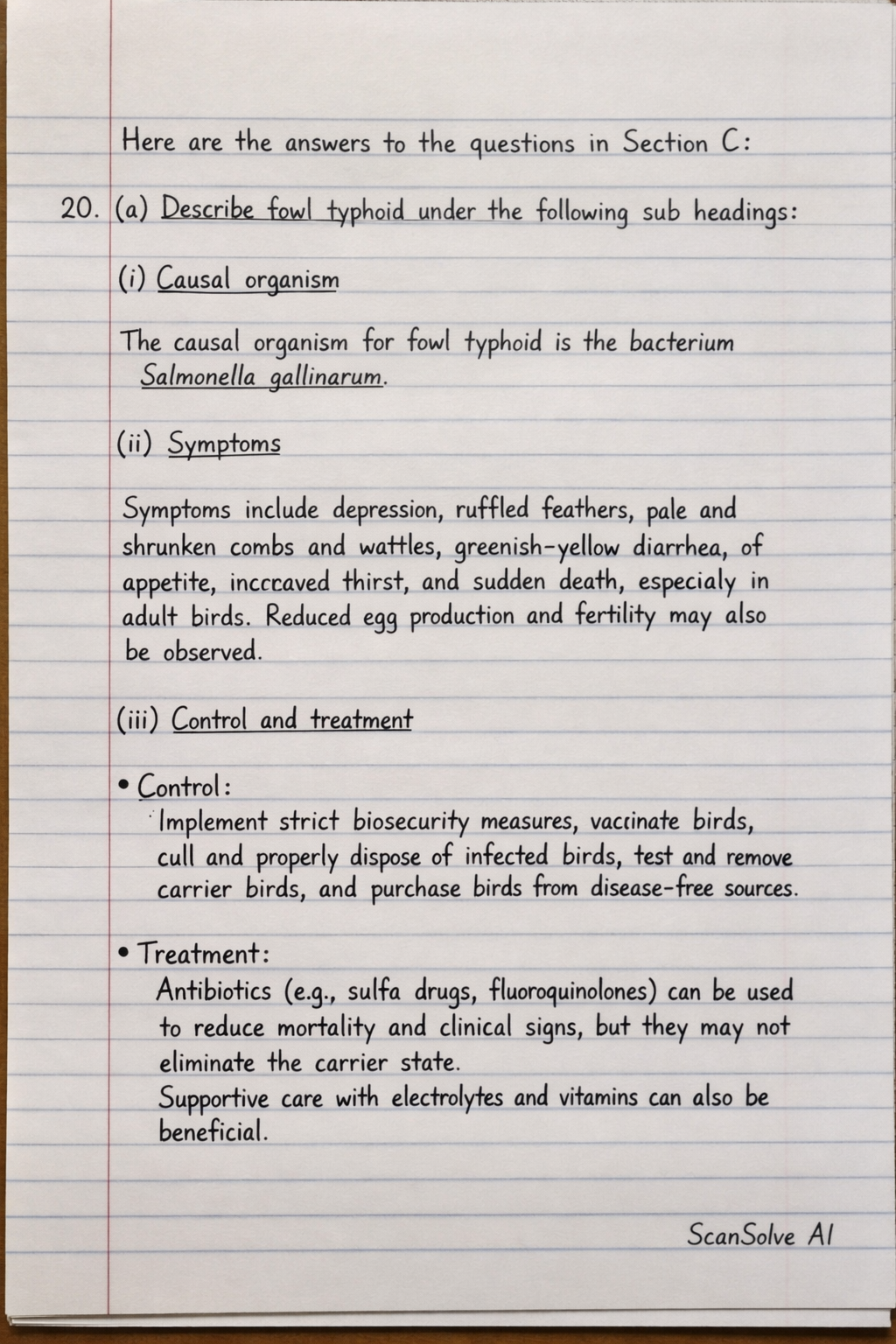
Here are the answers to the questions in Section C:
20. (a) Describe fowl typhoid under the following sub headings:
(i) Causal organism
The causal organism for fowl typhoid is the bacterium Salmonella gallinarum.
(ii) Symptoms
Symptoms include depression, ruffled feathers, pale and shrunken combs and wattles, greenish-yellow diarrhea, loss of appetite, increased thirst, and sudden death, especially in adult birds. Reduced egg production and fertility may also be observed.
(iii) Control and treatment
- Control: Implement strict biosecurity measures, vaccinate birds, cull and properly dispose of infected birds, test and remove carrier birds, and purchase birds from disease-free sources.
- Treatment: Antibiotics (e.g., sulfa drugs, fluoroquinolones) can be used to reduce mortality and clinical signs, but they may not eliminate the carrier state. Supportive care with electrolytes and vitamins can also be beneficial.
20. (b) Describe general characteristics of dairy cattle.
Dairy cattle are characterized by their high milk production and well-developed udders with prominent milk veins. They typically have a lean, angular, and wedge-shaped body conformation, indicating that energy is directed towards milk production rather than meat. They possess a docile temperament, making them easy to handle for milking, and exhibit early maturity and a long productive life.
21. (a) Describe factors that determine choice of poultry rearing system.
Several factors influence the choice of a poultry rearing system:
- Capital availability: Intensive systems (e.g., battery cage, deep litter) require higher initial investment compared to extensive systems (e.g., free-range).
- Land availability: Extensive systems demand large areas of land, whereas intensive systems can be implemented on smaller plots.
- Market demand: The specific product (eggs or meat) and market preferences (e.g., organic, free-range) dictate the most suitable system.
- Labor availability and cost: Intensive systems may require less labor per bird but more skilled labor, while extensive systems might need more general labor for supervision.
- Climatic conditions: Certain systems are better adapted to specific climates; for instance, open-sided houses are common in warm regions.
- Disease control: Intensive systems allow for better biosecurity, but outbreaks can be severe. Extensive systems have lower stocking densities, potentially reducing disease spread, but exposure to wild animals is higher.
- Management skills: Intensive systems demand higher management expertise for optimal production and disease prevention.
- Feed availability and cost: The cost and accessibility of feed significantly impact the economic viability of different rearing systems.
21. (b) State five deficiency symptoms of vitamins in livestock giving their cause in each case.
- Vitamin A:
- Symptoms: Night blindness, rough hair coat, poor growth, and reproductive problems.
- Cause: Lack of green forage, poor quality hay, or insufficient vitamin A supplementation in feed.
- Vitamin D:
- Symptoms: Rickets in young animals (bowed legs, swollen joints) and osteomalacia in adults (softening of bones).
- Cause: Insufficient exposure to sunlight, lack of sun-cured forage, or inadequate vitamin D supplementation.
- Vitamin E:
- Symptoms: White muscle disease (nutritional muscular dystrophy) in calves and lambs, reproductive failure, and encephalomalacia in poultry.
- Cause: Diets low in green forages, cereal grains, or poor quality stored feeds; often linked with selenium deficiency.
- Vitamin K:
- Symptoms: Impaired blood clotting, hemorrhages, and prolonged bleeding time.
- Cause: Ingestion of moldy sweet clover (which contains anticoagulants) or prolonged antibiotic use.
- Vitamin B12 (Cobalamin):
- Symptoms: Anemia, poor growth, reduced appetite, and "wasting disease" in ruminants.
- Cause: Cobalt deficiency in the diet, as cobalt is essential for microbial synthesis of B12 in the rumen.
22. (a) Describe the life cycle of a three host tick.
A three-host tick completes its life cycle on three different hosts, with each active developmental stage (larva, nymph, adult) feeding on a separate host.
- Egg stage: An engorged adult female tick drops off the third host and lays thousands of eggs on the ground, typically in vegetation.
- Larval stage: Eggs hatch into six-legged larvae. These larvae climb onto vegetation and wait for a suitable first host (often a small mammal or bird). They attach, feed, and engorge, then drop off the host onto the ground.
- Nymphal stage: The engorged larva molts into an eight-legged nymph on the ground. The nymph then climbs onto vegetation and waits for a second host (often a larger mammal). It attaches, feeds, and engorges, then drops off the host onto the ground.
- Adult stage: The engorged nymph molts into an eight-legged adult (male or female) on the ground. Adults climb onto vegetation and wait for a third host (typically a large mammal like cattle). They attach, feed, and mate on this host. The female engorges fully, then drops off to lay eggs, completing the cycle.
22. (b) State the rules followed in milking and for each rule give the reason for it to be observed.
- Rule 1: Wash and dry the udder and teats thoroughly before milking.
- Reason: To remove dirt, manure, and bacteria from the udder surface, minimizing bacterial count in the milk and stimulating milk let-down. Drying prevents water droplets from entering the milk.
- Rule 2: Fore-strip a few streams of milk from each teat into a strip cup.
- Reason: To check for abnormalities (flakes, clots) that indicate mastitis, allowing for early detection and segregation of affected milk. It also removes the first milk, which has a higher bacterial count.
- Rule 3: Milk rapidly and completely.
- Reason: Rapid milking ensures efficient milk removal while oxytocin (the milk let-down hormone) is active. Complete milking helps maintain high milk production and reduces the risk of mastitis by removing all milk.
- Rule 4: Dip teats in an antiseptic solution (teat dip) immediately after milking.
- Reason: To kill any bacteria remaining on the teat end and seal the teat canal, preventing new infections (mastitis) from entering the udder before the teat canal closes.
Still stuck on this one?
Ask a follow-up, and the answer starts from this question.
More Biology Questions
Handwritten Step-by-Step Solution
Get this as a handwritten image on WhatsApp — like a tutor wrote it for you.
Try on WhatsApp