

This biology question covers important biological concepts and processes. The step-by-step explanation below helps you understand the underlying mechanisms and reasoning.
ScanSolve AI Answer
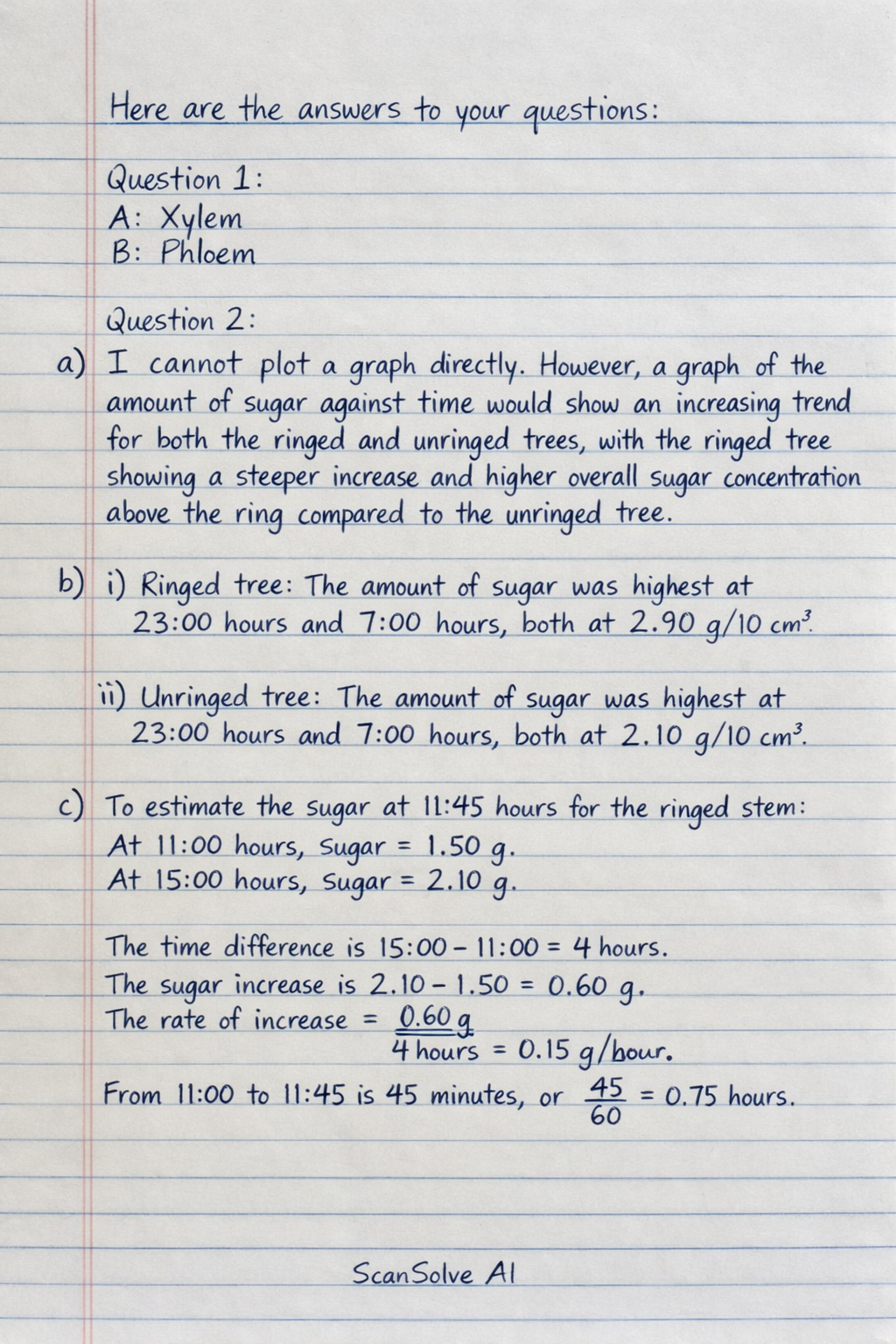
Here are the answers to your questions: Question 1: A: Xylem B: Phloem Question 2: a) I cannot plot a graph directly. However, a graph of the amount of sugar against time would show an increasing trend for both the ringed and unringed trees, with the ringed tree showing a steeper increase and higher overall sugar concentration above the ring compared to the unringed tree. b) i) Ringed tree: The amount of sugar was highest at 23:00 hours and 7:00 hours (the following day), both at 2.90 g/10 cm^3. ii) Unringed tree: The amount of sugar was highest at 23:00 hours and 7:00 hours (the following day), both at 2.10 g/10 cm^3. c) To estimate the sugar at 11:45 hours for the ringed stem: At 11:00 hours, sugar = 1.50 g. At 15:00 hours, sugar = 2.10 g. The time difference is 15:00 - 11:00 = 4 hours. The sugar increase is 2.10 - 1.50 = 0.60 g. The rate of increase is 0.60 g4 hours = 0.15 g/hour. From 11:00 to 11:45 is 45 minutes, or (45)/(60) = 0.75 hours. Increase in sugar during this period = 0.15 g/hour × 0.75 hours = 0.1125 g. Sugar at 11:45 hours = 1.50 g + 0.1125 g = 1.6125 g. d) At 07:00 hours, there was sugar in the stem of both trees because sugar produced during photosynthesis on the previous day would have been stored or was still being translocated. Photosynthesis would also be starting again at this time, contributing to sugar production. e) i) Between 06:45 hours and 11:45 hours: The sugar concentration in the ringed stem increases because photosynthesis is actively occurring, producing sugars. Since the phloem is removed below the ring, these sugars cannot be transported downwards and accumulate above the ring. ii) Between 11:45 hours and 06:45 hours (the next day): The sugar concentration continues to increase, albeit potentially at a slower rate during the night. During the day, photosynthesis continues to produce sugars, and at night, while photosynthesis stops, the accumulated sugars remain trapped above the ring, leading to a continued high concentration. f) Two compounds translocated in phloem other than sugars are amino acids and plant hormones. g) Plant shoots wilt when they lose more water through transpiration than they absorb through their roots. This leads to a loss of turgor pressure in the plant cells, causing the cells to become flaccid and the shoots to droop. h) The importance of transpiration to plants includes: • Cooling the plant as water evaporates from the leaf surface. • Transporting water and dissolved mineral salts from the roots to the leaves. • Creating a transpiration pull that helps in the absorption of water from the soil. i) Adaptive features which enable a plant to reduce the loss of water include: • Thick waxy cuticle on leaves to reduce evaporation. • Sunken stomata or hairy leaves to trap a layer of moist air, reducing the water potential gradient. • Reduced leaf surface area (e.g., spines or needles) to minimize the area for water loss. • Rolled leaves to protect stomata from direct exposure to wind and sun. **TRANSPORT IN