ScanSolve logoScanSolve
Toggle sidebar
  • Homework
  • Tutor
  • Humanizer
  • AI Detector
  • Questions
  • Blog
  • History
  • Mobile App

  • Homework
  • Tutor
  • Humanizer
  • AI Detector

  • Questions
  • Math homework helpMath
    Physics homework helpPhysics
    Chemistry homework helpChemistry
    Biology homework helpBiology
    Computer Science homework helpComputer Science
    History homework helpHistory
    More homework helpMore
  • Blog
  • History

  • Mobile App
ScanSolvePLUS
  • Unlimited answers
  • ScanSolve AI Pro
Start Free Trial →
Try on WhatsApp
Home > Biology Homework Help > Solution

G. Describe the circulatory system of cockroach.

Asked on March 27, 2026|Biology

This biology question covers important biological concepts and processes. The step-by-step explanation below helps you understand the underlying mechanisms and reasoning.

ScanSolve AI AnswerAnswered on March 27, 2026
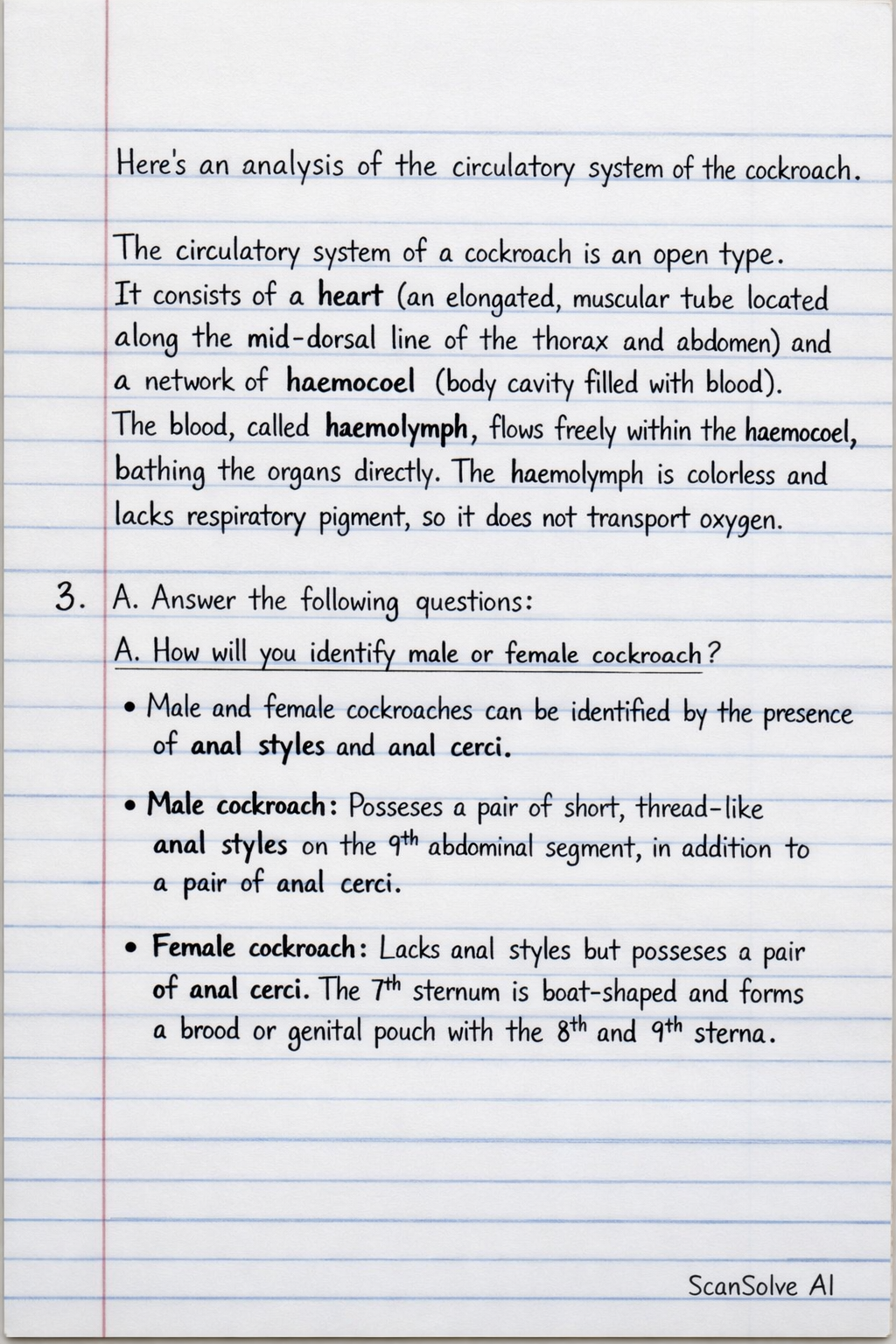
G. Describe the circulatory system of cockroach. The circulatory system of a cockroach is an open type. It consists of a heart (an elongated, muscular tube located along the mid-dorsal line of the thorax and abdomen) and a network of haemocoel (body cavity filled with blood). The blood, called haemolymph, flows freely within the haemocoel, bathing the organs directly. The haemolymph is colorless and lacks respiratory pigment, so it does not transport oxygen. 3. Answer the following questions A. How will you identify male or female cockroach? Male and female cockroaches can be identified by the presence of anal styles and anal cerci. Male cockroach: Possesses a pair of short, thread-like anal styles on the 9th abdominal segment, in addition to a pair of anal cerci*. Female cockroach: Lacks anal styles but possesses a pair of anal cerci*. The 7th sternum is boat-shaped and forms a brood or genital pouch with the 8th and 9th sterna. B. Write a note on : Gizzard of cockroach. The gizzard (or proventriculus) is a part of the foregut in a cockroach, located after the crop. It has an outer layer of thick circular muscles and an inner cuticle forming six highly chitinous plates called teeth. These teeth help in grinding the food particles. The gizzard also has a posterior plate that acts as a valve, preventing the regurgitation of food from the midgut. C. Give the systematic position of cockroach. Kingdom: Animalia* Phylum: Arthropoda* Class: Insecta* Order: Blattodea* Genus: Periplaneta* Species: americana* (for American cockroach) D. What would have happened if cockroach did not had gizzard? If a cockroach did not have a gizzard, it would be unable to effectively grind and pulverize its food. The chitinous teeth in the gizzard are essential for breaking down solid food particles into smaller pieces, which is crucial for subsequent enzymatic digestion in the midgut. Without a gizzard, the cockroach would struggle to process its food, leading to inefficient digestion and nutrient absorption, ultimately impacting its survival. E. What is the functional difference between eyes of cockroach and human being? Cockroach eyes: Possess compound eyes, which are made up of several thousand simple eyes called ommatidia. Each ommatidium forms a part of the image, resulting in a mosaic vision* (apposition image). This vision is highly sensitive to movement but has low resolution. Human eyes: Possess simple eyes with a single lens that focuses light onto the retina. This allows for high-resolution vision*, depth perception, and color vision, forming a single, clear image. F. What is the functional difference between respiratory systems of cockroach and human being? Cockroach respiratory system: Consists of a network of tracheae and tracheoles that open to the outside via spiracles. Oxygen is delivered directly to the tissues* and cells, and carbon dioxide is removed directly. The circulatory system (haemolymph) does not play a role in gas transport. Human respiratory system: Involves lungs for gas exchange. Air enters through the nose/mouth, travels down the trachea and bronchi to the alveoli in the lungs. Oxygen diffuses into the blood, which is then transported by haemoglobin* in red blood cells to the body tissues. Carbon dioxide is transported back to the lungs by the blood. 4. Explain the following in short A. What are anal cerci? Anal cerci are a pair of jointed, filamentous sensory appendages located on the 10th abdominal segment of both male and female cockroaches. They are sensitive to vibrations and air currents, helping the cockroach detect predators or changes in its environment. B. What is the ganglion? A ganglion (plural: ganglia) is a cluster of nerve cell bodies located outside the central nervous system. In cockroaches, ganglia form a ventral nerve cord and control various body functions, including movement and sensory processing, in different segments. C. What is the role of hypopharynx? The hypopharynx (or lingua) in a cockroach is a median, flexible, tongue-like lobe located within the mouth cavity. It helps in manipulating food and mixing it with saliva before ingestion. D. What is mesenteron? The mesenteron is another name for the midgut of the cockroach's digestive system. It is responsible for the primary digestion and absorption of nutrients, as it contains digestive enzymes and lacks a cuticular lining. E. Location of tergum. A tergum (or notum) is the dorsal (upper) plate of each segment of the exoskeleton in a cockroach. These plates are typically hardened and provide protection to the dorsal side of the body. F. What is ootheca? An ootheca is a dark reddish-to-blackish brown capsule, about 3/8 inch long, produced by the female cockroach. It contains fertilized eggs (typically 14-16 eggs) and is deposited or glued to a suitable surface, protecting the developing embryos. G. How many chambers are present in heart of cockroach? The heart of a cockroach is an elongated, tubular structure with 13 chambers. These chambers are arranged segmentally along the dorsal side of the thorax and abdomen.

Related Biology Questions

  • What is photosynthesis
  • Construct and simplify equation whose root are -3,1
  • Which hormone regulates blood glucose
  • A hormone is carried to it's target organ mainly by
  • Write short not on photosynthesis
  • 1. I eat a fruit.
See all Biology questions

This step-by-step solution was generated by ScanSolve AI. Need help with more biology problems? Browse Biology solutions or ask your own question.

Home›Biology Homework Help›G. Describe the circulatory system of cockroach.
Q

G. Describe the circulatory system of cockroach.

March 27, 2026|Biology
G. Describe the circulatory system of cockroach.

G. Describe the circulatory system of cockroach.

ScanSolve AI

ScanSolve AI Answer

Answered on March 27, 2026

G. Describe the circulatory system of cockroach. The circulatory system of a cockroach is an open type. It consists of a heart (an elongated, muscular tube located along the mid-dorsal line of the thorax and abdomen) and a network of haemocoel (body cavity filled with blood). The blood, called haemolymph, flows freely within the haemocoel, bathing the organs directly. The haemolymph is colorless and lacks respiratory pigment, so it does not transport oxygen.

  1. Answer the following questions

    • A. How will you identify male or female cockroach? Male and female cockroaches can be identified by the presence of anal styles and anal cerci.

      • Male cockroach: Possesses a pair of short, thread-like anal styles on the 9th abdominal segment, in addition to a pair of anal cerci.
      • Female cockroach: Lacks anal styles but possesses a pair of anal cerci. The 7th sternum is boat-shaped and forms a brood or genital pouch with the 8th and 9th sterna.
    • B. Write a note on : Gizzard of cockroach. The gizzard (or proventriculus) is a part of the foregut in a cockroach, located after the crop. It has an outer layer of thick circular muscles and an inner cuticle forming six highly chitinous plates called teeth. These teeth help in grinding the food particles. The gizzard also has a posterior plate that acts as a valve, preventing the regurgitation of food from the midgut.

    • C. Give the systematic position of cockroach.

      • Kingdom: Animalia
      • Phylum: Arthropoda
      • Class: Insecta
      • Order: Blattodea
      • Genus: Periplaneta
      • Species: americana (for American cockroach)
    • D. What would have happened if cockroach did not had gizzard? If a cockroach did not have a gizzard, it would be unable to effectively grind and pulverize its food. The chitinous teeth in the gizzard are essential for breaking down solid food particles into smaller pieces, which is crucial for subsequent enzymatic digestion in the midgut. Without a gizzard, the cockroach would struggle to process its food, leading to inefficient digestion and nutrient absorption, ultimately impacting its survival.

    • E. What is the functional difference between eyes of cockroach and human being?

      • Cockroach eyes: Possess compound eyes, which are made up of several thousand simple eyes called ommatidia. Each ommatidium forms a part of the image, resulting in a mosaic vision (apposition image). This vision is highly sensitive to movement but has low resolution.
      • Human eyes: Possess simple eyes with a single lens that focuses light onto the retina. This allows for high-resolution vision, depth perception, and color vision, forming a single, clear image.
    • F. What is the functional difference between respiratory systems of cockroach and human being?

      • Cockroach respiratory system: Consists of a network of tracheae and tracheoles that open to the outside via spiracles. Oxygen is delivered directly to the tissues and cells, and carbon dioxide is removed directly. The circulatory system (haemolymph) does not play a role in gas transport.
      • Human respiratory system: Involves lungs for gas exchange. Air enters through the nose/mouth, travels down the trachea and bronchi to the alveoli in the lungs. Oxygen diffuses into the blood, which is then transported by haemoglobin in red blood cells to the body tissues. Carbon dioxide is transported back to the lungs by the blood.
  2. Explain the following in short

    • A. What are anal cerci? Anal cerci are a pair of jointed, filamentous sensory appendages located on the 10th abdominal segment of both male and female cockroaches. They are sensitive to vibrations and air currents, helping the cockroach detect predators or changes in its environment.

    • B. What is the ganglion? A ganglion (plural: ganglia) is a cluster of nerve cell bodies located outside the central nervous system. In cockroaches, ganglia form a ventral nerve cord and control various body functions, including movement and sensory processing, in different segments.

    • C. What is the role of hypopharynx? The hypopharynx (or lingua) in a cockroach is a median, flexible, tongue-like lobe located within the mouth cavity. It helps in manipulating food and mixing it with saliva before ingestion.

    • D. What is mesenteron? The mesenteron is another name for the midgut of the cockroach's digestive system. It is responsible for the primary digestion and absorption of nutrients, as it contains digestive enzymes and lacks a cuticular lining.

    • E. Location of tergum. A tergum (or notum) is the dorsal (upper) plate of each segment of the exoskeleton in a cockroach. These plates are typically hardened and provide protection to the dorsal side of the body.

    • F. What is ootheca? An ootheca is a dark reddish-to-blackish brown capsule, about 3/8 inch long, produced by the female cockroach. It contains fertilized eggs (typically 14-16 eggs) and is deposited or glued to a suitable surface, protecting the developing embryos.

    • G. How many chambers are present in heart of cockroach? The heart of a cockroach is an elongated, tubular structure with 13 chambers. These chambers are arranged segmentally along the dorsal side of the thorax and abdomen.

Need help with your own homework?

Get instant step-by-step solutions to any question. Free to start.

Ask Your Question
Handwritten step-by-step solution

Handwritten Step-by-Step Solution

Get this solution as a handwritten image on WhatsApp — just like a tutor wrote it for you.

Try on WhatsApp

More Biology Questions

What is photosynthesisConstruct and simplify equation whose root are -3,1Which hormone regulates blood glucoseA hormone is carried to it's target organ mainly byWrite short not on photosynthesis1. I eat a fruit.
See all Biologyquestions →
Biology: G. Describe the circulatory system of cockroach. — Step-by-Step Solution | ScanSolve