
We read your photo as:
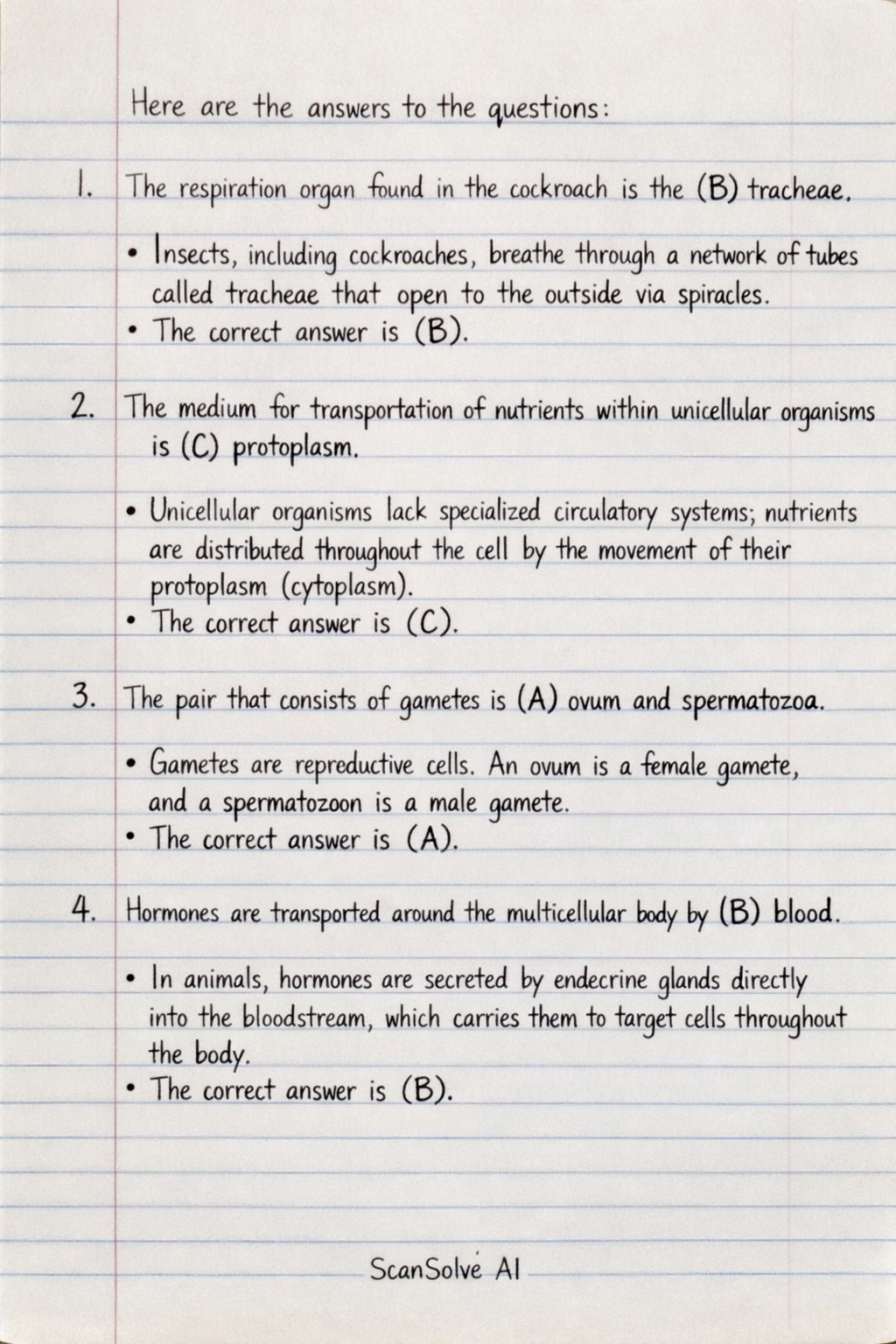
The respiration organ found in the cockroach is the (B) tracheae.
ScanSolve AI Answer
Answer
Here are the answers to the questions:
-
The respiration organ found in the cockroach is the (B) tracheae.
- Insects, including cockroaches, breathe through a network of tubes called tracheae that open to the outside via spiracles.
- The correct answer is (B).
-
The medium for transportation of nutrients within unicellular organisms is (C) protoplasm.
- Unicellular organisms lack specialized circulatory systems; nutrients are distributed throughout the cell by the movement of their protoplasm (cytoplasm).
- The correct answer is (C).
-
The pair that consists of gametes is (A) ovum and spermatozoa.
- Gametes are reproductive cells. An ovum is a female gamete, and a spermatozoon is a male gamete.
- The correct answer is (A).
-
Hormones are transported around the multicellular body by (B) blood.
- In animals, hormones are secreted by endocrine glands directly into the bloodstream, which carries them to target cells throughout the body.
- The correct answer is (B).
-
Infective hepatitis is a disease of the (C) liver.
- Hepatitis is an inflammation of the liver, often caused by viral infections.
- The correct answer is (C).
-
The hormone that promotes secondary sexual characteristics in females is (C) oestrogen.
- Oestrogen (estrogen) is the primary female sex hormone responsible for the development of female secondary sexual characteristics.
- The correct answer is (C).
-
The term Syncarpous is used to describe a flower when the carpels are (A) many and fused.
- A syncarpous gynoecium has two or more carpels that are fused together.
- The correct answer is (A).
-
After fertilization in a flowering plant, the zygote develops into a (D) embryo.
- The zygote, formed after the fusion of gametes, undergoes cell division and differentiation to form an embryo within the developing seed.
- The correct answer is (D).
-
A flowering plant having both male and female flowers on the same plant is said to be (B) monoecious.
- Monoecious plants have separate male and female flowers on the same individual plant.
- The correct answer is (B).
-
The following that may not contribute to environmental pollution is (A) solar energy radiation.
- Solar energy itself is a clean and renewable energy source. While excessive UV radiation can be harmful, solar energy as a source is not considered a pollutant in the same way as industrial waste, smoke, or emissions from nuclear power plants.
- The correct answer is (A).
-
The following that is a pollutant in air is (C) carbon monoxide.
- Carbon monoxide (CO) is a toxic gas produced by incomplete combustion and is a significant air pollutant. Oxygen, water vapor, and nitrogen are natural components of clean air.
- The correct answer is (C).
-
The water pollutant that may contain organisms that cause dysentery is (B) sewage.
- Sewage contains human and animal waste, which can harbor pathogenic microorganisms (bacteria, viruses, parasites) that cause waterborne diseases like dysentery.
- The correct answer is (B).
-
The failure of a species to adapt to any environment must lead to (C) extinction.
- If a species cannot adapt to changes in its environment, it will eventually be unable to survive and reproduce, leading to its extinction.
- The correct answer is (C).
-
The following that is not an adaptation of plants or animals for a desert environment is (D) broad leaves for storage.
- Broad leaves would increase the surface area for transpiration, leading to excessive water loss, which is detrimental in a desert. Desert plants typically have adaptations to reduce water loss, such as small or modified leaves (spines), thick cuticles, and deep root systems.
- The correct answer is (D).
-
The organism that does not show color adaptation to its environment is (D) earthworm.
- Toads and chameleons are known for their camouflage and ability to blend with their surroundings. Earthworms live underground and do not rely on color adaptation for survival or camouflage.
- The correct answer is (D).
-
An association between two organisms in which both benefit is called (C) symbiosis.
- More specifically, this relationship is called mutualism, which is a type of symbiosis where both organisms benefit. Given the options, symbiosis is the best general term that encompasses mutualistic relationships.
- The correct answer is (C).
Try one yourself
A new problem that tests the same skill.
Still stuck on this one?
Ask a follow-up, and the answer starts from this question.
More Biology Questions
Handwritten Step-by-Step Solution
Get this as a handwritten image on WhatsApp — like a tutor wrote it for you.
Try on WhatsApp