
We read your photo as:
Which of the following terms best describes the structure that is a common passageway for air and food, and where does gas exchange occur?
ScanSolve AI Answer
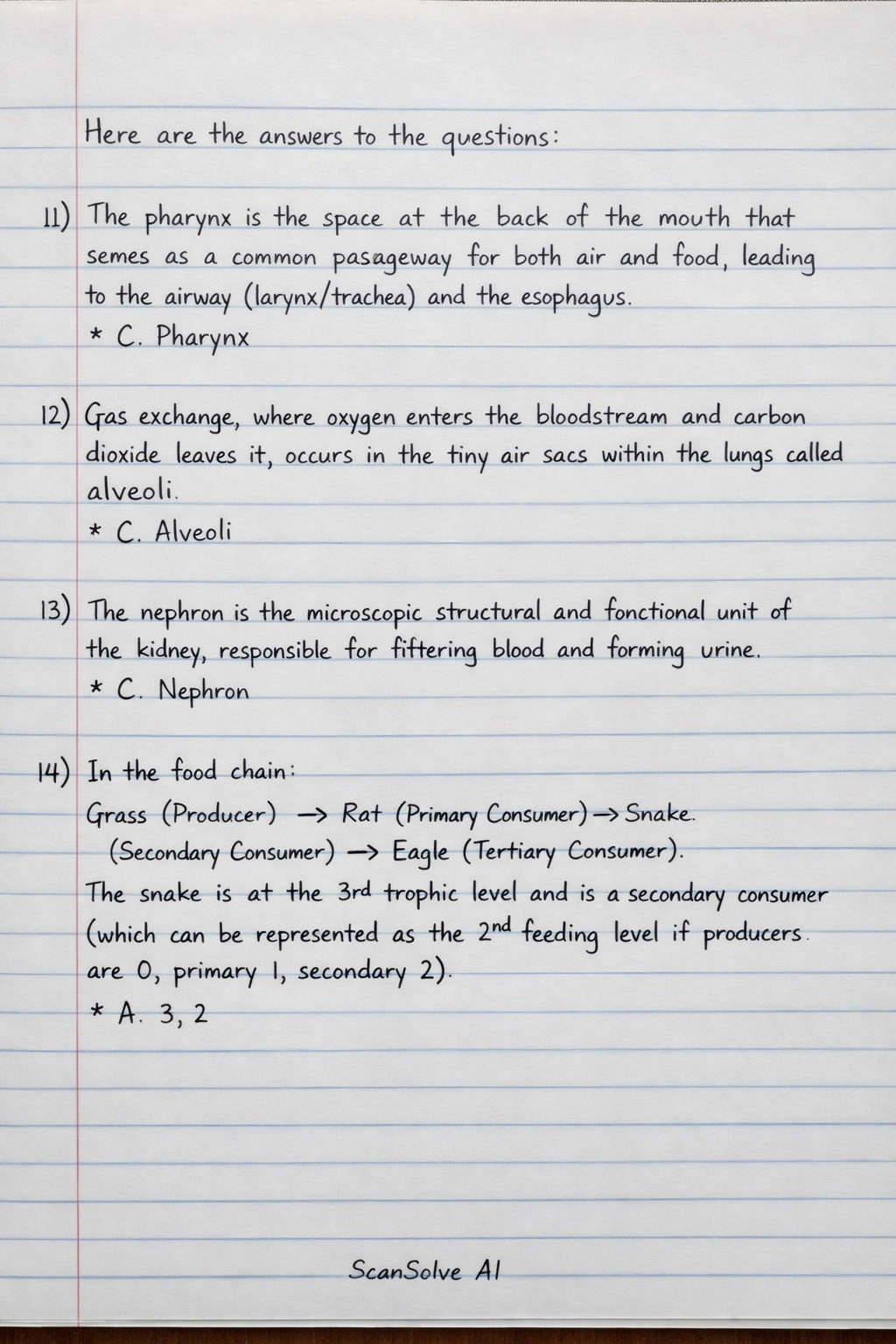
Here are the answers to the questions:
11) The pharynx is the space at the back of the mouth that serves as a common passageway for both air and food, leading to the airway (larynx/trachea) and the esophagus.
- C. Pharynx
12) Gas exchange, where oxygen enters the bloodstream and carbon dioxide leaves it, occurs in the tiny air sacs within the lungs called alveoli.
- C. Alveoli
13) The nephron is the microscopic structural and functional unit of the kidney, responsible for filtering blood and forming urine.
- C. Nephron
14) In the food chain: Grass (Producer) -> Rat (Primary Consumer) -> Snake (Secondary Consumer) -> Eagle (Tertiary Consumer). The snake is at the 3rd trophic level and is a secondary consumer (which can be represented as the 2nd feeding level if producers are 0, primary 1, secondary 2).
- A. 3, 2
15) According to the 10% rule of energy transfer in an ecological pyramid: * Producers: * Primary Consumers: of * Secondary Consumers: of * Tertiary Consumers: of Based on this, the primary consumers would have .
- B. The primary consumers would have a total of energy
16) Biomass refers to the total mass of living organisms (plants, animals, microorganisms) in a given area or ecosystem.
- B. The total mass of living organisms in an ecosystem
17) In nitrogen fixation, atmospheric nitrogen () is converted into ammonia () or other nitrogenous compounds. This process involves nitrogen combining with hydrogen.
- B. Hydrogen
18) The process where water vapor in the air cools and changes back into liquid water droplets is called condensation. This is how clouds form.
- A. Condensation
Instruction III: Fill in the blank space with appropriate words to complete the statements.
19) Tiny sacs in the lungs where gas exchange takes place are called alveoli.
20) A wave of involuntary muscle contractions that moves food through the digestive system is called peristalsis.
Still stuck on this one?
Ask a follow-up, and the answer starts from this question.
More Biology Questions
Handwritten Step-by-Step Solution
Get this as a handwritten image on WhatsApp — like a tutor wrote it for you.
Try on WhatsApp