
We read your photo as:
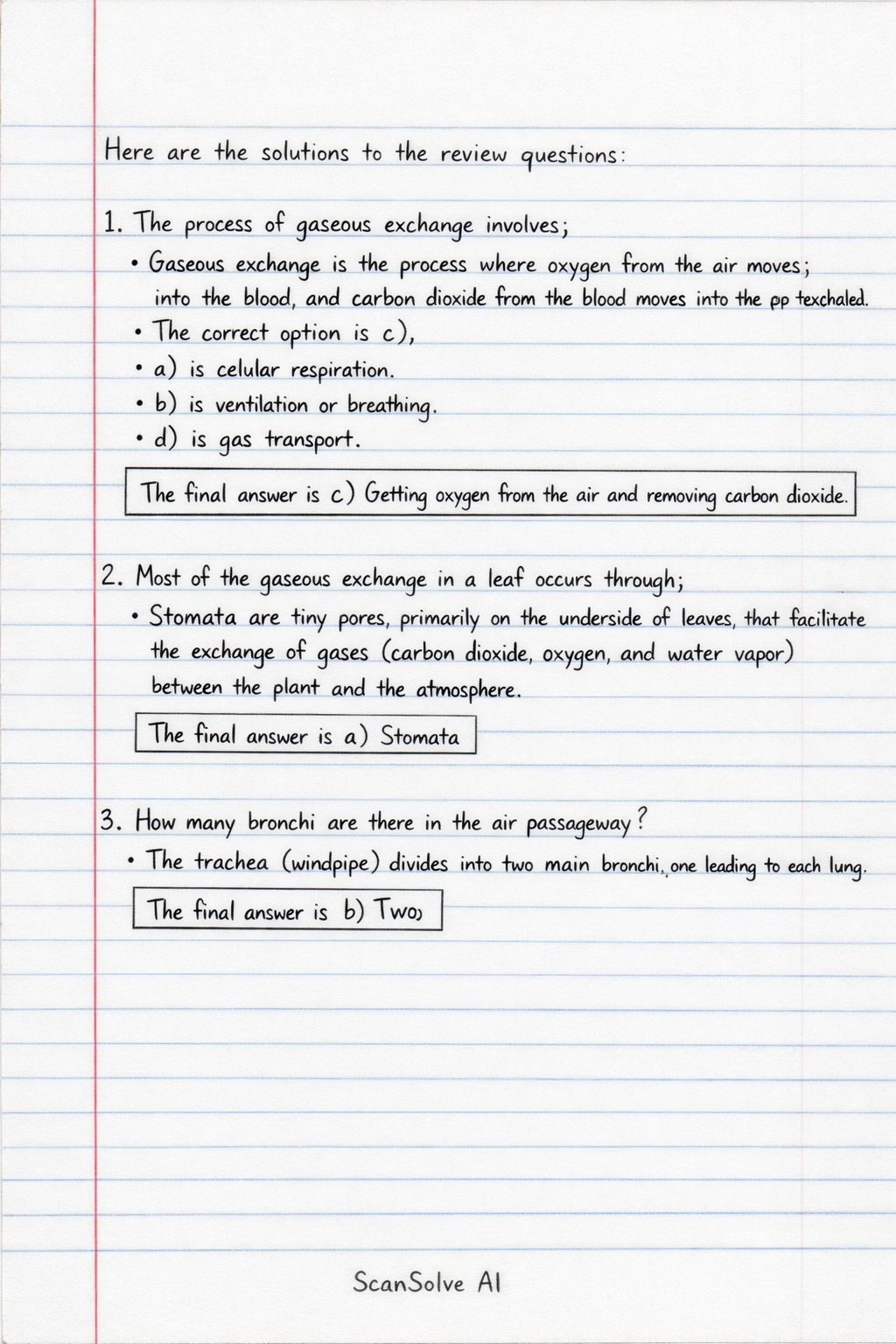
The process of gaseous exchange involves;
ScanSolve AI Answer
Answer
Here are the solutions to the review questions:
-
The process of gaseous exchange involves;
- Gaseous exchange is the process where oxygen from the air moves into the blood, and carbon dioxide from the blood moves into the air to be exhaled.
- The correct option is c).
- a) is cellular respiration.
- b) is ventilation or breathing.
- d) is gas transport.
- The final answer is
-
Most of the gaseous exchange in a leaf occurs through;
- Stomata are tiny pores, primarily on the underside of leaves, that facilitate the exchange of gases (carbon dioxide, oxygen, and water vapor) between the plant and the atmosphere.
- The final answer is
-
How many bronchi are there in the air passageway?
- The trachea (windpipe) divides into two main bronchi, one leading to each lung.
- The final answer is
-
Where does the gaseous exchange occur in humans?
- In humans, gaseous exchange takes place in the alveoli, which are tiny air sacs in the lungs. Their thin walls and rich capillary network are ideal for diffusion.
- The final answer is
-
Which structure actively helps in taking the air out of lungs?
- During normal, quiet exhalation, the diaphragm relaxes, moving upwards and reducing the volume of the thoracic cavity, which pushes air out of the lungs. While this is often considered a passive process, the relaxation of the diaphragm is a crucial muscular action that facilitates it. For forced exhalation, other muscles (internal intercostals, abdominal muscles) contract actively. Among the given options, the diaphragm is the primary muscle involved in the breathing cycle.
- The final answer is
-
The primary chemical stimulus for breathing is the concentration of;
- The concentration of carbon dioxide in the blood is the primary chemical stimulus that regulates breathing rate. An increase in blood leads to a decrease in blood pH, which is detected by chemoreceptors, signaling the brain to increase breathing rate and depth.
- The final answer is
-
Point out the FALSE statement about respiration.
- a) Gases can easily pass through the walls of the alveoli. (True, alveolar walls are very thin).
- b) Gas exchange in lungs is very efficient because lungs provide large surface area. (True, millions of alveoli provide a vast surface area).
- c) In emphysema the walls of alveoli break and there is more surface area. (False, in emphysema, the walls of the alveoli are destroyed, leading to fewer, larger air sacs, which reduces the total surface area available for gas exchange).
- d) Dust particles can damage the lung by irritating the inner alveoli surface. (True, dust and pollutants can cause inflammation and damage).
- The final answer is
-
A disease involving the breakdown of air sacs of the lungs is;
- Emphysema is a chronic lung disease characterized by the destruction of the walls of the alveoli, leading to the formation of larger, less efficient air spaces.
- The final answer is
-
Which process does NOT occur in the nasal cavity?
- The nasal cavity is responsible for trapping large dust particles (via hairs and mucus), humidifying the inhaled air, and warming the inhaled air (via blood vessels). Exchange of gases (oxygen and carbon dioxide) primarily occurs in the alveoli of the lungs, not in the nasal cavity.
- The final answer is
-
What type of blood vessels surrounds the alveoli?
- The alveoli are surrounded by a dense network of tiny, thin-walled blood vessels called capillaries. This close proximity and thinness allow for efficient gas exchange between the air in the alveoli and the blood.
- The final answer is
Try one yourself
A new problem that tests the same skill.
Still stuck on this one?
Ask a follow-up, and the answer starts from this question.
More Computer Science Questions
Handwritten Step-by-Step Solution
Get this as a handwritten image on WhatsApp — like a tutor wrote it for you.
Try on WhatsApp