
We read your photo as:
Given that (3x+2) is a factor of P(x) = 18x³ + bx² − x − 2, we set 3x+2=0 to find the root.
ScanSolve AI Answer
Answer
Step-by-step solution
4 stepsApply the Factor Theorem.
The Factor Theorem states that if is a factor of a polynomial , then .
Given that is a factor of , we set to find the root.According to the Factor Theorem, must be equal to 0.
Substitute into and set the expression to zero.
Simplify the expression.
Calculate the powers:
Substitute these values back into the equation:
Simplify the first term: .
So, .
The equation becomes:Solve for .
Combine the constant terms:
To eliminate the denominators, multiply the entire equation by the least common multiple of 3 and 9, which is 9:
Combine the constant terms:
Add 60 to both sides:
Divide by 4:
The value of is .
Try one yourself
A new problem that tests the same skill.
Still stuck on this one?
Ask a follow-up, and the answer starts from this question.
More Biology Questions
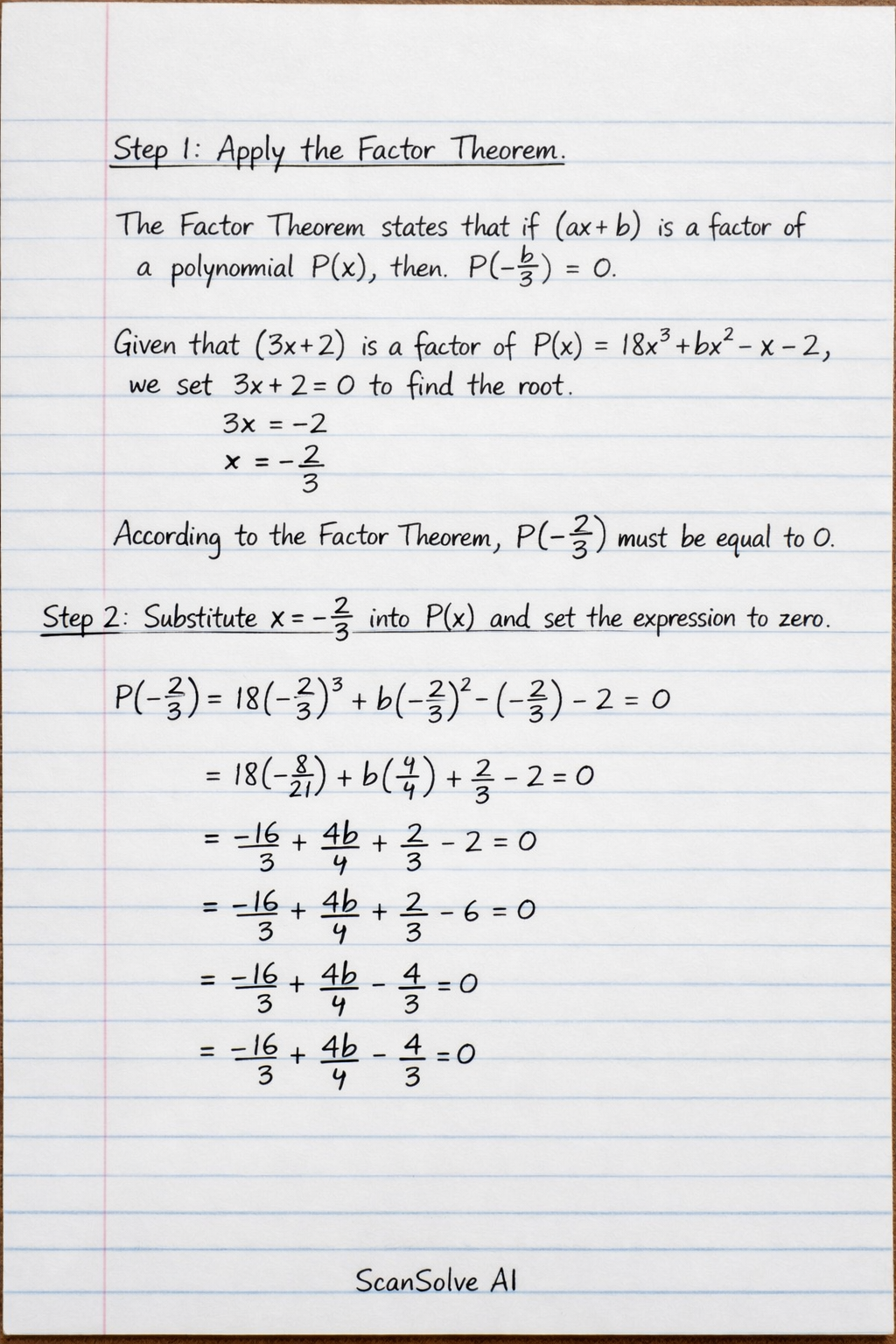
Handwritten Step-by-Step Solution
Get this as a handwritten image on WhatsApp — like a tutor wrote it for you.
Try on WhatsApp