
We read your photo as:
Please answer to my understanding. It's a gross anatomy question
ScanSolve AI Answer
here is the answer to the gross anatomy question.
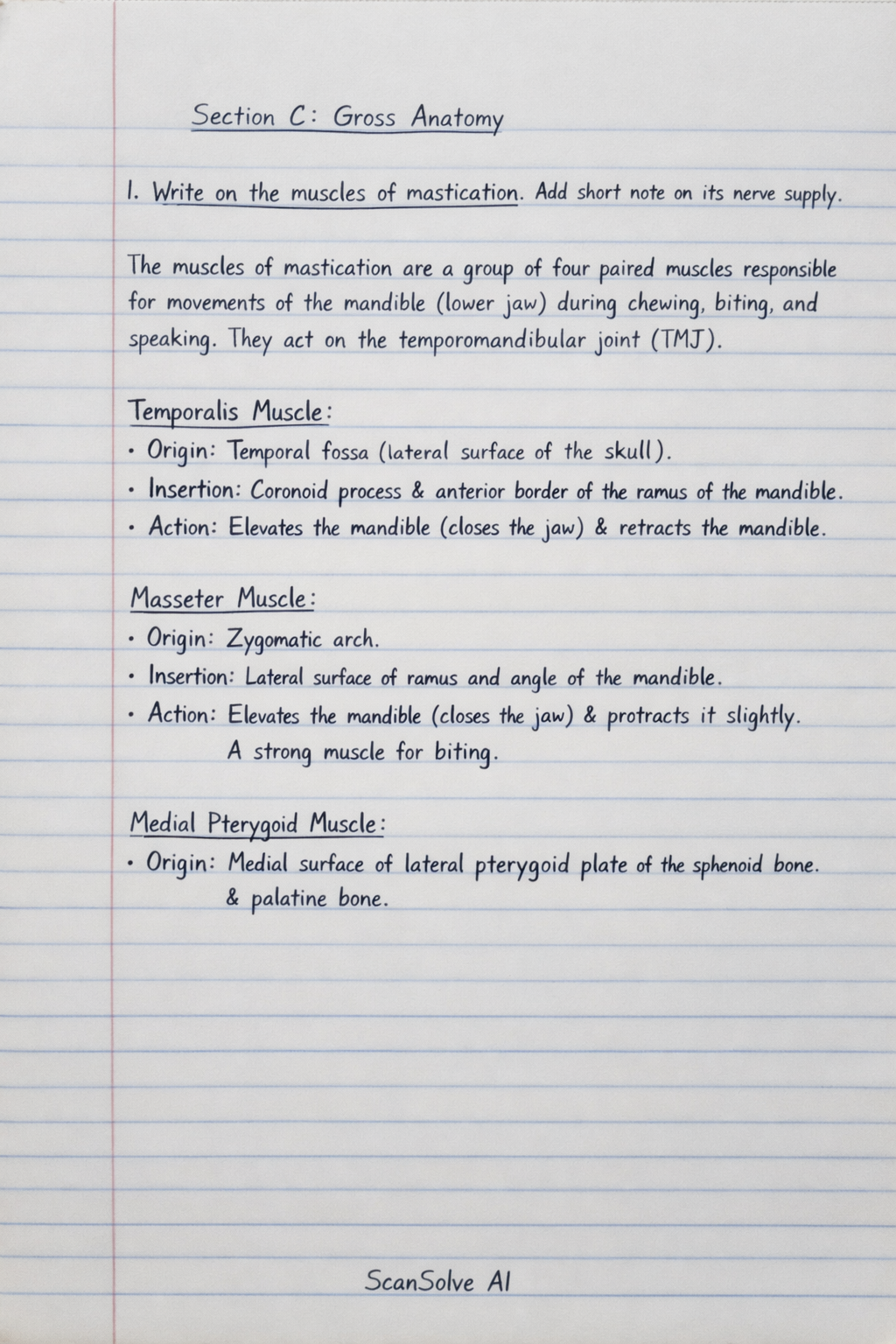
SECTION C: GROSS ANATOMY
1. Write on the muscles of mastication. Add short note on its nerve supply
The muscles of mastication are a group of four paired muscles responsible for movements of the mandible (lower jaw) during chewing, biting, and speaking. They primarily act on the temporomandibular joint (TMJ).
- Temporalis Muscle:
- Origin: Temporal fossa (lateral surface of the skull).
- Insertion: Coronoid process and anterior border of the ramus of the mandible.
- Action: Elevates the mandible (closes the jaw) and retracts the mandible (posterior fibers).
- Masseter Muscle:
- Origin: Zygomatic arch.
- Insertion: Lateral surface of the ramus and angle of the mandible.
- Action: Elevates the mandible (closes the jaw) and protracts it slightly. It is a powerful muscle for biting.
- Medial Pterygoid Muscle:
- Origin: Medial surface of the lateral pterygoid plate of the sphenoid bone and palatine bone.
- Insertion: Medial surface of the ramus and angle of the mandible.
- Action: Elevates the mandible (closes the jaw) and aids in protraction and side-to-side grinding movements.
- Lateral Pterygoid Muscle:
- Origin: Superior head from the greater wing of the sphenoid bone; inferior head from the lateral surface of the lateral pterygoid plate.
- Insertion: Neck of the condyle of the mandible and articular disc/capsule of the TMJ.
- Action: Protracts the mandible (opens the jaw by pulling the condyle forward) and depresses the mandible. Unilateral contraction causes side-to-side movement.
Nerve Supply:
All four muscles of mastication (temporalis, masseter, medial pterygoid, and lateral pterygoid) are innervated by branches of the mandibular nerve (V3), which is the third division of the trigeminal nerve (Cranial Nerve V). Specifically, they receive motor innervation from the muscular branches of the mandibular nerve.
Still stuck on this one?
Ask a follow-up, and the answer starts from this question.
More Biology Questions
Handwritten Step-by-Step Solution
Get this as a handwritten image on WhatsApp — like a tutor wrote it for you.
Try on WhatsApp