
We read your photo as:
Please provide answers for the following questions about human anatomy and physiology.
ScanSolve AI Answer
Here are the answers to the questions:
-
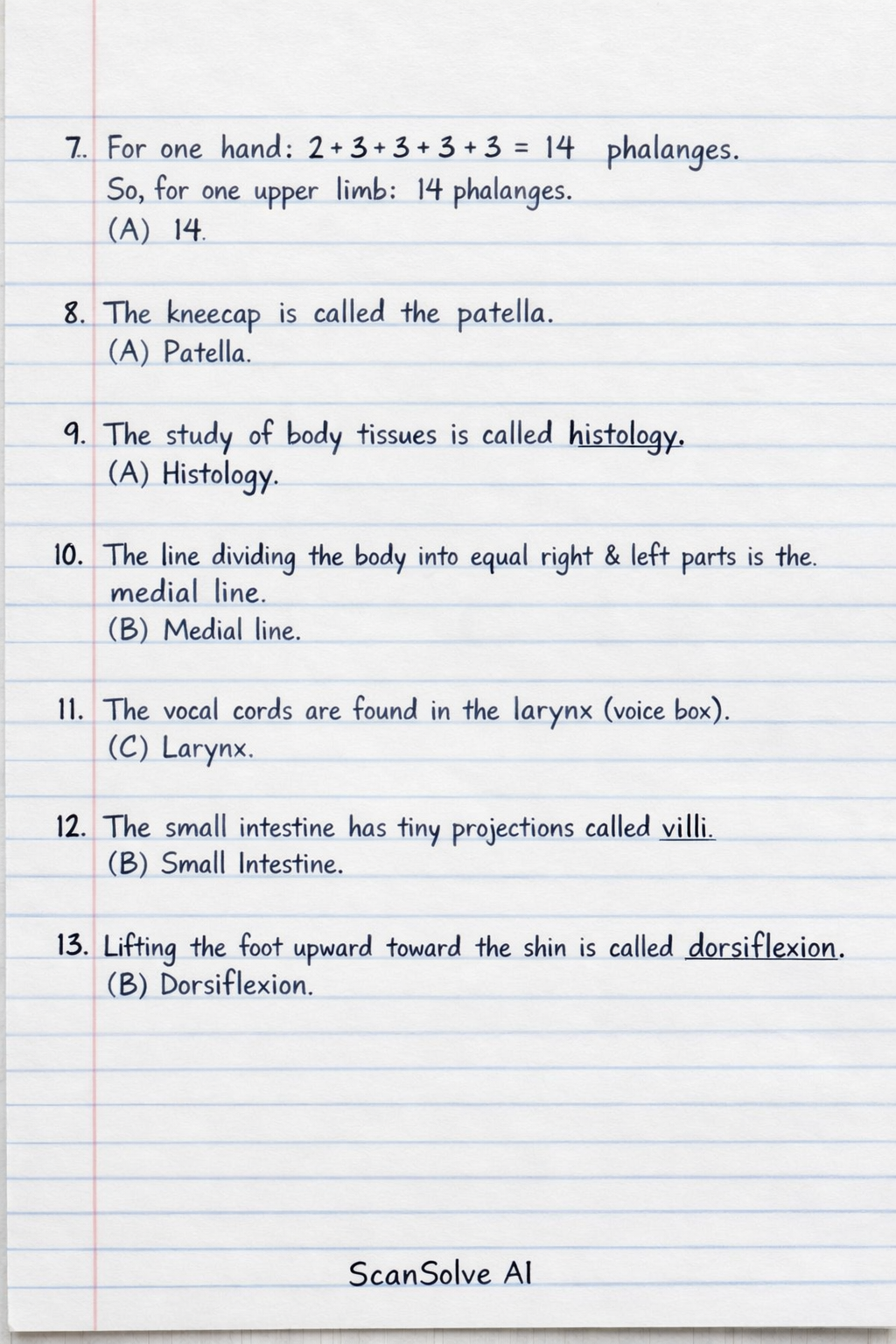
Each human hand has 14 phalanges (2 in the thumb and 3 in each of the other four fingers). Therefore, one upper limb (hand) has 14 phalanges.
- A. 14
-
The bone also known as the kneecap is the patella.
- A. Patella
-
The branch of anatomy that deals with the study of the structure of body tissues is histology.
- A. Histology
-
The line that divides the human body into two equal right and left parts is known as the medial line (or midsagittal line).
- B. Medial line
-
The vocal cords are located within the larynx, also known as the voice box.
- C. Larynx
-
The small intestine is an organ of the digestive system that has microscopic finger-like projections called villi, which increase its surface area for nutrient absorption.
- B. Small Intestine
-
When the distance between the top of the foot and the anterior surface of the leg is decreased (i.e., the foot is lifted upwards towards the shin), this movement is known as dorsiflexion.
- B. Dorsiflexion
Still stuck on this one?
Ask a follow-up, and the answer starts from this question.
More Biology Questions
Handwritten Step-by-Step Solution
Get this as a handwritten image on WhatsApp — like a tutor wrote it for you.
Try on WhatsApp