
We read your photo as:
What are the answers to the following multiple-choice anatomy and radiography questions?
ScanSolve AI Answer
Answer
Step-by-step solution
6 stepsAnswer Question 13.
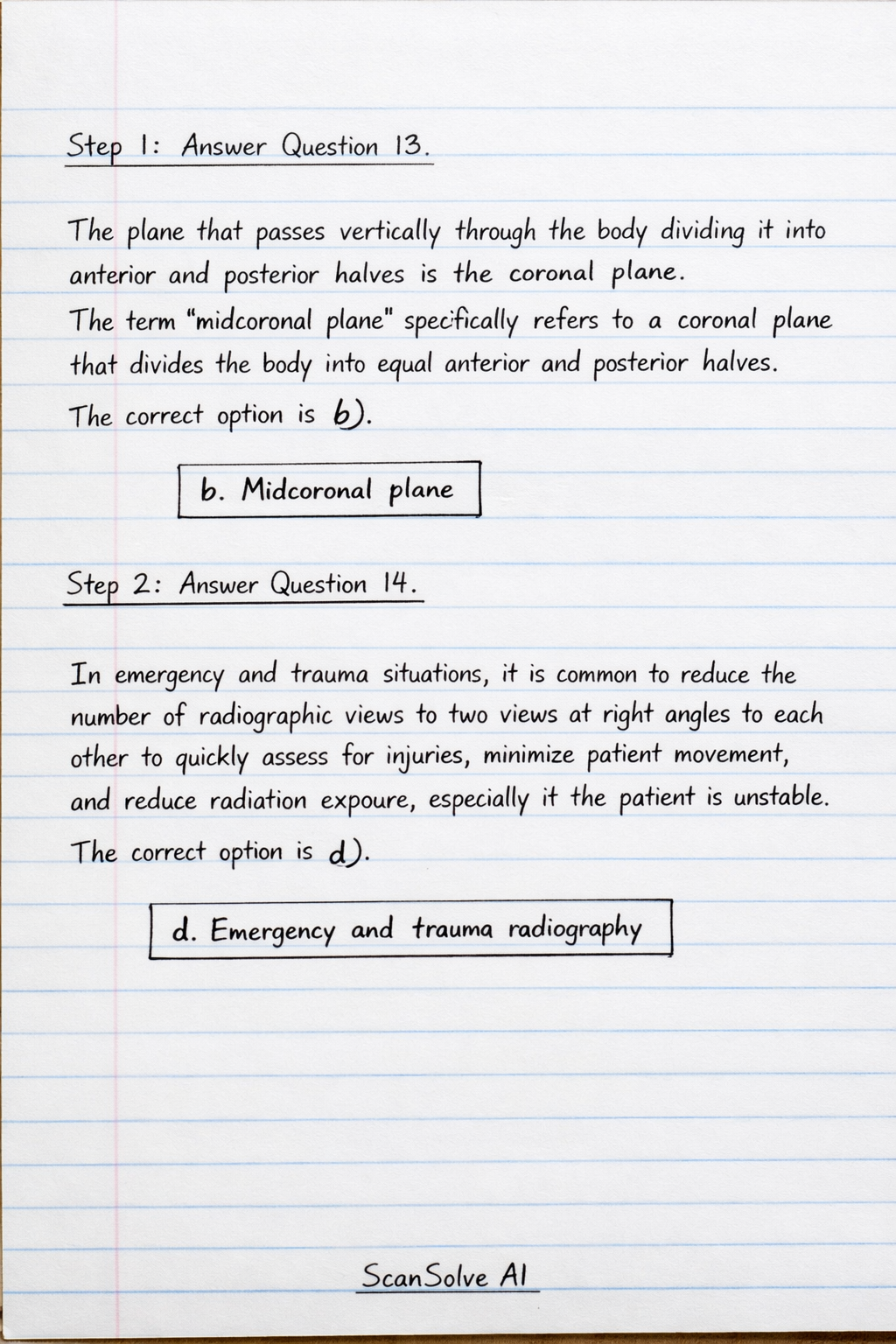
The plane that passes vertically through the body dividing it into anterior and posterior halves is the coronal plane. The term "midcoronal plane" specifically refers to a coronal plane that divides the body into equal anterior and posterior halves.
The correct option is b).Answer Question 14.
In emergency and trauma situations, it is common to reduce the number of radiographic views to two views at right angles to each other to quickly assess for injuries, minimize patient movement, and reduce radiation exposure, especially if the patient is unstable.
The correct option is d).Answer Question 15.
AP stress studies of the ankle are performed to evaluate the stability of the ankle joint and assess for ligamentous injuries.
- I. Stress views are not primarily used to demonstrate fractures of the distal tibia and fibula; standard views are used for this.
- II. They are commonly performed following inversion or eversion injuries to assess for ligamentous damage.
- III. Their main purpose is to demonstrate ligament tears by showing excessive joint space widening under stress. Therefore, II and III are correct. The correct option is c).
Answer Question 16.
To better demonstrate the tarsometatarsal joints in the dorsoplantar (AP) projection of the foot, the central ray is angled to open up the joint spaces. An angle of 10° posteriorly (or cephalad) helps to project the metatarsal bases away from the tarsals.
The correct option is c).Answer Question 17.
To open the L5-S1 interspace in an AP projection, the central ray must be angled cephalad (towards the head) to align with the angle of the interspace. A typical angle is 30-35° cephalad.
The correct option is a).Answer Question 18.
In a pelvic radiograph, the symphysis pubis is an anterior landmark. The most prominent part of the greater trochanter is generally considered to be in a similar transverse plane or slightly inferior to the superior margin of the symphysis pubis, making it the closest option. The ischial tuberosity is inferior, and the anterior superior/inferior iliac spines are superior.
The correct option is b).
Try one yourself
A new problem that tests the same skill.
Still stuck on this one?
Ask a follow-up, and the answer starts from this question.
More Biology Questions
Handwritten Step-by-Step Solution
Get this as a handwritten image on WhatsApp — like a tutor wrote it for you.
Try on WhatsApp