

This biology question covers important biological concepts and processes. The step-by-step explanation below helps you understand the underlying mechanisms and reasoning.
ScanSolve AI Answer
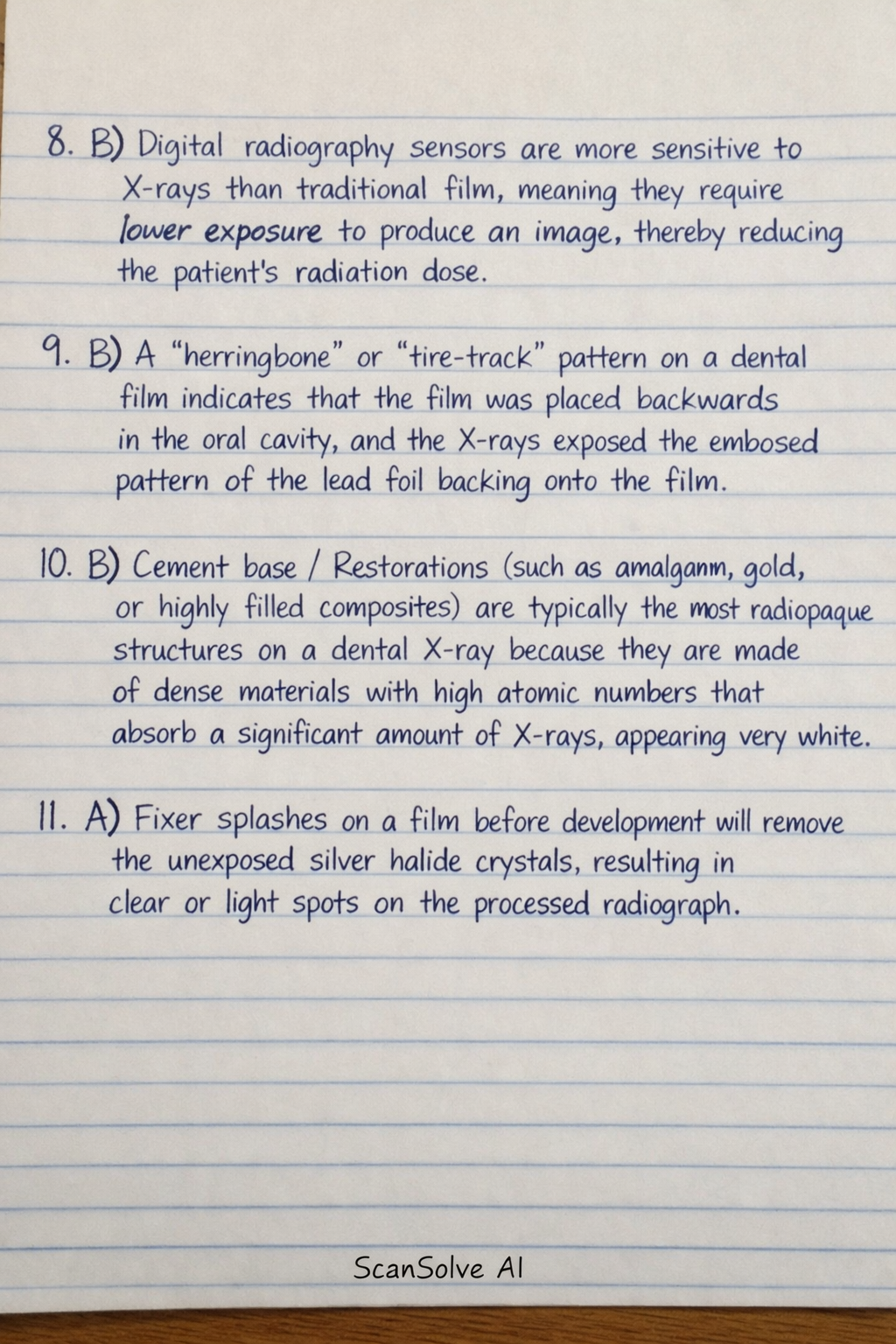
Here are the answers to the questions: 8. B) Digital radiography sensors are more sensitive to X-rays than traditional film, meaning they require lower exposure to produce an image, thereby reducing the patient's radiation dose. 9. B) A "herringbone" or "tire-track" pattern on a dental film indicates that the film was placed backwards in the oral cavity, and the X-rays exposed the embossed pattern of the lead foil backing onto the film. 10. B) Cement base/Restorations (such as amalgam, gold, or highly filled composites) are typically the most radiopaque structures on a dental X-ray because they are made of dense materials with high atomic numbers that absorb a significant amount of X-rays, appearing very white. 11. A) Fixer splashes on a film before development will remove the unexposed silver halide crystals, resulting in clear or light spots on the processed radiograph. 12. C) CBCT (Cone Beam Computed Tomography) is the imaging modality commonly used in dentistry for a 3D view, which is crucial for detailed assessment of implant sites, bone volume, and anatomical structures. 13. A) The Submentovertex (SMV) view, also known as the basal view, is particularly useful for visualizing fractures of the zygomatic arch as it projects the arches laterally, allowing for clear assessment.