
We read your photo as:
Here are the answers to the questions: Multiple Choice Questions: The organelle which is absent in animals cell: a. Plastids The special proteins which carry lipid-insoluble large molecules through po
ScanSolve AI Answer
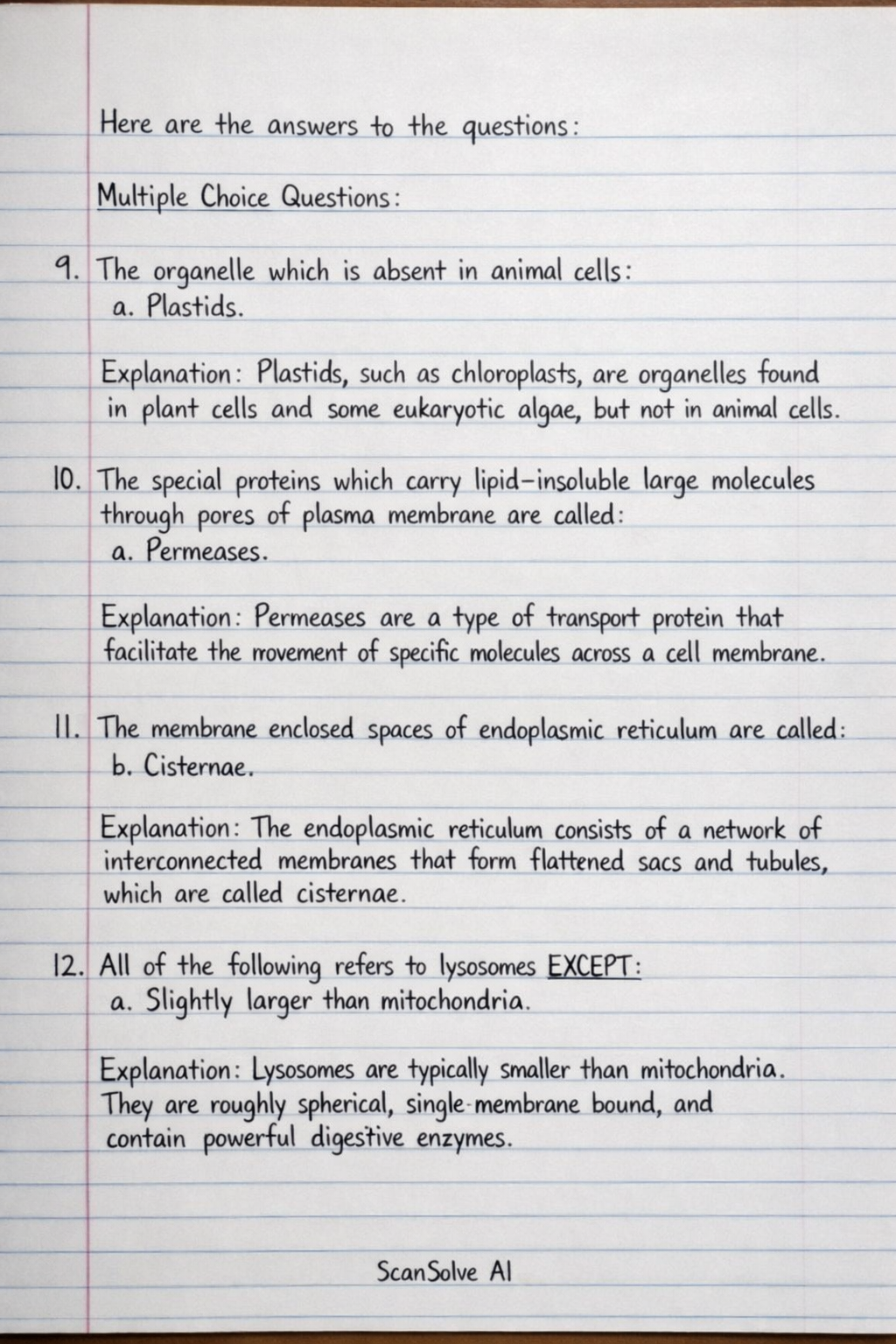
Here are the answers to the questions:
Multiple Choice Questions:
-
The organelle which is absent in animals cell:
- a. Plastids
- Explanation: Plastids, such as chloroplasts, are organelles found in plant cells and some eukaryotic algae, but not in animal cells.
-
The special proteins which carry lipid-insoluble large molecules through pores of plasma membrane are called:
- a. Permeases
- Explanation: Permeases are a type of transport protein that facilitate the movement of specific molecules across a cell membrane.
-
The membrane enclosed spaces of endoplasmic reticulum are called:
- b. Cisternae
- Explanation: The endoplasmic reticulum consists of a network of interconnected membranes that form flattened sacs and tubules, which are called cisternae.
-
All of the following refers to lysosomes EXCEPT:
- a. Slightly larger than mitochondria
- Explanation: Lysosomes are typically smaller than mitochondria. They are roughly spherical, single-membrane bound, and contain powerful digestive enzymes.
-
Lysosomes are also called as:
- c. Phagosomes
- Explanation: While lysosomes are not directly called phagosomes, phagosomes are vesicles formed during phagocytosis that fuse with lysosomes to form phagolysosomes, where digestion of ingested material occurs. Among the given options, phagosomes are the most directly related structures in the process of cellular digestion involving lysosomes.
-
In the leaves of green plants, peroxisomes are the sites of:
- c. Photorespiration
- Explanation: Peroxisomes play a crucial role in photorespiration in plant cells, a process that occurs in conjunction with chloroplasts and mitochondria.
Short Answer Questions:
-
List four main functions of a nucleus.
- The nucleus stores the cell's genetic material (DNA) in the form of chromosomes.
- It controls the cell's activities by regulating gene expression.
- It is the site of DNA replication and transcription (RNA synthesis).
- The nucleolus within the nucleus is responsible for ribosome synthesis.
-
What do you know about peroxisomes?
- Peroxisomes are small, single-membrane-bound organelles found in eukaryotic cells. They contain enzymes like catalase and oxidase, which are involved in metabolic processes such as the breakdown of fatty acids and amino acids, and the detoxification of harmful substances by producing and then breaking down hydrogen peroxide. In plants, specialized peroxisomes called glyoxysomes convert stored fats into carbohydrates.
-
Write two differences between rough endoplasmic reticulum and smooth endoplasmic reticulum.
- Ribosomes: Rough ER has ribosomes attached to its surface, giving it a "rough" appearance, whereas smooth ER lacks ribosomes.
- Function: Rough ER is primarily involved in the synthesis, folding, modification, and transport of proteins destined for secretion or insertion into membranes. Smooth ER is involved in lipid synthesis, detoxification of drugs and poisons, and storage of calcium ions.
-
What is cytoskeleton? Why it is consider to be important organelle in the cell.
- The cytoskeleton is a dynamic network of protein filaments and tubules (microtubules, microfilaments, and intermediate filaments) found in the cytoplasm of eukaryotic cells. It is considered important because it provides structural support to the cell, maintains its shape, facilitates cell movement, plays a vital role in intracellular transport of organelles and vesicles, and is essential for cell division.
-
Calling a cell a 'factory' is an appropriate analogy. Justify this statement.
- The analogy of a cell as a factory is appropriate
Still stuck on this one?
Ask a follow-up, and the answer starts from this question.
More Biology Questions
Handwritten Step-by-Step Solution
Get this as a handwritten image on WhatsApp — like a tutor wrote it for you.
Try on WhatsApp